© Thomas Hübner and mytwostotinki.com, 2014-5. Unauthorized use and/or duplication of this material without expressed and written permission from this blog’s author and/or owner is strictly prohibited. Excerpts and links may be used, provided that full and clear credit is given to Thomas Hübner and mytwostotinki.com with appropriate and specific direction to the original content.
Broken Glass
A lot of broken glass at work today. The whole car park, entrance doors and windows of the Ministry of Trade and Industry vandalized by “protesters”.
A sad day, but what to expect when even in Parliament elected representatives show their “respect” for democracy and the rule of law by throwing tear gas grenades…
© Thomas Hübner and mytwostotinki.com, 2014-5. Unauthorized use and/or duplication of this material without expressed and written permission from this blog’s author and/or owner is strictly prohibited. Excerpts and links may be used, provided that full and clear credit is given to Thomas Hübner and mytwostotinki.com with appropriate and specific direction to the original content.
Magister Tinius – Priest, Book Collector, Killer
This blog post is part of the German Literature Month, hosted by Lizzie (Lizzies Literary Life) and Caroline (Beauty is a Sleeping Cat)
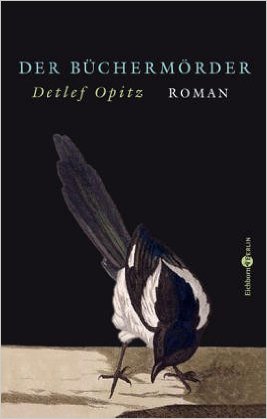
The Books Murderer (Der Büchermörder) by Detlef Opitz is a novel that is remarkable for various reasons. It is an extremely well-researched historical novel; it is a novel that tries to resolve the mystery of a series of crimes – including murder – that are all linked to the insane passion of a priest for books; and it is a novel that uses in a most virtuous way probably all existing writing styles in German language from the 18th to the 21th century.
As an additional interesting element there is a “we”-narrator that takes certain liberties in filling in the gaps that the documents that he uses leave in order to tell us the story of his “hero” – and who this “we” is, a single person or indeed a small group of persons the reader will never know for sure. And even if the “hero” really committed those terrible crimes is not absolutely sure…
I am a quite compulsive book buyer and collector myself, and maybe that’s why I am particularly drawn to novels or stories about obsessive book lovers. That was what made The Name of the Rose so appealing to me, that was why I immediately grabbed The House of Paper by Carlos Maria Dominguez when I saw it in a book store some time ago. Peter Kien and Don Quijote belong of course also in this category of book addicts. I even collect news stories from the media about obsessive book lovers, such as the story of the civil servant from Darmstadt (a city where I worked for a few years) who stole about 25,000 books from libraries – not for pecuniary reasons but because of his wish to own a big library himself.
No wonder I stumbled sooner or later over a quote by Arno Schmidt from his The Stony Heart (Das steinerne Herz):
“Ich dachte lange an den Magister Tinius, den Bücherverfallenen, der mit seinem Hammer durch die öden Heiden des Fläming schlich: wenn andere das Geld haben, und er braucht doch die Bücher?!”
“I thought for a long time about Magister Tinius, the book addict, who creeps with his hammer through the barren heaths of the Fläming: if others have the money, but he needs the books?!”
Arno Schmidt, a great expert when it comes to obscure German writers of the 18th and 19th century must have been referring to a real, not an invented person, so I thought. And indeed, the “Neue Pitaval” (“New Pitaval”), a very popular collection of real crime stories that was used as source material by many German authors contains a chilling story about a man who had turned from a small protestant Parish priest to a biblio-maniac, and finally to a criminal and murderer as a result of his insane book love.
Johann Georg Tinius (1764-1846) was a priest in a small town in Saxony who had aspirations to be a writer and scholar and who loved books. So far, so good. But somehow things got out of hand and over the years he bought more and more books and had even to rent a barn for his library. People were getting suspicious: how was it possible that a priest with an income that was a mere pittance could acquire such a vast and expensive book collection? The good priest may have been the beneficiary of a small inheritance and his wife who died comparatively early (some suspected foul play) came from a family with a small wealth; too bad that at that time financial irregularities regarding the budget of the parish church were also becoming obvious and an investigation started. But somehow the priest was able to pledge for “not guilty” and because the final evidence that he was the reason for the sudden disappearance of a certain sum of money from the coffers of the church was missing, he got away – this time.
After his wife had passed away, Tinius hurried to remarry a wealthy wife. And, you guessed correctly, he started immediately to put his wife’s money (much to her dismay) to a good use, i.e. by buying much more books. After his book collection had reached a number of 50,000 to 60,000, he ran again out of money. And almost at the same time, robberies, and even a murder and an attempted murder happened in which everything hinted at the man in black with the book hobby.
Tinius got arrested and the court proceedings lasted almost ten years. His defence strategy was very simple: “I am innocent”. Nevertheless, the evidence was overwhelming and he got a long prison sentence. He lost everything: his wife divorced him, and – much worse for him – his book collection was auctioned off. Even Goethe bought books from the auction!
Tinius used the time in jail to try to prove his innocence; he wrote a short autobiography which is for sure one of the strangest texts of the 19th century, so utterly inadequate is what Tinius has to say about his book addiction and the crimes he had obviously committed.
After twelve years in prison, Tinius was released because of his old age and poor health. He lived another eleven years in obscurity, some distant relatives had taken care of the man in his last years.
As I said already, Opitz’ novel is not only well researched, it is also extremely well written – but the virtuosity of the language may be a reason why it is untranslated so far. Still, I hope this masterpiece will be available one day also to readers who don’t read German.
The author, and that’s a nice irony, had collected a huge library himself in his younger years – but he lost it all in a game of poker. (And if it’s not true, it’s at least well invented.)
Detlef Opitz: Der Büchermörder, Eichborn Verlag 2005
Johann Georg Tinius: Merkwürdiges und lehrreiches Leben des M. Johann Georg Tinius, Pfarrers zu Poserna in der Inspektion Weißenfels. Von ihm selbst entworfen. Mit einem Essay von Herbert Heckmann, Friedenauer Presse, Berlin 1986 (written 1813)
Julius Eduard Hitzig / Georg Wilhelm Heinrich Häring (eds.): Der Neue Pitaval, Brockhaus, Leipzig 1843
Arno Schmidt: Two Novels: The Stony Heart and B/Moondocks, translated by John E. Woods, Dalkey Archive 1999
Translation of the Arno Schmidt quote by Thomas Hübner
© Thomas Hübner and mytwostotinki.com, 2014-5. Unauthorized use and/or duplication of this material without expressed and written permission from this blog’s author and/or owner is strictly prohibited. Excerpts and links may be used, provided that full and clear credit is given to Thomas Hübner and mytwostotinki.com with appropriate and specific direction to the original content.
Under the Linden Tree
This blog post is part of the German Literature Month, hosted by Lizzie (Lizzies Literary Life) and Caroline (Beauty is a Sleeping Cat)
Very little is known about the life of Walther von der Vogelweide, the most remarkable German poet before Goethe; neither the birthplace of this troubadour (Minnesinger) – probably in Austria, but maybe also in Northern Italy – nor his exact years of birth (ca. 1170) and death (ca. 1230) are known. He was obviously the loyal servant of a bishop and was rewarded with an amount of money sufficient for an expensive fur coat once – the only official mentioning of his name in the records and proof of his comparatively elevated social status.
Walther’s poetry is written in Middle High German (Mittelhochdeutsch) which is surprisingly intelligible to modern-day native speakers – especially when you are from Southern Germany or Austria. It covers a number of topics and genres but his love poetry features most prominently. While a big part of it worships an aristocratic, married and therefore inaccessible frouwe from a distance, Walther’s poetry also covers other, to us modern readers more familiar grounds that make his charming poems still very fresh and appealing until this day. I am therefore recommending his works to anyone with a genuine interest in German literature.
In the following Taglied the poet lends his voice to a girl after her spending a night with her lover (most probably a man of higher social status).
Under der linden
Under der linden
an der heide,
dâ unser zweier bette was,
dâ muget ir vinden
schône beide
gebrochen bluomen unde gras.
Vor dem walde in einem tal,
tandaradei,
schône sanc diu nahtegal.
Ich kam gegangen
zuo der ouwe:
dô was mîn friedel komen ê.
Dâ wart ich empfangen
(hêre frouwe!)
daz ich bin sælic iemer mê.
Kust er mich?
Wol tûsentstunt:
tandaradei,
seht wie rôt mir ist der munt.
Dô hete er gemachet
alsô rîche
von bluomen eine bettestat.
Des wirt noch gelachet
inneclîche,
kumt iemen an daz selbe pfat:
bî den rôsen er wol mac,
tandaradei,
merken wâ mir’z houbet lac.
Daz er bî mir læge,
wesse’z iemen
(nu enwelle got!), so schamte ich mich.
Wes er mit mir pflæge,
niemer niemen
bevinde daz, wan er und ich,
und ein kleinez vogellîn:
tandaradei,
daz mac wol getriuwe sîn.
Under the linden tree
on the heather,
where we shared a bed
there you may find
lovely together
broken flowers and grass.
Near a forest in a vale,
tandaradei,
beautifully sang the nightingale.
I came to meet him
at the green:
there was my beloved come before.
Such was I received
(Queen of Heaven!)
that I am blessed for evermore.
Did he kiss me?
Perhaps a thousand times and some:
tandaradei,
see how red my mouth has become.
There he had been making
for luxury
a bed from every kind of flower.
It sets to laughing
delightedly
whoever comes upon that bower;
by the roses well one may,
tandaradei,
mark the spot my head once lay.
If someone knew
he lay with me
(may God forbid!), for shame I’d die.
What did he do?
may none but he
ever be sure of that — and I,
and one tiny bird,
tandaradei,
that may well not say a word.
(Translation by Thomas Hübner, after Graeme Dunphy)
For those who read German, I can recommend the edition of Walther’s poetry in the legendary Reclam Universal Edition (bi-lingual, High German/Middle High German), Stuttgart 2013 (“Gedichte – Auswahl”); there is an English edition “Selected Poems of Walther von der Vogelweide: The Minnesinger”, translated by Walter Alison Phillips in 1896 and republished by Cornell University Library in 2009; another more modern translation of the poem in English can be found in Raymond Oliver’s “To Be Plain: Translations from Greek, Latin, French, and German”, Robert L. Barth, 1981
© Thomas Hübner and mytwostotinki.com, 2014-5. Unauthorized use and/or duplication of this material without expressed and written permission from this blog’s author and/or owner is strictly prohibited. Excerpts and links may be used, provided that full and clear credit is given to Thomas Hübner and mytwostotinki.com with appropriate and specific direction to the original content.
A Public Intellectual
This blog post is part of the German Literature Month, hosted by Lizzie (Lizzies Literary Life) and Caroline (Beauty is a Sleeping Cat)
He is probably the most important living German poet, an essayist whose publications are usually a reason for major public discussions, an author of novels, stories, plays, children’s books, a book about mathematics, several poetological books and a scholarly work on Clemens Brentano, the co-author of a poetry automaton, the editor of the famous book series Andere Bibliothek, the founder of the Kursbuch, for a long time Germany’s most important journal for political debates, and of Transit, another important journal, a film regisseur, a librettist, a congenial translator from French (Moliere, Denis Diderot, Antoine de Saint-Exupery, Jean de la Varende), Italian (Franco Fortini), Spanish (Cesar Vallejo, Federico Garcia Lorca), English (William Carlos Williams, Charles Simic, Stanley Moss), Hungarian (Gyorgy Dalos), and Swedish (Lars Gustafsson), amongst others, and and and…It is impossible to write about him in a few lines.
Hans Magnus Enzensberger (born 1929) is the public intellectual par excellence, a very urban and unique figure in German literature.
Fortunately quite a number of his books are available in translations, and a new poetry collection (New Selected Poems) has just been published – so maybe this is a good opportunity to discover at least the poet Enzensberger for now. Here are three exemplary poems in German and English translation:
ins lesebuch für die oberstufe
lies keine oden, mein sohn, lies die fahrpläne:
sie sind genauer. roll die seekarten auf,
eh es zu spät ist. sei wachsam, sing nicht.
der tag kommt, wo sie wieder listen ans tor
schlagen und malen den neinsagern auf die brust
zinken. lern unerkannt gehn, lern mehr als ich:
das viertel wechseln, den paß, das gesicht.
versteh dich auf den kleinen verrat,
die tägliche schmutzige rettung. nützlich
sind die enzykliken zum feueranzünden,
die manifeste: butter einzuwickeln und salz
für die wehrlosen. wut und geduld sind nötig,
in die lungen der macht zu blasen
den feinen tödlichen staub, gemahlen
von denen, die viel gelernt haben,
die genau sind, von dir.
In a College Textbook
don’t read odes, my son, read timetables:
they are more exact, unroll the sea-charts
before it is too late, be on guard, don’t sing.
the day will come again when they paste blacklists upon the door
and place their mark on the no-sayers,
learn to pass unidentified, learn more than I:
how to change your living quarters, passport, face.
understand the small betrayal,
the sordid daily escape, useful
are the wide-spread fire starters,
the manifestoes: wrapped-up butter and salt
for the defenseless. anger and endurance are necessary
to blow a fine deadly dust
into the lungs of power, ground up
by those such as you who have learned much
and are fastidious in their ways.
Translated by Jim Doss, Loch Raven Review, Summer 2008
—
Privilegierte Tatbestände
Es ist verboten, Personen in Brand zu stecken.
Es ist verboten, Personen in Brand zu stecken,
die im Besitz einer gültigen Aufenthaltsgenehmigung sind.
Es ist verboten, Personen in Brand zu stecken,
die sich an die gesetzlichen Bestimmungen halten und im Besitz einer gültigen Aufenthaltsgenehmigung sind.
Es ist verboten, Personen in Brand zu stecken,
von denen nicht zu erwarten ist, daß sie den Bestand und die Sicherheit der Bundesrepublik Deutschland gefährden.
Es ist verboten, Personen in Brand zu stecken,
soweit sie nicht durch ihr Verhalten dazu Anlaß geben.
Es ist insbesondere auch Jugendlichen,
die angesichts mangelnder Freizeitangebote und in Unkenntnis der einschlägigen Bestimmungen sowie aufgrund von Orientierungsschwierigkeiten psychisch gefährdet sind, nicht gestattet, Personen – ohne das Ansehen der Person – in Brand zu stecken.
Es ist mit Rücksicht auf das Ansehen der Bundesrepublik Deutschland im Ausland davon abzuraten.
Es gehört sich nicht.
Es ist nicht üblich.
Es sollte nicht zur Regel werden.
Es muß nicht sein.
Niemand ist dazu verpflichtet.
Es darf niemandem zum Vorwurf gemacht werden,
wenn er es unterläßt, Personen in Brand zu stecken.
Jedermann genießt ein Grundrecht auf Verweigerung.
Entsprechende Anträge sind an das zuständige Ordnungsamt zu richten.
Nota bene. Wer diesen Text in eine andere Sprache überträgt, wird gebeten, an Stelle der Bundesrepublik Deutschland versuchsweise die offizielle Bezeichnung seines eigenen Landes einzusetzen. Diese Fußnote sollte auch in der Übersetzung stehen bleiben.
Privileged Facts of the Case
It is forbidden to set people on fire.
It is forbidden to set people on fire in possession
of a valid green card.
It is forbidden to set people on fire who uphold
the laws and are in possession of a valid green card.
It is forbidden to set people on fire who
are not thought to endanger the continuance
and security of the United States of America.
It is forbidden to set people on fire who do not
arouse suspicion with their behavior.
This particularly applies to youngsters who, in view
of the lack of leisure opportunities and their ignorance
of the relevant regulations or because
of difficulties in orientation are psychologically endangered,
are forbidden to set people on fire they do not respect.
In consideration of the reputation of the United States of America
abroad it is urgently advised against.
It isn’t proper.
It isn’t normal.
It shouldn’t become the rule.
It doesn’t have to be this way.
No one is obligated.
No one will be reproached if they decline
to set a person on fire.
Each enjoys a fundamental right to refuse.
Suitable applications are to be submitted
to the Municipal Office of Public Order.
Translated by Jim Doss, Loch Raven Review, Summer 2008
—
John von Neumann
1903 – 1957
Doppelkinn, Mondgesicht, leichtes Watscheln –
das muß ein Komiker sein
oder ein Generalvertreter in Teppichböden,
ein Bonvivant aus dem Rotary Club.
Aber wehe, wenn Jánsci aus Budapest
anfängt zu denken!
Unerbittlich tickt unter der Schädeldecke
sein weicher Prozessor,
ein Flimmern geht durch den Datenspeicher
und blitzartig wirft er ballistische Gleichungen aus.
Eichmann und Stalin hat er mattgesetzt
in drei Zügen: Göttingen-Cherbourg,
Cherbourg-New York, New York-Princeton.
Erster Klasse verließ er die Todeszone.
Mehr brauchte er nicht als vier Stunden Schlaf,
reichlich Schlagobers auf den Mohnstrudel
und ein paar Bankkonten in der Schweiz.
Auch wer nie von ihm gehört hat
(und das sind die meisten),
der setzt mit der Maus in der Hand
seine Schaltalgebra in Gang.
Und was die Künstliche Intelligenz betrifft –
ohne die seinige wäre sie vielleicht heute noch
ein Wechselbalg ohne Adresse.
Ganz egal, ob es um eine Knobelpartie
oder um einen Hurrikan geht,
um fruchtbare Automaten oder um Schußtabellen,
die Kreide in seiner Hand hinkt hinterher –
so schnell ist sein neuronales Netz.
Manisch kritzelt er Hilbert-Räume,
Ringe und Ideale hin. Unbeschränkt
operiert er mit unbeschränkten Operatoren.
Hauptsache: elegante Lösungen,
um den Planeten zum Tanzen zu bringen.
Ein altes Wunderkind mit Schnittstelle zum Geheimdienst.
Wummernd landen die Helikopter auf seinem Rasen.
»Fat Man« auf Nagasaki: reine Mathematik.
Der Krieg als Droge. Eine zu große Waffe
kann es nicht geben. Immer gut gelaunt
beim Lunch mit den Admirälen.
Eigentlich ist er schüchtern, und es gibt Rätsel,
vor denen seine Black Box versagt.
Die Liebe zum Beispiel,
die Dummheit, die Langeweile.
Pessimismus = Sünde gegen die Wissenschaft.
Energie aus der Dose, Klimakontrolle, ewiges Wachstum!
Island in ein tropisches Paradies zu verwandeln –
kein Problem. Der Rest ist nebbich.
Dann der Betriebsausflug auf eine andere Insel,
im Zweireiher, mit geschwärzter Brille: Bikini.
»Operation Wendepunkt.« Der Test war gelungen.
Zehn Jahre brauchte der Strahlenkrebs,
um seine Synapsen abzuschalten.
John von Neumann (1903–1957)
Moon face, double chin, waddling gait:
a stand-up comedian, most likely,
or a salesman for fitted carpets,
a bon vivant from the Rotary Club.
But as soon as he starts to think
watch out for Jáncsi from Budapest!
The soft processor under his skull-cap
will relentlessly tick away,
and with a mere flicker of his memory chip
he will produce a rush of ballistic equations.
In three moves he checkmated Eichmann and Stalin:
Göttingen-Cherbourg, Cherbourg-New York,
New York-Princeton. First Class
he escaped from the Final Solution.
All he needs is four hours’ sleep,
plenty of whipped cream on his Viennese strudel
and a couple of Zürich bank accounts.
Even those who have never heard of him
(and most of us haven’t)
switch with a click of the mouse
into his algebraic circuitry.
Without his own brand of it,
Artificial Intelligence
might never have got off the ground.
Whether it’s a question of playing dice
or detailing a hurricane — you name it..
self-fertilising automata or firing-tables
the piece of chalk in his hand
will lag behind the speed of his mind.
A maniac scribbling down Hilbert spaces,
rings and ideals, operating beyond all limits
with unlimited operators. A few new ideas,
he says, and we could jiggle the planet.
An elderly wunderkind with an interface
to the CIA. Helicopters roaring down on his lawn.
‘Fat Man’ on Nagasaki: pure mathematics.
War is his cocaine. There is no such thing
as too big a weapon. Always in high spirits,
lunching with admirals.
A shy fellow at heart. Mysteries
his black box cannot cope with.
Love, for example,
stupidity, boredom.
Pessimism = a sin against science.
Energy out of the can, climate control,
eternal growth! To turn Iceland
into a tropical paradise — no problem!
The rest is nebbich.
Finally: staff outing to another island,
in business suit and blackened glasses,
Bikini. ‘Operation Turning-point’.
The test was successful. The cancer from the radiation
took ten years to turn off his synapses.
Translated by Hans Magnus Enzensberger

Several collections (most of them bi-lingual) of Enzensberger’s poems are available in English:
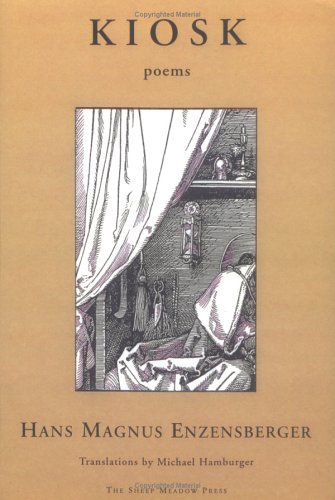
Hans Magnus Enzensberger: Selected Poems, bi-lingual edition, translated by Hans Magnus Enzensberger, Michael Hamburger, Fred Viebahn and Rita Dove, Sheep Meadow Press, Rhineback 1999; Kiosk, bi-lingual edition, translated by Hans Magnus Enzensberger and Michael Hamburger, Sheep Meadow Press, Rhineback 1999; Lighter Than Air, bi-lingual edition, translated by Reinhold Grimm, Sheep Meadow Press, Rhineback 2000; New Selected Poems, bi-lingual edition, translated by Hans Magnus Enzensberger, Michael Hamburger and David Constantine, Bloodaxe Books, Hexham 2015

© Hans Magnus Enzensberger and Suhrkamp Verlag, 1957ff. © Jim Doss and Loch Raven Review, 2008 © Hans Magnus Enzensberger and Bloodaxe Books, 2015 © Thomas Hübner and mytwostotinki.com, 2014-5. Unauthorized use and/or duplication of this material without expressed and written permission from this blog’s author and/or owner is strictly prohibited. Excerpts and links may be used, provided that full and clear credit is given to Thomas Hübner and mytwostotinki.com with appropriate and specific direction to the original content.
Schilleriana or The Pleasures of a Literary Archive
This blog post is part of the German Literature Month, hosted by Lizzie (Lizzies Literary Life) and Caroline (Beauty is a Sleeping Cat)
Friedrich Schiller Week opens the German Literary Month this year officially and I am looking forward to reading what my blogger colleagues will post in this context. Lizzie, one of the co-hosts of German Literary Month has just published a very interesting introduction to Schiller’s life and works, obviously inspired by a recent visit in Weimar.
Weimar is definitely worth a visit and not only because of Schiller as you know. But there is a second place which can be similarly inspiring if you are interested in the work of this literary genius: Marbach am Neckar, his birthplace. It is not only the house in which he was born but of course also the Deutsches Literatur Archiv (German Literary Archive; address: Schillerhöhe 8-10) that preserves an incredible amount of manuscripts and belongings of German writers, and that showcases frequently extremely interesting exhibitions. The catalogues and other publications of the Archive are a treasure for those that are interested in German literature (and with a knowledge of German).
—
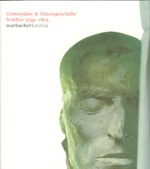
Great plans and projects: Schiller was usually thinking big. But the fact that he was not wealthy and his life a permanent struggle to secure an income and regular employment influenced his writing. For some time he took a break from drama writing in order to focus on the more lucrative publication of historical works. These tensions between his idealistic plans and his precarious existence as a writer who was not independent from market requirements were in 2005 the subject of an important exhibition at the Deutsches Literatur Archiv (DLA), and the beautiful catalogue is a treat for Schiller fans.
Frank Druffner und Martin Schalhorn: Götterpläne & Mäusegeschäfte. Schiller 1759–1805, 2nd edition, Marbacher Katalog 58, Deutsche Schillergesellschaft Marbach 2005
—
It was for sure a very tough experience for Johann Caspar Schiller, Friedrich’s father, when his son – then a regiment doctor – deserted from the army and fled Württemberg. Not only was Johann Caspar a loyal officer in the same army from which his son ran away, he was also for 21 years the responsible supervisor of the Duke’s garden at Schloss Solitude and therefore in a quite close working and personal relationship with the Duke and thus in a particularly delicate position. The letters written by the father to his famous son are interesting documents; while after young Schiller’s desertion shame and disappointment are the dominating feelings from Johann Caspar‘s side, he had later to acknowledge that his son achieved more than his father could hope for.
Jean-Baptiste Joly: Johann Caspar Schiller auf der Solitude, Spuren 27, Deutsche Schillergesellschaft Marbach 1994
—
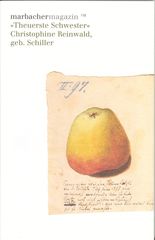
Schiller’s older sister Christophine wrote memoirs of Schiller’s youth which are a valuable source for Schiller scholars. Although she was like most women of her time forced to lead a life according to social conventions that limited women mainly to homework, education of children and representative tasks, she had an artistic talent of her own, as her drawings and watercolors that are in the possession of the DLA show. The reproductions of her works are one of the highlights of a small catalogue dedicated to her.
Edda Ziegler in cooperation with Michael Davidis: »Theuerste Schwester«. Christophine Reinwald, geb. Schiller, Marbacher Magazin 118, Deutsche Schillergesellschaft Marbach 2007
—
The catalogue „Aus dem Leben eines Hofrats“ is the indispensable guide book if you visit the Schiller House in Marbach in which Friedrich Schiller was born.
Michael Davidis and Sabine Fischer: Aus dem Hausrat eines Hofrats, Marbacher Magazin 77, Deutsche Schillergesellschaft Marbach 1997
—
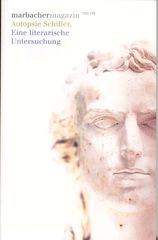
An original way to approach the person Schiller and his work is via some of his belongings which are now a part of the DLA collection: a hat, headband, three vests, two pairs of pants, two pairs of socks, seven shoe buckles, finger rings, hand warmers, toothpicks, dressing gown button and pocket, a walking stick and numerous curls attributed to him – all of these items have their own history, a history that says a lot about the person Schiller and about his work.
Heike Gfrereis, with an essay by Wilhelm Genazino: Autopsie Schiller. Eine literarische Untersuchung, Marbacher Magazin 125/126, Deutsche Schillergesellschaft Marbach 2009
—
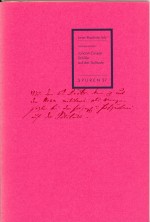
While still in Württemberg, Schiller visited the poet, journalist and musician Christian Friedrich Daniel Schubart in his prison at Hohenasperg in November 1781. Schubart was incarcerated for ten years without trial and verdict, the most famous victim of the „justice“ of Duke Carl Eugen. A slender booklet informs the reader about this fascinating episode in Schiller’s life that triggered his escape from the Duke’s service and that left literary traces especially in Schiller’s play „Kabale und Liebe“.
Wolfgang Ranke: Schiller, Schubart und der Hohenasperg, Spuren 86, Deutsche Schillergesellschaft Marbach 2009
—
From September 1793 to May 1794, Schiller could visit for the first time after his desertion his home region again. On May, 4, briefly before Schiller’s return to Jena, the then almost unknown publisher Johann Friedrich Cotta invites Schiller on a coach ride from Stuttgart to Untertürkheim and to the Kahlenstein hill near Cannstatt. During this day trip, the two men discussed Schiller’s plan for his new journal project „Die Horen“. It turned out that this ride was the beginning of a long friendship and a for both sides very fruitful author-publisher relationship. A small booklet documents this crucial moment in Schiller’s life.
Martin Schalhorn: Ein Sonntagsausflug von Schiller und Cotta nach Untertürkheim am 4. Mai 1794, Spuren 69, Deutsche Schillergesellschaft Marbach 2006
—
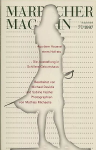
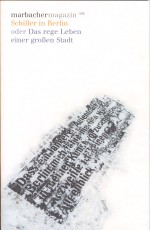
In May 1804, Schiller visited Berlin for about two weeks. This time is extremely well documented – whom he met, what theatre and opera performances he visited, where he had dinner and what was going on regarding his planned academic posting to Berlin. All this from Schiller’s own notebooks and other sources, but also a comparison of the intellectual climate of Berlin and Weimar and beautiful illustrations you can find in another nice exhibition catalogue.
Michael Bienert: Schiller in Berlin oder Das rege Leben einer großen Stadt, 2nd edition, Marbacher Magazin 106, Deutsche Schillergesellschaft Marbach 2005
—
Until the first half of the 19th century, monuments were only erected in honor of Kings or other aristocratic persons. The Schiller Monument in Stuttgart, created by Bertel Thorvaldsen and inaugurated in May 1839 was the first public monument in Germany in honor of a poet and had therefore a great impact for the democratization of Erinnerungskultur (memorial culture). A small booklet describes the public contemporary debate that preceded and followed the inauguration of the Schiller monument in Stuttgart.
Michael Davidis: 150 Jahre Schiller-Denkmal in Stuttgart, Spuren 4, Deutsche Schillergesellschaft Marbach 1989
—
All publications are available directly from the DLA online shop or at the DLA premises in Marbach.
—
A lot of Schiller, I know. If you are now feeling inspired to write like him, buy yourself an antique standing secretary desk as was used by Schiller (and Goethe), and get in Marbach one of those neat nibs he used for writing (9 Euro; it comes with a small gift case and description).
But don’t forget the famous rotten apples for a really authentic Schiller feeling!
© Thomas Hübner and mytwostotinki.com, 2014-5. Unauthorized use and/or duplication of this material without expressed and written permission from this blog’s author and/or owner is strictly prohibited. Excerpts and links may be used, provided that full and clear credit is given to Thomas Hübner and mytwostotinki.com with appropriate and specific direction to the original content.
The Poetry of Thomas Kling
This blog post is part of the German Literature Month, hosted by Lizzie (Lizzies Literary Life) and Caroline (Beauty is a Sleeping Cat)
Ten years ago, the arguably most outstanding representative of this generation of German-language poets, Thomas Kling, passed away at the age of 47. With his almost encyclopedic knowledge of many subjects, including literature, history, geology and his rich language he created “poetic installations” that are particularly gripping in their polyphony when read by an experienced performer that make his poetry sound like spoken music; Kling was an impressive stage performer (a “Rampensau” as we say in German) and if you can you should look not only for a collection of his poetry, but also for a CD with poems read by himself.
As always with poetry, a translation can only give a pale reflection of the original, and many of the most elaborated poems of Kling are simply untranslatable; but I want to give at least a small impression by presenting you translations of three comparatively conventional poems by Thomas Kling (in his very special orthography):
porträt JB. fuchspelz,
humboldtstrom, tomatn(ca. ‘72)
düsseldorf, aufm schadowplatz. Eines
vormittags, im niesel. hinterm tapezier-
tisch im fuxxpelz im mantel. hab ich so
aus einiger entfernung hinter flugzetteln
gesehn; da macht ich BLAU eines vor-
mittags unter -strom(ca. ’75)
humboldtgymnasium, düsseldorf. ich sachs
euch: WIR BEKAMN HUMBOLDTSTROM. Doctor
august peters, (GESCHICHTE) zu meinem zuspät-
kommndn freund roehle: ZIEHN SIE DEN BEUYS
AUS! SEIN MANTEL WAR GEMEINT.(’77)
kassel. installation der HONIGPUMPE. ein-
leitung von sauerstoff, daß honigfluß wir
sehn konntn. mittags, vorm friderizianum
bat ich den lagerndn mann bat ich die angler-
weste um den tagschatten gibst du mir
die TOMATN und kam zu mir sein tomatnhant!From: Thomas Kling: brennstabm, Suhrkamp, Frankfurt am Main 1991
portrait JB. fox fur,
humboldt current, tomatos(ca ’72)
düsseldorf, on schadow square. One
morning, in the dizzle. behind the trestle
table in a fox fur in a coat. I saw
from a distance behind leaflets;
I was skiving off one morning
under –current(’ca 75)
humboldt school, düsseldorf. I’m telling
you: we got humboldt current. Doctor
august peters, (HISTORY) to my friend roehle
who was late: TAKE OFF YOUR BEUYS!
HE MEANT HIS COAT.(’77)
kassel. HONIGPUMPE installation. in-
sertion of oxygen, so that honey stream we
could see. Afternoon, in front of fridericianum
I begged the warehousing man begged the fishing
jacket for the day’s shadow will you give me
the tomatoes and to me came his tomato hand!Translation by Noël Reumkens, Trans 8/2009
——————————————————————————–SERNER, KARLSBAD
wo in angesagter umgebun’
di zensur ihr sprudeln begann.zentralgranitmassn.
geselchter schnee. nichtswußte ich, zweiundsiebzig,
von einem haus edelweiß womattkaiserschrunde oder ocker-
gestimmte, oder sonstwi-erinnerun’:“sprich deutlicher”
in karlovy vary. . . di (mittags?)sonne, geschwächt,
in spiegeln mitgeteilt wurd; woder becherovka in geschliffenen
gläsern und rede auf di marmor-helligkeit knallte, karlsbad-sounds:
“o sprich deutlicher” in geselchtmschnee, und “jedes hauptwort ein
rundreisebillet.” SERNERder ging von prag aus
gemeinsam ins gas.From: Thomas Kling: morsch. Gedichte, Suhrkamp, Frankfurt am Main 1998
SERNER, KARLSBAD
where even in posted areas
the censors babbled.tall granite masses.
smoky snow. I knewnothing, seventy-two,
about edleweiss, ocherhouses of the emperors’ realm,
or an otherwise-remembrance:“speak more clearly”
in karlovy vary.. . . the (midday?) sun, weakened,
reflected by mirrors; wherethe schnapps served in cut glass
and the talk bounced aroundthe shining marble. karlsbad sounds:
“o, speak more clearly” in smokysnow, “every noun
a round trip ticket.” SERNERwho left prague as well
headed for the gas.Translation by Peter Filkins, Poetry Magazine Oct/Nov 1998
——————————————————————————–
LARVEN
1913 sind auf Papua-Neuguinea die ströme und
gebirge längst nach den Hohenzollern benannt.
der kopf der fremde schnurrt und liefert, für neue
ferne dinge neue namen wobei die sprachn sich
vermischen, im mund der fremdes neues schmeckt
wie kopra oder kasuar. das passt zum helm. so
dampfen neue masken aus den sumpf-eiländern
auf die feierliche zunge abendland. die gaumen
segel knattern frisch ein wind aus übersee, berlin –
die zunge – erhebt als frische toteninsel sich aus
dem fiebersumpf der mark. die insel schnalzt schon
kommen worte aus der ferne. südfrüchte fallen
der stadt aus dem mund. der ist die neue zunge so
gesprächig. anders irgendwie: es sprechen alle plötzlich
wie die papuas, hofsprache iatmul. der mund als Über¬
see, als schein, so strömt der sepik mündet in den rhein.
From: Thomas Kling: Fernhandel, DuMont, Köln 1999
LARVAEIn 1913 the currents and mountains in Papua-New Guinea
are named after the Hohenzollern since a long time.the head of the foreign land hums and provides for new
distant things new names in which the languagesare mixing, in the mouth that tastes strange new things
like copra or cassowary. that fits to the helmet. Thusare steaming new masks from the swamp-islands
on the solemn tongue occident. the softpalate rattles freshly a wind from the outlands, berlin –
the tongue – rises as fresh island of the deaths fromthe fever swamp of the Mark. the island clicks already
words are coming from the distance. tropical fruits are fallingfrom the mouth of the city. the new tongue of hers is so
talkative. somehow different: suddenly everybody speakslike the papuas, court language iatmul. the mouth as over-
sea, as glow, thus streams the sepik flows into the rhine.Translation by Thomas Hübner
It would be great to see an edition of Selected Poems by this author in English!
Thomas Kling: Gesammelte Gedichte, DuMont, Köln 2006
Thomas Kling: Die gebrannte Performance, Audio Book, 4 CDs, Lilienfeld, Düsseldorf 2015
© Thomas Kling, Suhrkamp Verlag and DuMont Verlag, 1991-2006 © Peter Filkins and Poetry Magazine, 1998 © Noël Reumkens and TRANS, 2009 © Thomas Hübner and mytwostotinki.com, 2014-5. Unauthorized use and/or duplication of this material without expressed and written permission from this blog’s author and/or owner is strictly prohibited. Excerpts and links may be used, provided that full and clear credit is given to Thomas Hübner and mytwostotinki.com with appropriate and specific direction to the original content.
The Tortoises
This blog post is part of the German Literature Month, hosted by Lizzie (Lizzies Literary Life) and Caroline (Beauty is a Sleeping Cat)
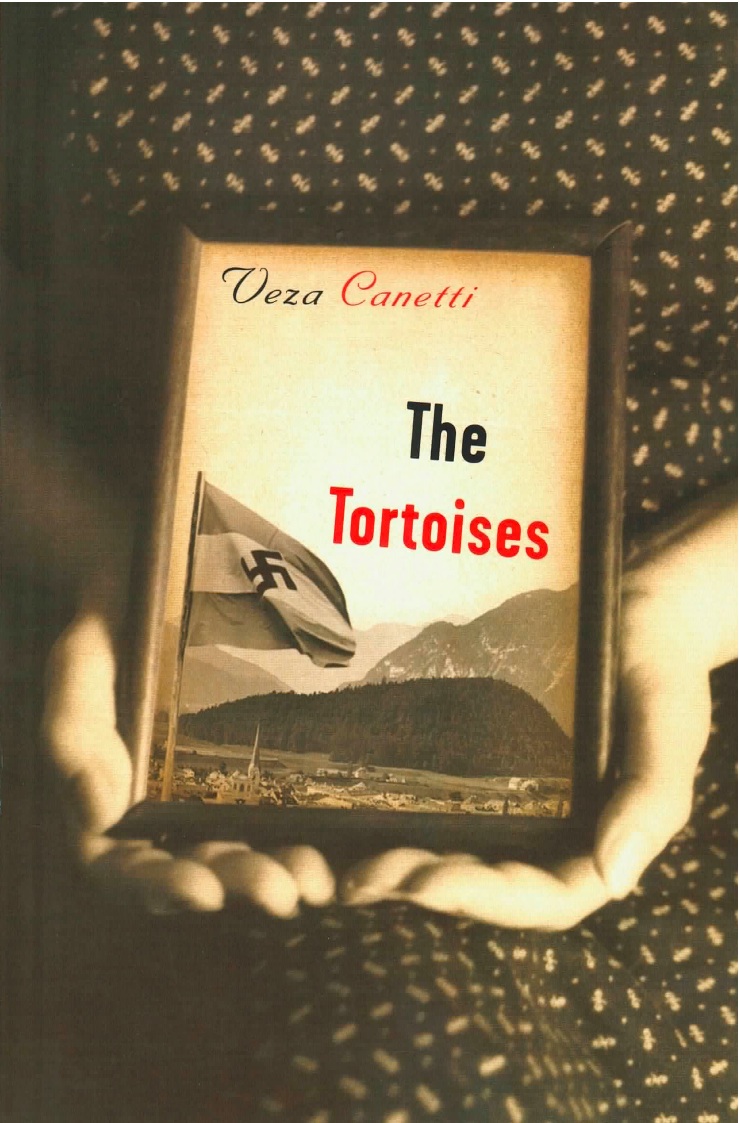
Austria 1938. Andreas Kain, a renowned writer and his wife Eva, live in a beautiful villa just outside Vienna. What could be a normal and fulfilled life in the “loveliest city of Central Europe” turns for Kain, Eva, and Werner – Kain’s brother with whom he has a loving but nevertheless troubled relationship – into a nightmare: it is the time of the Anschluss, the Nazis are triumphing also in Austria, and for Jews like the three main characters of Veza Canetti’s novel The Tortoises (Die Schildkröten) a time of growing humiliations and deadly dangers has begun. The bank accounts of the Jews are frozen, those among them who have a regular job are dismissed, and the homes and furniture of Jewish households are being “requisitioned”. And that will be just the beginning.
While Kain and Eva have to leave their home, they have nowhere to go and visas are getting unattainable. Hilde, a Jewish girl from the neighborhood, tries to find a rather grotesque way out of this situation: with her father’s money and her charms for whom one of the new Nazi neighbors falls, she intends to hire or even buy a private airplane with which the whole group could possibly leave Austria (illegally), a project that is obviously doomed from the very beginning.
The Tortoises is a brilliant novel. Not only because of Veza Canetti’s ability to describe her own ordeal – the book is autobiographical – in an elegant, beautiful prose (well translated by Ian Mitchell). If you ever asked yourself how it was possible that the Nazis took hold of the big majority of Germans and Austrians within such a short time and how – at least on the surface – normal and otherwise decent people turned into Nazis or willing followers seemingly out of the blue then you should read this book. It gives a haunting description of the paranoid atmosphere in Vienna after the Anschluss.
Veza Canetti’s language is Viennese – elegant and always slightly ironic. The plays of Johann Nestroy, the prose of Arthur Schnitzler, the satiric furor of Karl Kraus, they all resonate in her writing. And she can write exceptionally well dialogues that sound as if they come directly from a Volksstück of Ödön von Horvath. The Nazis are ridiculous and pathetic figures; the name of the main villain in the book is Pilz (=mushroom), and this gives Frau Wlk (whose Czech name means “wolf”), the cleaner, an opportunity to denigrate this man but at the same time we readers get an insight in the mentality of even good-natured people like the landlady who is suddenly impressed by the Nazis:
“His name is Pilz-Mushroom! Toadstool, Mould, Fungus, Frau Wlk goes through all the variations. He lives down there where she lives, he’s a brownshirt, a bigwig, because he has a low number. Having a low number means he was one of the very first to be in the National Socialist Party….It seems that this low number exudes a fascinating effect. Because Frau Wlk was complaining. Even the landlady, here in this house, who is so kind, for whom she cleans the house, even she has been taken in. She who, after all, goes to church every Sunday. Who puts her last penny into the collection box to pay for a new figure of the Holy Virgin. Here in this house, the right atmosphere reigns to corrupt the landlady. The Mushroom came up and immediately won her over. And, simply because he has promised her South Tyrol, the landlady, who is so persnickety, is letting him move in here.”
Another “horvathesque” element are the dialogues between Pilz and Kain and his wife – on the surface polite (“Herr Ingenieur!” “Herr Doktor!”) and considering the changed circumstances even funny – but there can be no doubt that the new rulers will ruthlessly execute their program of extermination of the weak and of the “inferior” races, particularly the Jews.
While this is at least in the first days after the Anschluss not yet visible in the bourgeois villa neighborhood where Kain – the name is alluding not only to the biblical Kain but also to Peter Kien, the main character of Elias Canetti’s novel Auto-da-fé – and Eva are living, the open brutality of the new regime is evident from the very beginning in less privileged areas of the city. But also in the villa suburb, the signs are clear: a sparrow, and later a dog are killed by one of the new Nazis in front of a group of children to “teach” them that the weak and the useless have to be wiped out mercilessly. And the tortoises to which the title of the novel is referring, are branded with a swastika by another Nazi and sold as souvenirs, but some of them can be saved by the good-hearted Andreas Kain. As Schopenhauer says in The Basis of Morality:
“Compassion for animals is intimately associated with goodness of character, and it may be confidently asserted that he who is cruel to animals cannot be a good man.”
The novel is also a book about the relationship between the brothers Andreas and Werner, and is mirroring the relationship between Elias Canetti, Veza’s husband, and his brother Georges. In this respect it is not only interesting to read Elias Canetti’s autobiography (which mentions Veza’s great importance for Elias Canetti’s intellectual development, but doesn’t say a word about the fact that Canetti’s first wife was an exceptional author in her own right), but also the correspondence between Elias, Georges, and Veza Canetti that was published a few years ago.
The Tortoises was completed after the Canettis could escape to England in the very last moment, but never published during Veza’s lifetime. She published very little during her life and in a bout of depression destroyed the manuscripts of most of her unpublished works. During the last years of Elias Canetti’s life, he published/re-published her remaining works. Veza Canetti is one of the greatest prose writers of the 20th century in German language. It is high time to discover her.
Veza Canetti: The Tortoises, translated by Ian Mitchell, New Directions Books, New York 2001; Die Schildkröten, Carl Hanser Verlag, München 1999
Veza Canetti / Elias Canetti: “Dearest Georg!”: Love, Literature, and Power in Dark Times, The Letters of Elias, Veza, and Georges Canetti, 1933-1948, translated by David Dollenmayer, Other Press, New York 2010; Briefe an Georges, Carl Hanser Verlag, München 2006
For German speakers I recommend also the performance “Der Herr Karl” by Helmut Qualtinger, a truly revealing portrait of a (fictional) Nazi follower in Vienna – where until today a considerable part of the population views itself – quite in contrast to the overwhelming and frenetic support of the biggest part of the Austrian population for the Nazis after the Anschluss – as “the first victims of the Nazis”.
© Thomas Hübner and mytwostotinki.com, 2014-5. Unauthorized use and/or duplication of this material without expressed and written permission from this blog’s author and/or owner is strictly prohibited. Excerpts and links may be used, provided that full and clear credit is given to Thomas Hübner and mytwostotinki.com with appropriate and specific direction to the original content.
From the Tartar Desert
Maybe THE highlight of my visit at the book fair in Frankfurt this year was the Indonesian pavilion; when you entered you literally were in another world. Much has been written about the late start of the Indonesian preparations for the fair, particularly the late kick-off of the translation grant program – but it was all well and who took a little bit time to enter the Indonesian pavilion with its slightly mystic flair could easily forget the frantic atmosphere at the fair. Well done, Indonesia! And it was a pleasure not only to catch a glimpse of the Indonesian book world, but also of the cultural treasures in other areas (Music! Film! Comics! Food!) that the world’s biggest archipelago has to offer. (Not that it was new to me as a former long-term resident of Indonesia…)
We paid of course also a visit to the Indonesian publishers (not ALL Indonesian books are published by the giant Gramedia), and particularly the visit at the Lontar booth with its interesting program of translated titles was a pleasure. Besides, Frankfurt, as is usual during the book fair, paid homage to the Guest of Honor all over the place: there were many readings, gamelan concerts and several art exhibitions at Frankfurter Kunstverein (Eko Nugroho and other artists from Yogyakarta), and at Portikus (Ade Darmawan) to name just a few activities of the program surrounding the book fair.
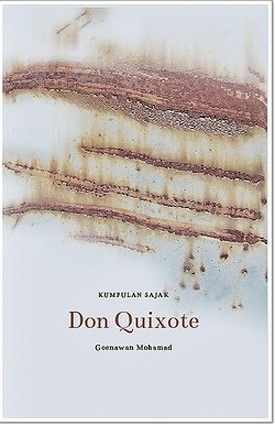
That Indonesia presented itself in such a splendour at the world’s biggest cultural event is to a considerable part the work of Goenawan Mohamed. Mohamed, the president of the committee that organized and coordinated Indonesia’s participation, is not only the arguably most important Indonesian journalist and since decades the publisher of the famous journal Tempo that played a big role in Indonesia’s reformasi process; he is also an accomplished poet:
Dari Gurun Orang Tartar
Dari gurun orang Tartar,
apa yang diharapkannya?
Dari luas yang mengancam,
apa yang dikhayalkannya?
Di Entah itu, Sancho Panza,
kita cuma nunggu.
Jangan, jangan mengeluh.
Berdirilah kau
di dekatku.
Sebab para ksatria hanya tanda:
angan-angan dan epilepsi
yang tak ingin selesai.
2008
From The Tartar Desert
From the Tartar desert,
what does he expect?
From the threatening width,
what is he imagining?
In that Anywhere, Sancho Panza,
we just wait.
Do not, do not complain.
Stand
beside me.
Because the knight is just a presage:
thoughts and convulsions
that do not want to end.
2008

Goenawan Mohamed: Don Quixote, PT Tempo Inti Media, Jakarta 2013
Translation from Bahasa Indonesia by Thomas Hübner
P.S. – While I am writing these lines, I receive rather disturbing news from Indonesia: the most renowned literary event of the country, the Ubud Writers and Readers Festival, organized since 12 years by Janet DeNeefe, has become the target of some officials who threaten to shut it down. The reason: the festival is – like such events should be – a place for open discussion and exchange, also about topics that are still painful for some people in the Indonesian authorities. If the Festival doesn’t cancel its panel discussions about the mass killings of 1965, one of the worst genocides of the 20th century, and is screening Joshua Oppenheimer’s documentary The Look of Silence, it will be shut down according to local police, military and government officials.
Maybe these “officials” should have a look at the Indonesian Constitution before they make a mistake – it guarantees freedom of expression and free speech and renders these violent acts of censorship and intimidation completely illegal.
I hope the organizers of the Frankfurt Book Fair issue a swift statement against this incredible scandal. Indonesia was chosen as a Guest of Honor, as a democratic country that respects human rights and democratic values. Those who terrorize the Ubud Writers and Readers Festival destroy the positive image Indonesia just built up – I hope they will not succeed to suppress freedom of expression and free speech. Otherwise it would have been better to not invite Indonesia as a Guest of Honor to Frankfurt.
© Goenawan Mohamed and PT Tempo Inti Media, 2013 © Thomas Hübner and mytwostotinki.com, 2014-5. Unauthorized use and/or duplication of this material without expressed and written permission from this blog’s author and/or owner is strictly prohibited. Excerpts and links may be used, provided that full and clear credit is given to Thomas Hübner and mytwostotinki.com with appropriate and specific direction to the original content.
Frankfurt, here I come
Yours truly is traveling to the Book Fair in Frankfurt. I am sure I will have blisters and excess baggage when I am coming back.
A detailed report will follow later.
© Thomas Hübner and mytwostotinki.com, 2014-5. Unauthorized use and/or duplication of this material without expressed and written permission from this blog’s author and/or owner is strictly prohibited. Excerpts and links may be used, provided that full and clear credit is given to Thomas Hübner and mytwostotinki.com with appropriate and specific direction to the original content.











Facebook
RSS
Twitter