Bibliomania, or The House of Paper

Are you a bookworm? Great, then we have a thing in common! Are you a bibliophile, a person who loves books? You are not alone! Are you a book collector? Yes, I also belong to that species! Are you a bibliomane? Uh-oh, then you might be in trouble!

According to Wikipedia, “bibliomania can be a symptom of obsessive–compulsive disorder which involves the collecting or even hoarding of books to the point where social relations or health are damaged.” Next to this definition you see a photo of some bookshelves with the neat caption: “Cluttered bookshelf, one symptom of bibliomania.” – No, the photo was not taken at my home – since even cluttering my bookshelves isn’t sufficient anymore for all the books at my place…

Bibliophilia or bibliomania can even have tragic consequences, in fiction and in real life; Peter Kien in Elias Canetti’s Auto-da-fe comes to mind, as well as the real-life biblio-criminals Don Vicente or Magister Tinius, two priests who committed murder out of an insane compulsion to increase their libraries. (Isn’t it interesting that of all people two priests are the most extreme cases of book-insanity?)

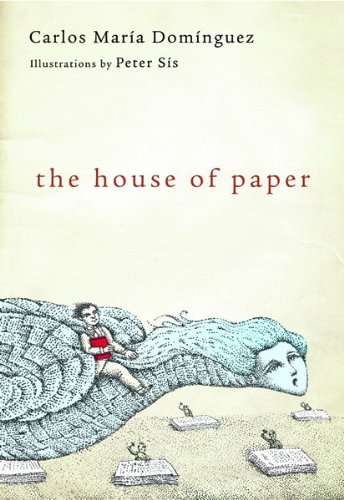
The small and charming book The Paper House by Carlos Maria Dominguez (with beautiful illustrations by Peter Sis) fits very well here.

The ingredients: Bluma Lennon, an attractive female English literature professor with a – in the true sense of the word – fatal love of the poetry of Emily Dickinson; her Argentinian part-time lover and successor at the university who is the narrator of the story; a stained and gritty copy of Joseph Conrad’s The Shadow Line; and Carlos Brauer, an Uruguyan book collector who sent this strange copy to Bluma.

While on a visit at home in Buenos Aires, the narrator uses the opportunity to go to Montevideo and to investigate about Brauer and his relationship with Bluma. What he learns from the owner of an antiquarian bookshop in the Uruguayan capital, and a book collector who knew Brauer well, makes the narrator – and the reader! – more and more curious; and when he finally discovers the House of Paper to which the title alludes, Brauer has become a real mystery. Of course I will not give away the full story here – but for addicted readers like you this small book will be a treat, that’s for sure.

The House of Paper is a very enjoyable novella that I read in one sitting. For all of you that have an issue with bibliomania, the book may be also of educational value. Carlos Maria Dominguez is a very productive Argentinian author who lives in Uruguay. The House of Paper makes me curious to read more of his books. If I am not mistaken, this is the only book by him so far translated in English; two of his novels and another book with stories are available in German.

Dominguez

Carlos Maria Dominguez: The House of Paper, translated by Nick Caistor, illustrations by Peter Sis, Harcourt, San Diego 2005

© Thomas Hübner and mytwostotinki.com, 2014-5. Unauthorized use and/or 
duplication of this material without expressed and written permission from this blog’s author and/or owner is strictly prohibited. Excerpts and links may be used, provided that full and clear credit is given to Thomas Hübner and mytwostotinki.com with appropriate and specific direction to the original content.

A Lost Opportunity

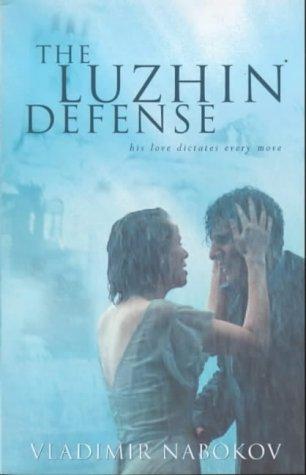
Once again The Luzhin Defense – this time it’s about the film based on Vladimir Nabokov’s novel.

There are thousands of movies based on books; some of them are great artworks in their own right; many are quite ok; and a very big number is simply disappointing. Unfortunately, the feature film The Luzhin Defense (UK/France 2000; Director: Marleen Gorris; Screenplay: Peter Berry; Actors: John Turturro, Emily Watson, Stuart Wilson et al.) belongs to the last category in my opinion.

That the short and fat Luzhin of the novel is played by the haggard John Turturro: granted, because he is a good actor. That the story was transposed from Berlin to an Italian hotel: granted, because it means the film focuses even more on chess than the novel. That the role of Valentinov is expanded in the film compared to the novel: granted, because this ambigous character creates additional interest. That the main female character has now a name: granted, because her having no first name works well in the book but wouldn’t work in a movie.

With other decisions of the film crew I am not at all d’accord. To introduce a major character (Jean de Stassard) that is not in the book and that doesn’t fit at all in this story makes me like this film already much less. 

But the worst are the two major chess scenes in the film that make a real disaster of this attempt to visualize Nabokov’s book.

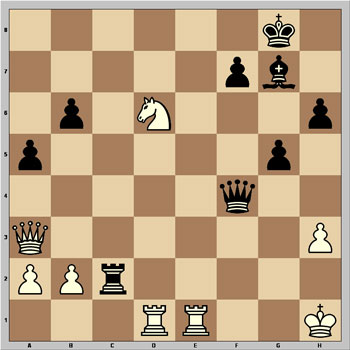
In the semifinale of the tournament in which Luzhin participates in the movie he seems to be in a hopeless position. But thanks to a hidden brilliant combination he can defeat his opponent and qualify for the final game against his main rival Turati. And here, in showing this supposedly brilliant combination – which is based on a real tournament game Dr. Vidmar-Dr.Euwe, Karlsbad 1929 – the movie lost me completely:

vidmar-euwe

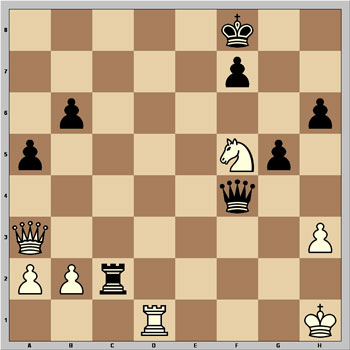
This is the real position in the historical game in which Vidmar is threatened to be checkmated in the next move. But he found a spectacular rescue and played in cold blood 1.Re8+ Bf8 (1.-Kh7 is answered by 2.Qd3+ and black loses its Rook on c2), and now 2.Rxf8+! Kxf8 3.Nf5+

vidmar-euwe2

In the real game, Euwe resigned here already. 3.-Ke8 is followed by 4.Qe7#, and 3.-Kg8 is answered of course by 4.Qf8+!! Kxf8 (4.-Kh7 5.Qg7# doesn’t help) 5.Rd8# – really a brilliant end and a clever choice for the movie.

However, someone in the film crew placed the black rook on c1 and not on c2, and since Luzhin’s opponent plays until the end, we see – under frenetic applause from the tournament kibitzers in the movie the following key position on screen:

vidmar-euwe3

The Film-Luzhin plays exactly like Vidmar, but the last move is illegal with the black rook on c1! To make things worse, in the movie position White is not threatened at all by mate on h2 and the simple 1.Rxc1 wins in the most trivial way.

For anyone familiar with the rules of the game, this scene is ruining the whole movie. As if this was not enough the film provides us with a kitschy and completely unrealistic ending that is not only violating the content and spirit of Nabokov’s book but that would make even each B-movie screenwriter in Hollywood look like a great artist.

A lost opportunity. 

© Thomas Hübner and mytwostotinki.com, 2014-5. Unauthorized use and/or 
duplication of this material without expressed and written permission from this blog’s author and/or owner is strictly prohibited. Excerpts and links may be used, provided that full and clear credit is given to Thomas Hübner and mytwostotinki.com with appropriate and specific direction to the original content.

An Afternoon in the Museum

A few days ago, I had the opportunity to pay a visit to the newly opened National Art Gallery “Square 500” in Sofia which shows right now a huge exhibition curated by two former museum directors. The exhibition gives an overview over the Bulgarian Museum collections of the National Gallery (for Bulgarian art) and of the National Museum for Foreign Art.

The museum, ridiculously dubbed “the Bulgarian Louvre” by a part of the media and political “elite” of the country was already before its opening subject to many headlines in the media, namely because of the delayed opening and – not completely untypical for Bulgaria – because of alleged irregularities in the procurement and tender process of the reconstruction of the building that houses the museum. A rather big amount of tax payers’ money went into the coffers of the shady construction mogul who – allegedly – won the manipulated tender because he – allegedly – is a friend of the Minister of Culture.

If these rumors are really true I cannot say – but I wouldn’t be surprised. As an art lover I am of course more concerned about the result and I want to give my informed opinion about it here.

The edifice of the building which houses the museum is a late 19th century design in Viennese style, adapted after WWII to the needs of a museum and again changed now by several modern attachments, all in all a worthy location for such a museum.

Most of the artworks I saw in the exhibition were already known to me – except for a few that are borrowed from other collections for this exhibition – it is basically a combination of the works that were housed before in the two separate museums mentioned above. So regarding what I saw I can say: a good overview about Bulgarian art since the 1830s until 1989 (I didn’t see any artwork produced after the collapse of communism – if this reflects a lack of budget for new acquisitions in the last 25 years or a political statement that tells us that there is no good art produced in Bulgaria in the last decades according to the exhibition curators I don’t know), and a – in my opinion not very favorable mix with foreign artworks that are hung frequently together with Bulgarian artists of the same period.

While the Bulgarian art collection is in a way representative (except for the most recent period), the presented examples of foreign art are in most cases mediocre. It is also not visible or explained why the artworks are hung in that specific neighborhood (which frequently has no relation/influence with the respective Bulgarian artist).

Another thing that struck me was the lighting: in some rooms it was really awful and much too intense. Artworks are sensitive items and the light must be carefully balanced between the need to protect it against possible damage and the wish of the visitors to see and study it in the best possible way. The lighting as it is now doesn’t do justice to either of these requirements.

I had also the impression that the plates which describe the artwork have been done in the very last moment; there are frequently four or five of such very basic paper clippings stuck to the wall in one place and the visitor has to guess which plate belongs to which artwork. It looks cheap and inadequate.

Alas, the most surprising thing for me was something else: when you prepare such an exhibition which shows a considerable part of the visual art heritage of the country and which many people would like to see, you should make sure that people really see it when they visit the building. My guess is that a lot of the visitors will not have seen many of the artworks because the orientation in the exhibition is very very difficult.

The exhibition covers several floors and the whole building is a little bit like a labyrinth – there are only a few (very small) arrows that guide the visitors, room numbers are missing frequently, as a visitor you stumble from 19th century Bulgarian art to Christian Indian art from Goa, to Japanese woodcuts, and you have never an idea what comes next or what you have probably missed when you have once chosen a direction that was not the one intended by the exhibition makers (but which you can only guess). Friends who visited the exhibition told me for example that they almost didn’t find the room with the artwork of Vladimir Dimitrov-Maistora, one of the most famous Bulgarian painters, and only because of their persistence they found the hidden room where his paintings from the collection are displayed. And I am sure I saw – probably! – all works only because I am a very persistent visitor. Just when I prepared to leave I realized I had missed a complete flight of rooms with four more exhibition rooms!

That the museum shop where you can buy the exhibition catalogue and many other catalogues and books is hidden in a corner at the very edge of the outermost corner of the building and not in the entrance area where it belongs adds to the picture. The exhibition makers could easily print a small map on the backside of the ticket for orientation – this small thing would add indeed a lot of value for the visitors. But no, you have to pay 10 Leva (5 Leva for students, pensioners, unemployed), a proud amount considering the average salaries of the Bulgarians – and then you are on your own in the building. 

A nuisance: while most living Bulgarian artists are not at all represented in the exhibition, the Minister of Culture, Mr. Razhidov, a sculptor of modest talent has two of his own artworks in the show. It reminds me of the fact that when I visited the last time the small gallery in the Ministry of Culture it displayed an exhibition with works of – the Minister. Remember Alek Popov’s description of the visiting sculptor in his Mission London? I am not sure but my strong guess is that it is based on a real person most Bulgarians know…

That even if Mr. Razhidov would be a second Giacometti it would not be appropriate to include his own artworks in any exhibitions sponsored by the Ministry he leads seems to have never crossed his mind. It is called “Conflict of Interest” and borders the territory of outright corruption. He uses his position and taxpayers’ money to increase his popularity and potential market value as an artist. And of course he gets away with it. Also a part of the “Culture” he is promoting.

Conclusion: if you are in Sofia and are interested in Bulgarian art, this exhibition is a must. The collection itself is the by far best in that field in Bulgaria or anywhere else, the result of decades of diligent collecting. (When Lyudmila Zhivkova, the daughter of the dictator Todor Zhivkov was de facto in charge of the collection, it increased considerably – mainly by acquiring fake artworks she was tricked into buying by some clever crooks.) That this extraordinary show is so poorly prepared and presented is a pity and shows again the lack of professionalism that is so typical for many of those people who are politically responsible for Bulgarian Culture. 

Zograf_self

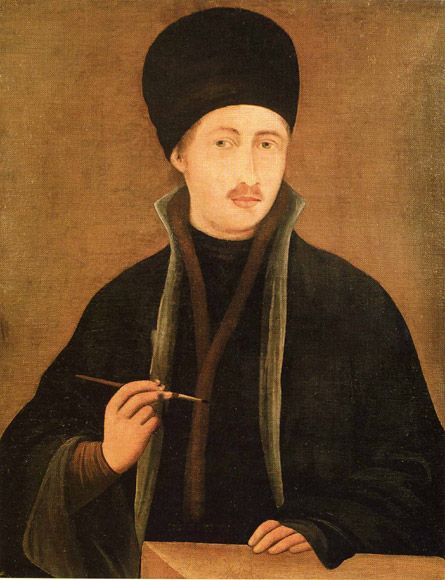
Zahari Zograf, Self-portrait, National Art Gallery Sofia, ca. 1840

The exhibition can be visited at the building of the National Gallery of Foreign Art, Sofia, 19 February Str. No.1, near the Cathedral Alexander Nevski 

© Thomas Hübner and mytwostotinki.com, 2014-5. Unauthorized use and/or 
duplication of this material without expressed and written permission from this blog’s author and/or owner is strictly prohibited. Excerpts and links may be used, provided that full and clear credit is given to Thomas Hübner and mytwostotinki.com with appropriate and specific direction to the original content.

A short note

Those who follow this blog regularly may have remarked that my reviews have become a bit more rare recently.

I just want to inform my regular readers that this reflects in no way a decrease in interest in blogging; it is just that my work, traveling and some new projects keep me quite busy these days. I hope to resume my old frequency regarding the publication of my book reviews here very soon.

Talking of new projects, I would like to mention that I am embarking also on a few book-related new activities: I am translating a book and I am (together with a friend and associate) undertaking the first steps as a (micro-)publisher and literary agent. I will report in due time more in detail about these projects. 

© Thomas Hübner and mytwostotinki.com, 2014-5. Unauthorized use and/or 
duplication of this material without expressed and written permission from this blog’s author and/or owner is strictly prohibited. Excerpts and links may be used, provided that full and clear credit is given to Thomas Hübner and mytwostotinki.com with appropriate and specific direction to the original content.


Just wondering

The Bulgarian Minister of Culture Vezhdi Razhidov awarded recently an important prize to the so-called historian Bozhidar Dimitrov, an ultra-nationalist propagandist and – according to renowned international historians – scientific crook and impostor with a past in some very dirty business.

Just wondering:

Since when is stealing documents from the Vatican Library, manipulating Bulgarian history in the sense of a chauvinist, ultra-nationalist political agenda, and working decades as a snitch and informer for the Stalinist State Security a reason to be bestowed with the biggest honor in the field of Bulgarian culture, the order „Златен век“ (Golden Age)?

Bozhidar Dimitrov is not a historian but a “chalga historian” – he is known under this name among his colleagues internationally – and the name fits him perfectly.

Once again, Minister Razhidov is besmirching the dignity of all people working in the cultural sphere in Bulgaria and all cultured people there.

Revolting!

© Thomas Hübner and mytwostotinki.com, 2014-5. Unauthorized use and/or 
duplication of this material without expressed and written permission from this blog’s author and/or owner is strictly prohibited. Excerpts and links may be used, provided that full and clear credit is given to Thomas Hübner and mytwostotinki.com with appropriate and specific direction to the original content.


Waiting for the Barbarians

It is difficult to keep track with the speed and “efficiency” with which our cultural world heritage is wiped out by a bunch of barbarians.

Timbuktu, Nimrud, Niniveh, Mosul, Hatra, and now Palmyra as it seems. And the world is watching…

I am speechless.

© Thomas Hübner and mytwostotinki.com, 2014-5. Unauthorized use and/or 
duplication of this material without expressed and written permission from this blog’s author and/or owner is strictly prohibited. Excerpts and links may be used, provided that full and clear credit is given to Thomas Hübner and mytwostotinki.com with appropriate and specific direction to the original content.

The Luzhin Defense

“What struck him most was the fact that from Monday on he would be Luzhin.”

These words mark a beginning and an end – the beginning of Vladimir Nabokov’s novel The Luzhin Defense and the end of the probably happiest period in the life of the protagonist when he was the pampered only child of a wealthy St. Petersburg family in pre-revolutionary Russia, living the protected existence of children of this class, when life seemed to be a long holiday. But time is not standing still, finally the boy has to attend school in the city where everybody will address him by his family name only. A rather traumatic experience as it turns out, although the child seems to accept the fact quietly.

It is an interesting decision of Nabokov to present this rather strange boy and later even more strange grown-up with his family name only (even his parents and his wife address him half-jokingly only with this name and not with his first name and patronym as would be usual). It is not until the very end when the readers learn the full name of the hero of the book.

And indeed, there seems to be an aura that creates a distance between Luzhin and the rest of the people. He is not communicative, likes to stay on his own, resolving mathematical problems or puzzles, and he seems to be unable to make friends or be even close with his parents who make all kind of efforts to shower Luzhin with their affection and love to which he reacts by withdrawing even more. His parents seem sometimes to be at a loss what to make of this strange bird that grows up in their nest and that shows no sign of serious interest in anything – until the day he discovers a chess set and learns how to play.

Luzhin develops into a chess wunderkind, with an all-absorbing passion for the game that is reluctantly supported by the father (who seems to be too happy that his son will not be a complete failure and be successful even when it is an activity that society doesn’t consider as something worthy of an educated person with his background). A chess impresario, Dr. Valentinov, takes the child prodigee under his wings and Luzhin becomes one of the most serious contenders for the title of a World Chess Champion.

The second part of the novel centers around a game of Luzhin with his main rival Turati, followed by a mental breakdown of Luzhin that forces him to give up on his chess career.

But Luzhin is lucky: he finds a young Russian woman from a wealthy emigrant family in Berlin that falls in love with him; despite strong reservations from the mother-in-law, the couple marries and finally Luzhin seems to embark for the first time in his life on a normal life. Everything would be fine, if he would not see everywhere these chess patterns, and to make things worse, one day his childhood nemesis Valentinov turns up again.

It is difficult not to quote excessively from this book – although written and published originally in Russian the English translation reads very smoothly and elegant, no surprise since Nabokov who co-authored the translation grew up bilingual – because there are simply too many parts which show the great mastery of Nabokov even at this comparatively early stage of his career. I will refrain myself and will give only two examples:

Dr. Valentinov, the chess impresario, is described as a cold, cunning, profit-oriented and extremely unsympathetic person (I was wondering: thinking of Silvio Danailov, a famous present day chess impresario, I suppose these character traits are part of the job description. Well, the real-life Danailov seems to be even more unlikable than the novel character Valentinov!).

When young Luzhin loses his wunderkind appeal and becomes just a strong chess grandmaster, Valentinov is walking away without saying much – but with a full bank account (while Luzhin remains quite poor and receives only a few “crumbs” from his income). While Valentinov becomes a film producer – there was much more money to make in the booming film industry of the 1920s – he comes up with a project idea for which he needs Luzhin and some other chessmasters as “staffage”. The few lines that describe their meeting after many years not being in touch are masterful and give in a nutshell a description of the character of both men:

“At this moment the door opened with a rush and a coatless, curly-haired gentleman shouted in German, with an anxious plea in his voice: “Oh, please, Dr. Valentinov, just one minute!” “Excuse me, dear boy,” said Valentinov and went to the door, but before reaching it he turned sharply around, rummaged in his billfold and threw a slip of paper on the table before Luzhin. “Recently composed it,” he said. “You can solve it while you are waiting. I’ll be back in ten minutes.” –

He disappeared. Luzhin cautiously raised his eyelids. Mechanically he took the slip. A cutting from a chess magazine, the diagram of a problem. Mate in three moves. Composed by Dr. Valentinov. The problem was cold and cunning, and knowing Valentinov, Luzhin instantly found the key. In this subtle problem he saw clearly all the perfidity of his author. From the dark words just spoken by Valentinov in such abundance, he understood one thing: there was no movie, the movie was just a pretext…a trap, a trap…he would be inveigled into playing chess and then the next move was clear. But this move would not be made.”

There are also many scenes where I had to laugh, especially the dialogues between the grubby, unworldly Luzhin and his future mother-in-law, a rich and very sophisticated woman – actually these are more monologues of the eccentric lady who doesn’t have exactly the highest opinion of the future husband of her only daughter. Or the attempts to find Luzhin a new occupation after the end of his chess career – rather sad, but also highly comical attempts at times that reach its climax when Luzhin acquires a typewriter:

“It was proposed to him that one of the office employees come and explain how to use it, but he refused, replying that he would learn on his own. And so it was: he fairly quickly made out its construction, learned to put in the ribbon and roll in the sheet of paper, and made friends with all the little levers. It proved to be more difficult to remember the distribution of the letters, the typing went very slowly; there was none of Tot-tot’s rapid chatter and for some reason – from the very first day – the exclamation mark dogged him – it leapt out in the most unexpected places.

At first he copied out half a column from a German newspaper, and then composed a thing or two himself. A brief little note took shape with the following contents: “You are wanted on a charge of murder. Today is November 27th. Murder and arson. Good day, dear Madam. Now when you are needed, dear, exclamation mark, where are you? The body has been found. Dear Madam! Today the police will come!!” Luzhin read this over several times, reinserted the sheet and, groping for the right letters, typed out, somewhat jumpily, the signature: “Abbe Busoni.”

At this point he grew bored, the thing was going too slowly. And somehow he had to find a use for the letter he had written. Burrowing in the telephone directory he found a Frau Louisa Altman, wrote out the address by hand and sent her his composition.”

I would have liked to see Frau Louisa Altman’s face when she read the letter.

Nabokov knew about what he was writing in this novel. He came from exactly the same milieu as the Luzhin in the book (even his father was like Luzhin’s father, an author). He knew the Berlin milieu of the Russian emigrants of the 1920s from his own life there. And he was a strong chess player that even composed and published chess problems – chess was his other life-long interest beside butterlies. It is very probable that he knew Alexander Alekhine (or Aljechin), the later World Chess Champion with whom Luzhin has many similarities personally – the Nabokov’s and the Alekhine’s were neighbors in St. Petersburg and both fathers were deputies in the Duma.

The chess part of the book is so much better and superior in every respect to Stefan Zweig’s Chess! (I don’t want to denigrate Stefan Zweig’s writing, but for me it is obvious that he had only a quite shallow knowledge of the game.) Needless to say that also the other chess masters mentioned in the book are inspired by real chess masters (Turati/Reti, Moser/Lasker); and even the end of the novel is based on the fate of a real chess master, Curt von Bardeleben, who was Nabokov’s neighbor in Berlin if I am not mistaken.

The Luzhin Defense is a fascinating book about an obsessive character and in my opinion the best chess novel ever published. It is also an excellent starting point to discover one of the greatest novelists of all times. Maybe his most mature English works are even better – but I can’t imagine any better starting point to discover the continent Nabokov than The Luzhin Defense.

Do you really need more reasons to read this book?

Luzhin

Vladimir Nabokov: The Luzhin Defense, translated by Michael Scammell in co-operation with the author, Penguin Books (originally published as Защита Лужина, by V. Sirin, Slovo, Berlin 1930)

The copy I was reading contained Nabokov’s very sarcastic foreword to the English edition “with a few words of encouragement to the Viennese delegation” (i.e. the psychoanalysts for whom N. had so much mockery and contempt) and an instructive afterword by John Updike.

© Thomas Hübner and mytwostotinki.com, 2014-5. Unauthorized use and/or 
duplication of this material without expressed and written permission from this blog’s author and/or owner is strictly prohibited. Excerpts and links may be used, provided that full and clear credit is given to Thomas Hübner and mytwostotinki.com with appropriate and specific direction to the original content.

Men in the Sun

That people are leaving their home countries because they want to find a better life somewhere else is a phenomenon that is probably as old as mankind itself. But to me it seems that the extent and speed of this migration has increased a lot in the 20th and 21st centuries beyond anything experienced before.

Apart from the increase of the number of migrants, there is something else that puzzles me about this development: the cynicism and application of double standards towards migrants. While those of “us” westerners who work for some time or permanently abroad (like the writer of these lines) are usually labeled “expatriates”, the words that are used to characterize someone who for good reasons is looking for work in a wealthy country of the West are “economic migrant”, “poverty migrant”, “illegal immigrant”, “asylum shopper” – and these are still the more friendly terms.

When during the existence of the Iron Curtain migration from Eastern Europe was extremely limited, and those who tried to flee were leaving their countries in very dangerous circumstances, these migrants were branded as heroes and freedom fighters who wanted to leave behind a terrible communist dictatorship; now when the same people leave their places for the same reason – an unbearable situation for themselves and their families – they are usually downgraded linguistically a lot.

And those who flee by boat via the Mediterranean to Europe, or to Australia via the Indian Ocean: they all could be saved, but better let them drown so that less of “them” cause “us” any trouble…Welcome to the world of hypocrisy! – the same world that doesn’t give a damn about the civilians and children that fall victim to the drone assassinations of the “West” and starts a discussion about the moral implications of this extra-legal killings on a large scale only in that moment when some of the victims happen by chance to be one of “us” (i.e. Christians from Western countries).

Forced migration, ethnic cleansing, the attempt to cross borders in search for a better life, and the situation of exile in general are important topics of the literature of the last decades. The story Men in the Sun by the Palestinian author Ghassan Kanafani is a classic in this respect.  

Three Palestinian men that lost their homes in Palestine during the events of 1947/48 (the Naqba, or catastrophe, as it is called by the victims) are in the center of the story. They lead a rather miserable life without any perspective in the huge refugee camps in Jordan, Iraq and other Arab countries. (As an aside: also the Arab countries apply double standards; while “the Palestinians” are usually considered the victims of Zionism/Imperialism, most of the real Palestinians are less welcome by these countries and still live in refugee camps, decades after their eviction. Only Jordan granted the majority of them citizen rights.)

Kuwait, in the early 1960s developing its oil industry, was in this moment for many of these men a kind of Promised Land. Once you made it there (illegally), you had – with a little bit of luck, connections and backshish – a chance to get an employment based on a temporary contract. A unique opportunity to support your beloved one’s in the refugee camps, pay for a decent education for your siblings, or prepare to get married.

Basra in Iraq was at that time the place from which many small groups left to make their way past the border guards through the desert. Smuggling refugees was (and is) a very profitable business, and so we witness our three main characters looking for an affordable and reliable guide.

Kanafani made a very good decision to introduce each of the three men, their background and their way of thinking, their different character and outlook on life in a separate chapter.

There is Abu Quais, the oldest of the group. A farmer by profession, who is missing his olive trees in Palestine and who hopes to make enough money in Kuwait to be able to buy saplings for a new olive grove somewhere. In his fatalistic, a bit stubborn way he seems very characteristic for the Palestinian peasant, or the peasant in general.

Then there is young Marwan, who stands up to the financial demands of a particular unpleasant businessmen who insists on a high advance payment and no guarantee for success for the undertaking. Marwan quickly emerges as the unofficial leader of the small group, and we can almost be sure that with his energy and optimism, he can be very successful in Kuwait – if he gets there at all of course. 

And then there is the good-hearted, naive Assad. After his brother stopped to send money from Kuwait (he got married and supports his own small family now), he had to stop his studies and tries to get now also to Kuwait.

And there is of course the guide, Abul Khiazuran, who promises to smuggle them in the water tank of his truck through the border checkpoints. If only it wouldn’t be so terribly hot in the empty water tank – but it will be ok, if they don’t have to wait very long at the checkpoints. Otherwise…

For the reader it is not a surprise that this journey ends in a disaster. When the driver pulls out the bodies of the three men after the border crossing, he – like the reader – is asking himself a startling question:

“The thought slipped from his mind and ran onto his tongue: “Why didn’t they knock on the sides of the tank?” He turned right round once, but he was afraid he would fall, so he climbed into his seat and leaned his head on the wheel. “Why didn’t you knock on the sides of the tank? Why didn’t you say anything? Why? – The desert suddenly began to send back the echo: “Why didn’t you knock on the sides of the tank? Why didn’t you knock on the sides of the tank? Why? Why? Why?”

What struck me also about this story was the deep symbolism of the fact that the bodies are deposed at a garbage dump; this is how much a refugee’s life is worth. And also the fact that the driver lost his manhood literally as a result of his fight with the Israelis, and is now interested in only one thing: money is of course also charged with a symbolic meaning.

One more thing: there are no antisemitic slurs in any of Kanafani’s stories of this collection of stories. Sure, the Jews/Israelis are the enemies of these people; those who are responsible for the loss of their homes, their miserable lives in the refugee camps, and the loss of many lives too. But the enemy is not a demon, just someone who took away the land and existence of people who have lived in Palestine for hundreds of years.

The other stories in this collection are also very good; I was particular impressed by The Land of Sad Oranges, a short story about a family who is forced to flee their home and escape to Lebanon. The few oranges that they can take with them make them cry; a memory of what they lost and will probably never see again.

Ghassan Kanafani (born 1936) was one of the most talented Arabic prose writers. Born in Palestine, he had to leave his home at the age of 12 and shared many experiences of the people in his stories. He became also a political activist and joined the Popular Front for the Liberation of Palestine of George Habash. Fortunately, his work is not that of a political propagandist; it shows the suffering of the people of Palestine, and asks for empathy from its readers, not for agreement with a political program.

Kanafani was killed by a car-bomb explosion in 1972 in Beirut, together with his niece. Nowadays the assassination would have been executed by a drone. I suppose some people may call that “progress”.

Kanafani

Ghassan Kanafani, Men in the Sun and Other Palestinian Stories, translated by Hilary Kilpatrick, Lynne Rienner Publishers, Boulder 1998

© Thomas Hübner and mytwostotinki.com, 2014-5. Unauthorized use and/or 
duplication of this material without expressed and written permission from this blog’s author and/or owner is strictly prohibited. Excerpts and links may be used, provided that full and clear credit is given to Thomas Hübner and mytwostotinki.com with appropriate and specific direction to the original content.
Food for thought

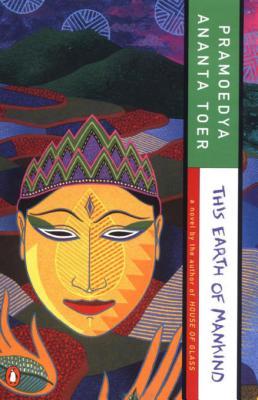
“…without a love of literature, you’ll remain just a lot of clever animals.”

—Pramoedya Ananta Toer, Bumi Manusia (This Earth of Mankind)

Bumi


© Thomas Hübner and mytwostotinki.com, 2014-5. Unauthorized use and/or 
duplication of this material without expressed and written permission from this blog’s author and/or owner is strictly prohibited. Excerpts and links may be used, provided that full and clear credit is given to Thomas Hübner and mytwostotinki.com with appropriate and specific direction to the original content.
Unforgiving Years

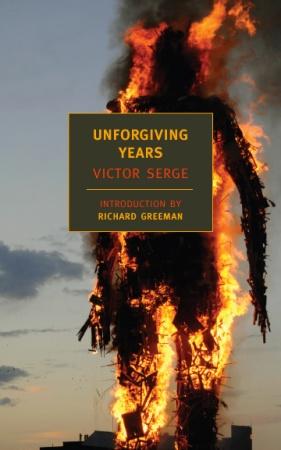
Unforgiving Years – a very suitable title for a novel that is reflecting the lives of the protagonists of Victor Serge’s posthumously published book about a group of life-long revolutionaries that have broken with the Communist Party after the show trials of the years 1936/37 in Moscow and the great purges in the Soviet Union, followed by the Ribbentrop-Molotov pact between Nazi Germany and the Soviet Union.

D – like all Comintern agents he is using several names and passports – has sent his “letter of resignation” to the service, a step that can result in any moment in retribution, i.e. assassination by one of the services loyal agents. Defectors are considered as traitors and have to be eliminated, in pre-War Paris where the novel starts like in any place of the world where Stalin’s long arm is reaching.

The novel consists of four sections, which are like large panels of a painting that shows the ideological, physical and personal devastations of these Unforgiving Years. In the first part, D is preparing his and his partner Noemi’s escape to the New World; the atmosphere is that of growing paranoia: both fear for very good reasons that a killer commando is after them and they are using all stratagems of conspiracy to stay safe. D tries to convince Daria, a close friend and fellow revolutionary whom he knows a long time (and was once in love with) to join them, but to no avail. Daria has made up her mind to go back to the Soviet Union.

In part Two, we are following Daria’s fate in the steppe of Kazakhstan and during the blockade of Leningrad. In part Three, she is on a dangerous mission behing enemy lines in a bombed-out German city during the last days of the war. These parts are full with some of the most impressive pages I have read about WWII; characters like the young officer Klim, the cripple Franz or the girl Brigitte and her fate leave a very strong impression on the reader. In the last part, Daria finally defects too and is joining D and Noemi – they have established themselves as small farmers in a remote part of Mexico – hoping that they have finally escaped the wrath of Stalin and the tentacles of his secret army of agents and killerati

It is interesting to compare Serge’s novel with a few others written by so-called renegades; authors that were not only “fellow-travelers” of communism but that participated actively as Comintern agents or in other official or secret function in the fight for the revolution (or for Stalin), and that grew more and more disappointed after the trials and the pact with the devil Nazism. Unforgiving Years, Like a Tear in the Ocean (by Manes Sperber), The Great Crusade (by Gustav Regler), Darkness at Noon (by Arthur Koestler), and I could mention also many other works by Silone, Spender, Malraux, Orwell and others – they all have a central character that turns after a long inner fight from a convinced communist and revolutionary into a renegade, a person that objects to brutal and inhumane Stalinist ideology.

Contrary to the other mentioned authors, Serge was a life-long activist and a revolutionary by birth so to say. He was born into a Russian family of emigrants in Brussels – a distant relative was the explosives expert of the anarchist group that assassinated Czar Alexander II -, got involved in the activities of an anarchist group (probably the first one to use cars as escape vehicles during their bank robberies), served some time in prison and went shortly after the October Revolution to the Soviet Union were he became a part of the so-called “Left Opposition”. The later part of his life resembles a lot that of the novel’s main character, 

Against all odds, this is also a novel of hope. D is expressing it after Daria arrives at his farm in Mexico and finds him changed and more calm, even philosophical:

“Every bit of basalt has its crown of greenery and flowers sprung from lifeless aridity. It’s a miracle of resurrection, like when the snows melt in our cold countries… For months there was nothing to see but a dried-up desert; who could guess that beneath the calcinated ground, millions of invincible seeds were concealed, ready to germinate. We observe that he true power is not that of darkness, or barrenness, but of life. All that exists cries, whispers, or sings that we must never despair, for true death does not exist.” 

For me, Unforgiving Years is first of all a novel about the conscience and responsibility of the individual. Quite in the beginning, D – who is also the narrator of this part – says something that reflects perfectly the author’s opinion of that question, I suppose. And I think it is worth it to quote it in detail:

“What is “conscience”? A residue of beliefs inculcated in us from the time of primitive taboos until today’s mass press? Psychologists have come up with an appropriate term for these imprints deep within us: the superego, they say. I have nothing left to invoke but conscience, and I don’t even know what it is. I feel an ineffectual protest surging up from a deep and unknown part of me to challenge destructive expediency, power, the whole of material reality, and in the name of what? Inner enlightenment? I’m behaving almost like a believer. I cannot do otherwise: Luther’s words. Except that the German visionary who flung his inkwell at the devil went on to add, “God help me!” What will come to help me?”

From his memoirs which I had read long ago, I knew that Serge was an interesting author. Judging from Unforgiving Years it seems that he was even a very accomplished novelist who is still to discover; the very informative preface of the translator explains us that a recent biography on Serge wants to make us believe that “writing, for Serge, was something to do only when he was unable to fight.” (Susan Weissman, The Course Is Set On Hope, Verso 2002). I find this opinion wrong and the biographer’s decision to reduce Serge to anti-Stalinist fighter and propagandist only diminishes this extraordinary novelist without reason.

In a perfect world, the works of Serge and other writers who tried to open the world’s eyes to see the ugly truth about Stalinism, would be read far more widespread – and the works of those authors who started their careers as GPU henchmen that organised the assassination of renegades and ended up as Stalin or Nobel Prize winners would be, where they belong…but, as we all know, the Pablo Neruda industry is still blooming, whereas Serge is still virtually unknown to a big part of the reading public. 

Thanks to New York Review Books, at least several of Serge’s books are available in English and we readers can do him justice: Memoirs of a Revolutionary, Midnight in the Century, Conquered City, The Case of Comrade Tulayev, and Unforgiving Years, a masterpiece that I can recommend strongly.

Unforgiving Years

Victor Serge: Unforgiving Years, translated by Richard Greeman, New York Review Books, New York 2008

 
© Thomas Hübner and mytwostotinki.com, 2014-5. Unauthorized use and/or 
duplication of this material without expressed and written permission from this blog’s author and/or owner is strictly prohibited. Excerpts and links may be used, provided that full and clear credit is given to Thomas Hübner and mytwostotinki.com with appropriate and specific direction to the original content.