Author Archives: admin

About admin

"Origin, resume - all nonsense! We all come from some small town Jüterbog or Königsberg and in some Black Forest we will all end" (Gottfried Benn) Therefore just a stenogram: Thomas Huebner, born in Germany, studied Economics, Political Science, Sociology, German literature, European Law. Consulting firm in Bulgaria. Lived in Germany, Bulgaria, Albania, Egypt, Turkey, Syria, Indonesia and Jordan. Now residing in Prishtina/Kosovo. Interested in books and all other aspects of human culture. Traveler. Main feature: intellectual curiosity

The Reckoning

Penguin’s Little Black Classics Series introduced me to number of authors I hadn’t read before; among them Edith Wharton – admittedly a rather embarrassing omission from my reading list until now. The Reckoning, a small booklet that contains apart from the story of the same name only one more piece, Wharton’s first ever published story Mrs Manstey’s View. 

Mrs Manstey’s View appeared 1891 and marked the beginning of the career of one of the most important American author’s of the first half of the 20th century, and although Wharton was later very critical regarding her early stories – most of them are not reprinted in her Collected Stories -, it is of course very interesting to get a first-hand impression of her writing before the novels that made her famous, following the publication of The House of Mirth.  

Mrs Manstey’s View is one of the most devastating portraits of lonely widowhood I have read. When the view from the window of her rented room in a boarding house to which the title is referring and which is her only joy is threatened by the construction of an extension building, the elderly Mrs Manstey, practically forgotten by her daughter who lives far away and considered as mad by her few social contacts because of her obsession about her view and her inadequate attempts to stop the construction work that will destroy this view for good, comes up with a last desperate idea to put a halt to the extension plans, an idea with catastrophic consequences…

While the language and the setting of the story are rather conventional, and while the story is too short to get a really deep inside into the character and psychology of the protagonist, this piece works nevertheless well as a short story, and although the more mature author found certain flaws in her early stories, it is already with this first work that appeared in print that the author made a mark in literary circles in 1891, the date of the first publication. 

The Reckoning, first published in 1911, shows Wharton already at the height of her powers as an author. It is considerably longer than the first story, and is also more elaborated in more than one respect. 

The story’s main character, Julia Westall, is married to her second husband Clement since ten years. Her marriage can be considered a “modern” one: in a time when divorce was – especially for a woman – a social stigma, Julia has left her first rich husband without regrets. Too socially awkward, too “impossible” was John Arment, and the friends of the Westall’s, among them the upper-class Van Sideren’s consider this, together with Julia’s obvious disinterestedness (her second husband is moving slowly upward the social ladder, but is not a really wealthy man) as something that makes an otherwise in such circles scandalous divorce acceptable. When Westall, a verbal advocate of “modern” ideas also regarding the institution of marriage, takes a serious interest in the daughter of the Van Sideren’s, Julia finds herself from one moment to the next in a situation where her orderly and seemingly happy life collapses. The surprising climax of the story sees Julia in the home of her first husband. But I will not reveal more details here…

With its six more elaborated characters, and especially with a heroine that has considerably more depth than the protagonist of the first story, The Reckoning is a really fascinating story. It is also a strong, almost brutal analysis of the power balance between men and women in the society in which Wharton was living. Once a husband decided to discard his wife, it meant for her usually that she lost everything, including her position in society (which considered women mainly as an adornment of their husbands). What is additionally tough for Julia is the fact that she doesn’t exactly understand why it happens, the marriage having been over ten years a happy one (at least by superficial standards), and her visit at her first husband is acknowledging the fact that now she knows that he also didn’t understand what happened when she left him ten years ago…

Altogether, The Reckoning is a remarkably fresh story that resonates long in the mind of the reader. 

I am glad that I started my personal Edith Wharton Reading Challenge with this teaser; now I am curious to read not only her most accomplished novels but also her Collected Stories!
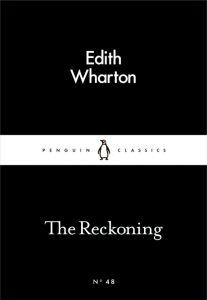
Edith Wharton: The Reckoning, Penguin Books 2015

© Thomas Hübner and mytwostotinki.com, 2014-7. Unauthorized use and/or duplication of this material without expressed and written permission from this blog’s author and/or owner is strictly prohibited. Excerpts and links may be used, provided that full and clear credit is given to Thomas Hübner and mytwostotinki.com with appropriate and specific direction to the original content.
Mytwostotinki is on Bloglovin’ too

You can follow this blog now also on Bloglovin’ – just saying…

<a href=”https://www.bloglovin.com/blog/12172529/?claim=tphwms8jbyp”>Follow my blog with Bloglovin</a>

© Thomas Hübner and mytwostotinki.com, 2014-7. Unauthorized use and/or duplication of this material without expressed and written permission from this blog’s author and/or owner is strictly prohibited. Excerpts and links may be used, provided that full and clear credit is given to Thomas Hübner and mytwostotinki.com with appropriate and specific direction to the original content.


fünf gedichte / пет стихотворения

In die Septemberausgabe der bulgarischen Literaturzeitschrift “Нова социална поезия”(Neue Soziale Poesie) wurden fünf meiner Gedichte aufgenommen, in der ausgezeichneten Übersetzung des Dichters und Literaturwissenschaftlers Vladimir Sabourin, der für diese Ausgabe auch Texte von Heiner Müller übersetzt hat. Herzlichen Dank, lieber Vladimir!

В Септемврийския брой на сп. “Нова социална поезия” има пет стихотворения от мен, в превод на Vladimir Sabourin на кого съм много благодарен за публикуването и отличния превод. 

© Thomas Hübner and mytwostotinki.com, 2014-7. Unauthorized use and/or duplication of this material without expressed and written permission from this blog’s author and/or owner is strictly prohibited. Excerpts and links may be used, provided that full and clear credit is given to Thomas Hübner and mytwostotinki.com with appropriate and specific direction to the original content.

My personal Edith Wharton reading challenge

A phenomenon with which every reader is familiar: no matter how much you read, there will be nevertheless always important books and authors that you will miss. A reader’s life is too short even for compulsive readers like me to have a complete overview regarding all important books and authors.

Despite this biological limitation, I am making an effort from time to time to fill in a few gaps; authors whose names are well-known to me and considered as important by authorities I usually trust; books that are on my personal TBR pile since a long time but which have constantly evaded my attention in the last moment. 

One such author is Edith Wharton, and since I have no less than five books by her on my shelves, I will read and review these books in the next weeks, and form my own opinion of this generally very well-reviewed author.

Have you read any of Edith Wharton’s books? Or are you willing to join this personal reading challenge of mine? If so, drop me a line here, or in the next weeks under one of my upcoming Edith Wharton blog posts. 

© Thomas Hübner and mytwostotinki.com, 2014-7. Unauthorized use and/or duplication of this material without expressed and written permission from this blog’s author and/or owner is strictly prohibited. Excerpts and links may be used, provided that full and clear credit is given to Thomas Hübner and mytwostotinki.com with appropriate and specific direction to the original content.

A new Bulgarian movie: Voevoda

Voevoda. This movie is better than Vasil Levski (the film) – but that’s not difficult, almost all movies are better than the chalga version of the Apostle’s life. Is Voevoda a good movie? No, it’s full of cliches, and visually the film is rather weak in my opinion. I doubt that I will remember a single scene after a few days. I didn’t fall asleep, as I did while watching Gasoline, the most boring Bulgarian movie I watched since a long time. So it was kind of entertaining, but it is not that you really have to see it. 2.5 out of 5 stars IMHO.

Voevoda, Bulgaria 2017, 126′, directed by Zornitsa Sophia, written by Zornitsa Sophia (based on a story by Nikolay Haytov), with Zornitsa Sophia, Valeri Yordanov, Goran Gunchev, Dimitar Trokanov, Leart Dokle, Dimitar Selenski, Yordan Bikov, Vladimir Zombori

© Thomas Hübner and mytwostotinki.com, 2014-7. Unauthorized use and/or duplication of this material without expressed and written permission from this blog’s author and/or owner is strictly prohibited. Excerpts and links may be used, provided that full and clear credit is given to Thomas Hübner and mytwostotinki.com with appropriate and specific direction to the original content.

“либерализм” vs. “либертарианство”

Фактът, че либерализм и либертарианство са две напълно различни политически понятия, все още не се разпространил в България – поне не сред политическите партии, които се наричат “либерални” …

© Thomas Hübner and mytwostotinki.com, 2014-7. Unauthorized use and/or duplication of this material without expressed and written permission from this blog’s author and/or owner is strictly prohibited. Excerpts and links may be used, provided that full and clear credit is given to Thomas Hübner and mytwostotinki.com with appropriate and specific direction to the original content.

A new Bulgarian movie: Gasoline (Бензин)

No, I will not become a customer of Bulbank, no I will not drink Spetema coffee, no I will never ever eat at McDonald’s. And no, I am not recommending the movie Gasoline (Бензин).

Benzin, Bulgaria 2017, 110′, directed by Assen Blatechki and Katerina Goranova, written by Alexey Kozhuharov, with Assen Blatechki, Snejana Makaveeva, Veselin Kalanovski, Kalin Vrachanski, Liliana Stanailova, Plamen Manassiev, Vasil Banov, Michael Madsen

© Thomas Hübner and mytwostotinki.com, 2014-7. Unauthorized use and/or duplication of this material without expressed and written permission from this blog’s author and/or owner is strictly prohibited. Excerpts and links may be used, provided that full and clear credit is given to Thomas Hübner and mytwostotinki.com with appropriate and specific direction to the original content.

Wie man in Berlin mit dem Poetik-Preisträger Eugen Gomringer umgeht

Berlin ist eine bemerkenswerte Stadt. Eine Stadt, in der man seit vielen Jahren unter Vernichtung von Milliarden an Steuermitteln vergeblich versucht, einen Flughafen zu bauen. Eine Stadt auch, in der es eine Hochschule gibt, die den Dichter Eugen Gomringer erst mit einem Poetik-Preis auszeichnet und die danach das so ausgezeichnete Gedicht von der Fassade der Hochschulfassade, wo es zu lesen war, wieder entfernen lässt, und zwar mit einer geradezu absurden, den Preisträger und sein Werk verhöhnenden Begründung.

Wenn die Leute vom Asta der Alice-Salomon-Hochschule repräsentativ für ihre Kommilitonen sind, muss man leider befürchten, dass da eine Generation verklemmter und bornierter Spiessbürger an deutschen Unis heranwächst, die sich in ihrer Dummheit und Selbstgefälligkeit nur schwer ertragen lässt. Hauptqualifikation: Unfähigkeit, verständig lesen zu können in Kombination mit pseudomoralischer Überheblichkeit. Früher hiess das “gesundes Volksempfinden”, und es war nichts anderes als die Diktatur derjenigen, die sich immer und überall beleidigt und provoziert fühlten – durch die Intelligenteren, besser Ausgebildeten, Erfolgreicheren, Schöneren, Weltgewandteren, Begabteren. 

“Nichts gibt so sehr das Gefühl der Unendlichkeit als wie Dummheit.” (Ödön von Horvath) 

© Thomas Hübner and mytwostotinki.com, 2014-7. Unauthorized use and/or duplication of this material without expressed and written permission from this blog’s author and/or owner is strictly prohibited. Excerpts and links may be used, provided that full and clear credit is given to Thomas Hübner and mytwostotinki.com with appropriate and specific direction to the original content.

An important improvement

While the quality of the coffee in most restaurants and coffee shops in Sofia is improving only very slowly according to my impression, there is a considerable improvement to be felt recently in another coffee-related issue. The quality of the късметче, those small rolled paper clips that are supposed to bring good luck and frequently contain a piece of folk wisdom or a supposedly thoughtful quote by a famous person has definitely changed to the better in a short time. Today I got “любов” (love), “здраве” (health), and “време ви е за купон” (it’s time for a party), while a few months ago chances would have been very high that I would have had quotes by authors that regularly made me spill my coffee in anger all over the place, such as Hitler, Ayn Rand, and Paulo Coelho…

© Thomas Hübner and mytwostotinki.com, 2014-7. Unauthorized use and/or duplication of this material without expressed and written permission from this blog’s author and/or owner is strictly prohibited. Excerpts and links may be used, provided that full and clear credit is given to Thomas Hübner and mytwostotinki.com with appropriate and specific direction to the original content.

The world, a village

I am having a coffee in Sofia. At the next table, three elderly ladies in animated discussion about the family of my Gorani landlord in Tirana (2004-2007), now living in Sofia.

The world has become a village.

© Thomas Hübner and mytwostotinki.com, 2014-7. Unauthorized use and/or duplication of this material without expressed and written permission from this blog’s author and/or owner is strictly prohibited. Excerpts and links may be used, provided that full and clear credit is given to Thomas Hübner and mytwostotinki.com with appropriate and specific direction to the original content.
