Category Archives: Books

Men in the Sun

That people are leaving their home countries because they want to find a better life somewhere else is a phenomenon that is probably as old as mankind itself. But to me it seems that the extent and speed of this migration has increased a lot in the 20th and 21st centuries beyond anything experienced before.

Apart from the increase of the number of migrants, there is something else that puzzles me about this development: the cynicism and application of double standards towards migrants. While those of “us” westerners who work for some time or permanently abroad (like the writer of these lines) are usually labeled “expatriates”, the words that are used to characterize someone who for good reasons is looking for work in a wealthy country of the West are “economic migrant”, “poverty migrant”, “illegal immigrant”, “asylum shopper” – and these are still the more friendly terms.

When during the existence of the Iron Curtain migration from Eastern Europe was extremely limited, and those who tried to flee were leaving their countries in very dangerous circumstances, these migrants were branded as heroes and freedom fighters who wanted to leave behind a terrible communist dictatorship; now when the same people leave their places for the same reason – an unbearable situation for themselves and their families – they are usually downgraded linguistically a lot.

And those who flee by boat via the Mediterranean to Europe, or to Australia via the Indian Ocean: they all could be saved, but better let them drown so that less of “them” cause “us” any trouble…Welcome to the world of hypocrisy! – the same world that doesn’t give a damn about the civilians and children that fall victim to the drone assassinations of the “West” and starts a discussion about the moral implications of this extra-legal killings on a large scale only in that moment when some of the victims happen by chance to be one of “us” (i.e. Christians from Western countries).

Forced migration, ethnic cleansing, the attempt to cross borders in search for a better life, and the situation of exile in general are important topics of the literature of the last decades. The story Men in the Sun by the Palestinian author Ghassan Kanafani is a classic in this respect.  

Three Palestinian men that lost their homes in Palestine during the events of 1947/48 (the Naqba, or catastrophe, as it is called by the victims) are in the center of the story. They lead a rather miserable life without any perspective in the huge refugee camps in Jordan, Iraq and other Arab countries. (As an aside: also the Arab countries apply double standards; while “the Palestinians” are usually considered the victims of Zionism/Imperialism, most of the real Palestinians are less welcome by these countries and still live in refugee camps, decades after their eviction. Only Jordan granted the majority of them citizen rights.)

Kuwait, in the early 1960s developing its oil industry, was in this moment for many of these men a kind of Promised Land. Once you made it there (illegally), you had – with a little bit of luck, connections and backshish – a chance to get an employment based on a temporary contract. A unique opportunity to support your beloved one’s in the refugee camps, pay for a decent education for your siblings, or prepare to get married.

Basra in Iraq was at that time the place from which many small groups left to make their way past the border guards through the desert. Smuggling refugees was (and is) a very profitable business, and so we witness our three main characters looking for an affordable and reliable guide.

Kanafani made a very good decision to introduce each of the three men, their background and their way of thinking, their different character and outlook on life in a separate chapter.

There is Abu Quais, the oldest of the group. A farmer by profession, who is missing his olive trees in Palestine and who hopes to make enough money in Kuwait to be able to buy saplings for a new olive grove somewhere. In his fatalistic, a bit stubborn way he seems very characteristic for the Palestinian peasant, or the peasant in general.

Then there is young Marwan, who stands up to the financial demands of a particular unpleasant businessmen who insists on a high advance payment and no guarantee for success for the undertaking. Marwan quickly emerges as the unofficial leader of the small group, and we can almost be sure that with his energy and optimism, he can be very successful in Kuwait – if he gets there at all of course. 

And then there is the good-hearted, naive Assad. After his brother stopped to send money from Kuwait (he got married and supports his own small family now), he had to stop his studies and tries to get now also to Kuwait.

And there is of course the guide, Abul Khiazuran, who promises to smuggle them in the water tank of his truck through the border checkpoints. If only it wouldn’t be so terribly hot in the empty water tank – but it will be ok, if they don’t have to wait very long at the checkpoints. Otherwise…

For the reader it is not a surprise that this journey ends in a disaster. When the driver pulls out the bodies of the three men after the border crossing, he – like the reader – is asking himself a startling question:

“The thought slipped from his mind and ran onto his tongue: “Why didn’t they knock on the sides of the tank?” He turned right round once, but he was afraid he would fall, so he climbed into his seat and leaned his head on the wheel. “Why didn’t you knock on the sides of the tank? Why didn’t you say anything? Why? – The desert suddenly began to send back the echo: “Why didn’t you knock on the sides of the tank? Why didn’t you knock on the sides of the tank? Why? Why? Why?”

What struck me also about this story was the deep symbolism of the fact that the bodies are deposed at a garbage dump; this is how much a refugee’s life is worth. And also the fact that the driver lost his manhood literally as a result of his fight with the Israelis, and is now interested in only one thing: money is of course also charged with a symbolic meaning.

One more thing: there are no antisemitic slurs in any of Kanafani’s stories of this collection of stories. Sure, the Jews/Israelis are the enemies of these people; those who are responsible for the loss of their homes, their miserable lives in the refugee camps, and the loss of many lives too. But the enemy is not a demon, just someone who took away the land and existence of people who have lived in Palestine for hundreds of years.

The other stories in this collection are also very good; I was particular impressed by The Land of Sad Oranges, a short story about a family who is forced to flee their home and escape to Lebanon. The few oranges that they can take with them make them cry; a memory of what they lost and will probably never see again.

Ghassan Kanafani (born 1936) was one of the most talented Arabic prose writers. Born in Palestine, he had to leave his home at the age of 12 and shared many experiences of the people in his stories. He became also a political activist and joined the Popular Front for the Liberation of Palestine of George Habash. Fortunately, his work is not that of a political propagandist; it shows the suffering of the people of Palestine, and asks for empathy from its readers, not for agreement with a political program.

Kanafani was killed by a car-bomb explosion in 1972 in Beirut, together with his niece. Nowadays the assassination would have been executed by a drone. I suppose some people may call that “progress”.

Kanafani

Ghassan Kanafani, Men in the Sun and Other Palestinian Stories, translated by Hilary Kilpatrick, Lynne Rienner Publishers, Boulder 1998

© Thomas Hübner and mytwostotinki.com, 2014-5. Unauthorized use and/or 
duplication of this material without expressed and written permission from this blog’s author and/or owner is strictly prohibited. Excerpts and links may be used, provided that full and clear credit is given to Thomas Hübner and mytwostotinki.com with appropriate and specific direction to the original content.
Food for thought

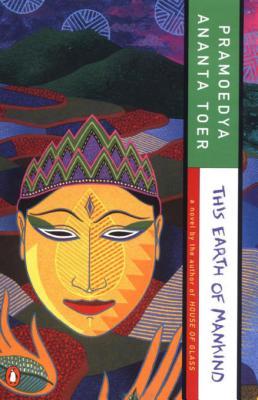
“…without a love of literature, you’ll remain just a lot of clever animals.”

—Pramoedya Ananta Toer, Bumi Manusia (This Earth of Mankind)

Bumi


© Thomas Hübner and mytwostotinki.com, 2014-5. Unauthorized use and/or 
duplication of this material without expressed and written permission from this blog’s author and/or owner is strictly prohibited. Excerpts and links may be used, provided that full and clear credit is given to Thomas Hübner and mytwostotinki.com with appropriate and specific direction to the original content.
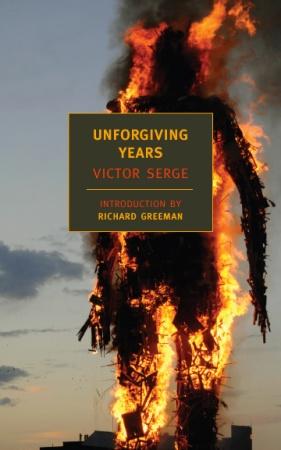
Unforgiving Years

Unforgiving Years – a very suitable title for a novel that is reflecting the lives of the protagonists of Victor Serge’s posthumously published book about a group of life-long revolutionaries that have broken with the Communist Party after the show trials of the years 1936/37 in Moscow and the great purges in the Soviet Union, followed by the Ribbentrop-Molotov pact between Nazi Germany and the Soviet Union.

D – like all Comintern agents he is using several names and passports – has sent his “letter of resignation” to the service, a step that can result in any moment in retribution, i.e. assassination by one of the services loyal agents. Defectors are considered as traitors and have to be eliminated, in pre-War Paris where the novel starts like in any place of the world where Stalin’s long arm is reaching.

The novel consists of four sections, which are like large panels of a painting that shows the ideological, physical and personal devastations of these Unforgiving Years. In the first part, D is preparing his and his partner Noemi’s escape to the New World; the atmosphere is that of growing paranoia: both fear for very good reasons that a killer commando is after them and they are using all stratagems of conspiracy to stay safe. D tries to convince Daria, a close friend and fellow revolutionary whom he knows a long time (and was once in love with) to join them, but to no avail. Daria has made up her mind to go back to the Soviet Union.

In part Two, we are following Daria’s fate in the steppe of Kazakhstan and during the blockade of Leningrad. In part Three, she is on a dangerous mission behing enemy lines in a bombed-out German city during the last days of the war. These parts are full with some of the most impressive pages I have read about WWII; characters like the young officer Klim, the cripple Franz or the girl Brigitte and her fate leave a very strong impression on the reader. In the last part, Daria finally defects too and is joining D and Noemi – they have established themselves as small farmers in a remote part of Mexico – hoping that they have finally escaped the wrath of Stalin and the tentacles of his secret army of agents and killerati

It is interesting to compare Serge’s novel with a few others written by so-called renegades; authors that were not only “fellow-travelers” of communism but that participated actively as Comintern agents or in other official or secret function in the fight for the revolution (or for Stalin), and that grew more and more disappointed after the trials and the pact with the devil Nazism. Unforgiving Years, Like a Tear in the Ocean (by Manes Sperber), The Great Crusade (by Gustav Regler), Darkness at Noon (by Arthur Koestler), and I could mention also many other works by Silone, Spender, Malraux, Orwell and others – they all have a central character that turns after a long inner fight from a convinced communist and revolutionary into a renegade, a person that objects to brutal and inhumane Stalinist ideology.

Contrary to the other mentioned authors, Serge was a life-long activist and a revolutionary by birth so to say. He was born into a Russian family of emigrants in Brussels – a distant relative was the explosives expert of the anarchist group that assassinated Czar Alexander II -, got involved in the activities of an anarchist group (probably the first one to use cars as escape vehicles during their bank robberies), served some time in prison and went shortly after the October Revolution to the Soviet Union were he became a part of the so-called “Left Opposition”. The later part of his life resembles a lot that of the novel’s main character, 

Against all odds, this is also a novel of hope. D is expressing it after Daria arrives at his farm in Mexico and finds him changed and more calm, even philosophical:

“Every bit of basalt has its crown of greenery and flowers sprung from lifeless aridity. It’s a miracle of resurrection, like when the snows melt in our cold countries… For months there was nothing to see but a dried-up desert; who could guess that beneath the calcinated ground, millions of invincible seeds were concealed, ready to germinate. We observe that he true power is not that of darkness, or barrenness, but of life. All that exists cries, whispers, or sings that we must never despair, for true death does not exist.” 

For me, Unforgiving Years is first of all a novel about the conscience and responsibility of the individual. Quite in the beginning, D – who is also the narrator of this part – says something that reflects perfectly the author’s opinion of that question, I suppose. And I think it is worth it to quote it in detail:

“What is “conscience”? A residue of beliefs inculcated in us from the time of primitive taboos until today’s mass press? Psychologists have come up with an appropriate term for these imprints deep within us: the superego, they say. I have nothing left to invoke but conscience, and I don’t even know what it is. I feel an ineffectual protest surging up from a deep and unknown part of me to challenge destructive expediency, power, the whole of material reality, and in the name of what? Inner enlightenment? I’m behaving almost like a believer. I cannot do otherwise: Luther’s words. Except that the German visionary who flung his inkwell at the devil went on to add, “God help me!” What will come to help me?”

From his memoirs which I had read long ago, I knew that Serge was an interesting author. Judging from Unforgiving Years it seems that he was even a very accomplished novelist who is still to discover; the very informative preface of the translator explains us that a recent biography on Serge wants to make us believe that “writing, for Serge, was something to do only when he was unable to fight.” (Susan Weissman, The Course Is Set On Hope, Verso 2002). I find this opinion wrong and the biographer’s decision to reduce Serge to anti-Stalinist fighter and propagandist only diminishes this extraordinary novelist without reason.

In a perfect world, the works of Serge and other writers who tried to open the world’s eyes to see the ugly truth about Stalinism, would be read far more widespread – and the works of those authors who started their careers as GPU henchmen that organised the assassination of renegades and ended up as Stalin or Nobel Prize winners would be, where they belong…but, as we all know, the Pablo Neruda industry is still blooming, whereas Serge is still virtually unknown to a big part of the reading public. 

Thanks to New York Review Books, at least several of Serge’s books are available in English and we readers can do him justice: Memoirs of a Revolutionary, Midnight in the Century, Conquered City, The Case of Comrade Tulayev, and Unforgiving Years, a masterpiece that I can recommend strongly.

Unforgiving Years

Victor Serge: Unforgiving Years, translated by Richard Greeman, New York Review Books, New York 2008

 
© Thomas Hübner and mytwostotinki.com, 2014-5. Unauthorized use and/or 
duplication of this material without expressed and written permission from this blog’s author and/or owner is strictly prohibited. Excerpts and links may be used, provided that full and clear credit is given to Thomas Hübner and mytwostotinki.com with appropriate and specific direction to the original content.
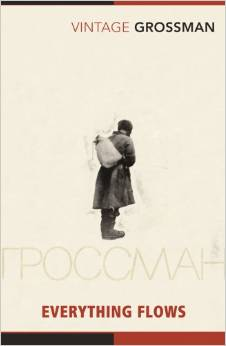
Everything Flows

Ivan Grigoryevich has just been released after 30 years in the GULag. He is set free after Stalin’s death – if one can call it “freedom” what a former political prisoner experiences in a just slightly changed country that is still run by the basically same dictatorial regime and totalitarian ideology. Ivan Grigoryevich comes back to a life that is physically and morally still devastated by war and terror.

The brilliant novel Everything Flows by Vasily Grossman, based on the fate of Grossman’s brother-in-law, describes the destroyed, almost extinguished life of a man that – like many millions of others – fell victim to the great purges of the 1930s in the Soviet Union, after his release from a slave labor camp in the Kolyma region in the Far North East of Siberia.

We follow Ivan during his train ride to Moscow, listening to the conversations of some typical representatives of the “new” society, a society which is alien and repelling for Ivan.

We meet his cousin with wife, his only relative, who – although not a bad person – made many compromises and committed small acts of treachery in the past in order to make the career he (and his ambitious wife) felt he was entitled to have.

We meet the person who decades ago denounced Ivan (which meant death or long term imprisonment as a slave worker in the GULag; in the case of a death sentence, the families were usually informed that the convicted was being sentenced to “ten years without right of correspondence”).

We see Ivan in front of the house where his big love is living, a woman that long ago stopped to send letters to the prisoner, either because she thought that Ivan is dead or because she simply moved on with her life.

Ivan feels that all these people have got nothing to do with him anymore. But how to live and for what purpose? And how to make sense of this wasted life since the decades that are missing will not come back?

With a little bit of luck, Ivan finds a job in a workshop where he is accepted despite his past. (By the way a bit similar to the workshop in Kharkov in which my father used to work for many years during the Stalin era.)

And he finds against all odds love: he meets the widow Anna and experiences for the first time in his life a form of warmth and tenderness that was unknown to him. But Ivan’s and Anna’s happiness lasts only for a short while…As Anna puts it:

“Happiness doesn’t seem to be our fate in this world.”

Everything flows is an extremely touching novel. It contains many scences that leave their mark on the reader for a very long time.

There is for example the scene when Anna describes how she as a young party activist participated in the so-called “dekulakisation”, i.e. the forced expulsion of the so-called kulaks (usually small landowners) to remote and uninhabited areas, which meant for hundreds of thousands of them death by starvation.

Or the few pages that describe the fate of a gentle, meek, family of Ukrainian farmers in the early 1930s, who – like their whole village and thousands of villages in the Ukraine – became a victim of the so-called Holodomor, the probably biggest man-made killing by starvation in history. (The grain, including the seeds, that the OGPU, Stalin’s ruthless secret police extorted from the farmers was exported – with the money, Stalin bought machinery that should help to modernize the Soviet Union fast. At the same time 5-8 millions of potential “enemies” of the system “disappeared” by starvation and cannibalism.)

The novel contains also a mock trial that sheds a light on the absurdity of the great purge which sent dozens of millions of people to the camps; and chapters that try to explain the nature of the Soviet system by the character of its leaders, especially Lenin. An interesting thought is Grossman’s explanation that progress and slavery in Russia were always combined: periods of great progress (like under Peter the Great or Katharina) were always periods where individual freedom was even more reduced than before – a model which also Stalin seemed to have in mind when he made himself a “Red” Czar that was aiming to exterminate freedom completely in his empire.

Stylistically and regarding its composition the novel is slightly uneven. Grossman was still working on the book when he died, so what we have as readers is not the version that Grossman would have considered as ready for publishing. Anyway, it was obvious that he couldn’t have published this book during his lifetime. Too open is his criticism not only against Stalinism but against the roots of the Soviet system as a whole. Still, despite this unevenness, it is a great and extremely impressive achievement.

Grossman is not condemning anyone that denounced his neighbor, or who was a political activist that participated in what he or she later recognized as monstrous crimes, or who in order to protect his/her own family stopped social contacts with the family members of someone that was arrested. He is particularly sympathetic with the women who became a victim of Stalinism; their fate was frequently even worse than that of the men. He tries to understand why it all happened.

Many Russian authors have written about the GULag (and about its Czarist predecessors in the 19th century). In the West, mainly the books of Alexander Solzhenitsyn about the GULag are known and read; A Day in the Life of Ivan Denisovich is a great story, but unfortunately Solzhenitsyn’s other works are too frequently marred by his reactionary, anti-semitic prejudices and rhetoric.

To me, the beautiful novels of Vasily Grossman and the breathtaking stories of Varlam Shalamov about the GULag, are far more important and worth reading.

Grossman


Vasily Grossman: Everything Flows, translated by Robert and Elizabeth Chandler, with Anna Aslanyan, Vintage, London 2011

© Thomas Hübner and mytwostotinki.com, 2014-5. Unauthorized use and/or 
duplication of this material without expressed and written permission from this blog’s author and/or owner is strictly prohibited. Excerpts and links may be used, provided that full and clear credit is given to Thomas Hübner and mytwostotinki.com with appropriate and specific direction to the original content.

The Tale of the Cross-Eyed Left-Handed Gunsmith from Tula and the Steel Flea

The 19th century was an extraordinarily rich period for Russian literature. Among the numerous gifted and productive authors of that period is at least one that – according to my impression – is not valued and read outside Russia as much as he would deserve it: Nikolay Leskov.

His probably best work The Steel Flea (full title: The Tale of the Cross-Eyed Left-Handed Gunsmith from Tula and the Steel Flea) contains on about 50 pages everything that makes this author so interesting in a nutshell, such as: a folk-like story about an unsung Russian everyday-life hero of the past; a narrative spiced with mild irony; a playful voice that uses many neologisms that are so up to the point that many of them achieved proverbial status and found their way into everyday communication of many Russians; a not condescending sympathy of the author/narrator with the “ordinary people”.

What is it about: Czar Alexander I (we are in the 1820s, more than half a century before Leskov wrote the story) is visiting England, then the technically most developed country; he is accompanied by Platov, a Cossack ataman, who represents the ordinary Russian that is proud and less easy to impress than the Czar by the display of technical superiority with which the English hosts shower their Royal guest. While the Czar views everything he sees as a sign of the hopeless inferiority and backwardness of his country, Platov makes it clear to the Czar that he thinks otherwise (ironically his opinion is confirmed in one instance much to the embarrassment of the hosts.)

As a gift, the Czar receives a tiny steel flea that can even perform a dance when properly wound up. How this complicated and perfectly crafted mechanism that can be seen properly under a strong microscope only is constructed is not revealed and leaves the Czar wondering how such a miracle of engineering was possible.

After the coronation of Alexander’s brother Nikolay a few years later, the steel flea becomes a political issue. Platov, in the meantime retired, is re-activated to service in order to investigate if somewhere in Russia craftsmen can do something that even “tops” the English feat of the dancing steel insect. Platov finds in Tula a left-handed and cross-eyed craftsman who, together with several of his colleagues indeed “improves” the English invention. (You have to read by yourself how.)

In the end, the Russians have a field day to see the impressed English who cannot believe their eyes when a Russian delegation with Lefty is visiting the island. So impressed are they this time that they try to lure the nameless Lefty to stay in England; but to no avail: the man from Tula is homesick and returns to Russia, where he dies soon after his arrival as a consequence of a drinking contest with a sailor. The last important message he has and that could have change the fate of Russia is not delivered.

In the end, Leskov tells his readers:

Lefty’s real name, like the names of many of the greatest geniuses, has been lost to posterity forever; but he is interesting as the embodiment of a myth in the popular imagination, and his adventures can serve to remind us of an epoch whose general spirit has been portrayed here clearly and accurately.

It goes without saying that Tula no longer has such master craftsmen as the legendary Lefty: machines have evened up the inequalities in gifts and talents, and genius no longer strains itself in a struggle against diligence and exactness. Even though they encourage the raising of salaries, machines do not encourage artistic, daring, which sometimes went so far beyond ordinary bounds as to inspire the folk imagination to create unbelievable legends like this one.  

One of the things I like particularly are Leskov’s neologisms that are translated quite ingeniously in the edition I had at hand. For example: the steel flea and its dance can be seen properly only when viewed under a strong microscope, or nitroscope – as the narrator says (it seems Leskov was the Godfather of nanotechnology); and when the steel flea is dancing, he is doing it in various fairiations.

Another thing I found amusing was the fact that the steel flea, a childish toy after all, becomes a state affair and the main object of national pride of two European leaders and their nations they represent; on a more serious note: how much better seem these old times to be where a Russian leader paid attention to the shoe strings of a tiny steel flea – especially considering most of the Russian leaders that came later… – !

Leskov had a difficult time as a writer in his days. The progressives viewed him as a conservative, the conservatives suspected him to be a leftist; the Slavophiles considered him as a propagandist of Western modernism, and the Westerners saw in him a romantic that was spreading nostalghia for Russia’s backwardness. A writer whose work is still so fresh and who was caught between so many stools is definitely worth it to be read again.

My edition was the one from Penguin’s “Little Black Classics”. This series contains many (re-)discoveries; the small format and limited number of pages make it (together with the very attractive price) the perfect companion for the daily commuting routine or on other occasions. When you carry (like me) always at least one book with you to use every opportunity for reading, this is an excellent series for you.

Leskov

Nikolay Leskov: The Steel Flea, translated by William Edgerton, London 2015

© Thomas Hübner and mytwostotinki.com, 2014-5. Unauthorized use and/or 
duplication of this material without expressed and written permission from this blog’s author and/or owner is strictly prohibited. Excerpts and links may be used, provided that full and clear credit is given to Thomas Hübner and mytwostotinki.com with appropriate and specific direction to the original content. 
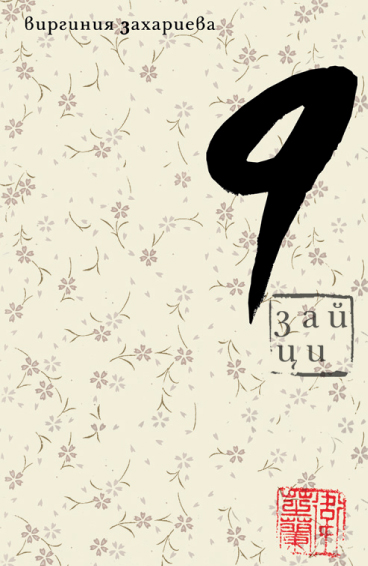
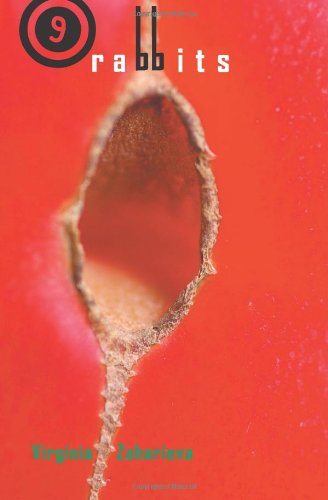
Nine Rabbits

The first part of Virginia Zaharieva’s autobiographical novel Nine Rabbits consists of childhood memories of the narrator. Manda, as everyone calls her, grows up in Nesebar in socialist Bulgaria in a house at the Black Sea coast. The men in the big family are mostly or completely absent. Boris, the Grandfather, a good-natured and friendly man works most of its life abroad and comes home only during holidays for a few weeks. Even later when he gets older and is back in Bulgaria, he avoids to spend too much time at home – he doesn’t get along well with his wife, Nikula. Manda’s parents are divorced and her father lives hundreds of kilometers away in Sofia; also Manda’s mother who works far away is most of the time not at home.

The big family is governed by Grandmother Nikula with a hard hand. Not only is she beating Manda frequently, she is even able to torture her for no apparent reason with needles. Only when she is cooking or baking she seems to become a different person who is more human and less rigid – maybe that’s why Manda loves cooking so much; cooking seems to give her life (and also the novel) a structure even when things are getting otherwise messy and difficult to handle. Manda’s favorite receipes are printed in the book and additionally collected in a small booklet that comes with the novel – the dishes are comparatively easy to prepare and I suppose very delicious. 

Beside her mother, who tries to protect her when she is at home, and a few childhood friends, Manda finds support and consolation at a nun’s monastery nearby. The nuns care for Manda’s (physical and psychological) wounds after Grandma has exercised again one of her cruel needle tortures; as a result Grandmother, who is an old activist of the Communist Party gets the monastery closed by the authorities and the nuns dispersed all over the country.

Politics cast a long shadow over this part of the novel – Prague 1968 is anxiously witnessed via the radio transmissions by the summer guests from Czechoslovakia; we read about Manda’s innocent friendship with a boy from the neighborhood; and finally her fate takes a turn to the better: her mother remarries and moves together with Manda to Sofia; later we learn of Grandfather’s and Grandmother’s death – they were divorced in old age.

The second part of the novel sets in decades later. Manda is now a 46-year old writer and therapist in Sofia. She has a son who is in the process to leave the house; a divorced husband (she was married for 13 years); a lover that is sixteen years younger than her; and she is in a serious crisis: writers block, panic attacks, the feeling that something has gone terribly wrong with her life.

While the first part of the novel is very much centered around the house in Nesebar where Manda spent a big part of her childhood, the second part involves changing places quite a lot.

We see Manda in Corfu; traveling with other writers through Europe by train; we see her having another panic attack in Moscow; her life in idyllic Kovachevitsa; her travel to Osaka; her yoga and other esoteric experiences with various groups that search for an alternative life style; we witness her at a performance of a writer colleague (Toma Markov) who reads her poems in a woman’s dress while Manda is serving huge amounts of tomato soup to the audience (“Don’t forget to bring your spoon!” was written on the invitation to the event); sometimes the second part of the novel gets a bit messy – just as the protagonist’s life. But, without wanting to reveal too much, it all ends well for Manda.

This is a book full of energy; the protagonist struggles to getting over the unhappy childhood of hers and the fact that the men in her life were always disappearing or withdrawing themselves; and although fate seems to repeat itself again (her lover Christos becomes more distant by accepting more jobs as an actor that keep him away from Manda over longer periods; and also her beloved son is leaving home), Manda finally seems to accept herself and reinvents herself as a strong, independent woman.

This is also a feminist book, a book that shows the failure of many men to really attach themselves to their wives and families. But it is definitely not the book of a man-hater, but of a rather compassionate person.

There are also plenty of weird, unforgettable moments in the book; a sense for the absurd; and a real wit and humor on many pages. Zaharieva has something to tell us and she has all the technical means at her command to tell her story in an interesting, intelligent, even enticing way. I enjoyed this book therefore very much and can only recommend it to everyone who loves a good novel. As Dubravka Ugrešić puts it:

“What makes this book exceptionally pleasant is Zaharieva’s vitality, her guiltless hunger for life, for every bit of it. It’s a happy book about a happy personal life.”

I read the English edition by Istros Books but compared it also with the original edition. The translation by Angela Rodel is excellent; unfortunately the English version frequently is alluding to the 1840s or 1850s, when in the original version it is referred to the Forties and Fifties (of the 20th century that is); that mistake is quite confusing especially for readers that are not very familiar with Eastern European history. 

It is a real pity that all but one of the author’s Chinese calligraphies have disappeared from the English version; I also much preferred the cover of the Bulgarian version to the cover of the Istros edition; my copy contained also an additional (double) set of pages. I don’t want to sound petty, but I pay attention to such small details and it would be great if they could be changed in future editions. –

But these are very small criticisms. Istros is a great, courageous publisher with an excellent program. And English-speaking readers can be grateful that thanks to publishers like Istros, true gems like this one (and many others) are available to them.    

Zaharieva BG Zaharieva

Virginia Zaharieva: Nine Rabbits, translated by Angela Rodel, Istros Books, London 2012 (each copy includes the booklet 29 receipes, by Virginia Zaharieva) 

This review is part of Stu’s (Winstonsdad’s Blog) Eastern European Lit month: https://winstonsdad.wordpress.com/2015/03/02/welcome-to-eastern-european-lit-month/

 
© Thomas Hübner and mytwostotinki.com, 2014-5. Unauthorized use and/or 
duplication of this material without expressed and written permission from this blog’s author and/or owner is strictly prohibited. Excerpts and links may be used, provided that full and clear credit is given to Thomas Hübner and mytwostotinki.com with appropriate and specific direction to the original content. 
L1, L2, indirect – and a few more words on translations

When I have some free time, I love to browse blog posts of my fellow book bloggers. It is always interesting to see what the colleagues and friends are doing, which books I missed but should read soon, what they think about books I reviewed recently – and sometimes what they are thinking about other book-related topics.

As I have said several times before, I am much more aware now of the fact that translations matter and are extremely important. Even when you can speak and read five or six languages it will still widen your horizon beyond imagination when you have access to translated books. The availability and also the quality of translations are therefore two of the most important defining elements of an existing book market.

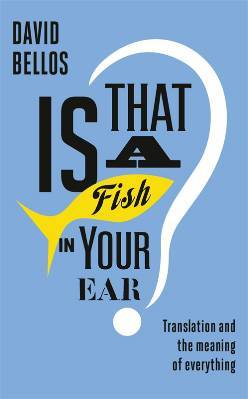
In an older blog post which I have just recently discovered, one of my favorite blogger colleagues, Caroline from Beauty is a Sleeping Cat, was writing about an interesting book by David Bellos, Is That a Fish in Your Ear? – Translation and the Meaning of Everything. Among other authors Bellos has translated the Albanian author Ismail Kadare into English – from the French, not the Albanian language. This is called “indirect translation”, contrary to the direct translation from the source to the target language. Depending on the question if the translator translates into his or her native language, or from his native language into the target language, direct translations are differentiated into so-called “L1” or “L2” translations. Many experts view L2 translations with scepticism or reject them completely, while some consider indirect translations as acceptable when there are no translators available for this particular combination of languages.

I think what counts at the end of the day is the quality of the translation, no matter if it is L1, L2, or indirect. Of course, chances that the translation is excellent are much higher with direct translations. When writers are sometimes using a language that is not their native one, why shouldn’t some translators be able to do the same? (Since Nabokov grew up bilingual, I wouldn’t include him in this list of writers, but there are plenty of them and not the worst) –

An indirect translation might be a kind of second-best solution in cases when there are really no translators available for this particular combination. For Kadare it shouldn’t be a problem to be translated directly into English, since there is not one, but plenty of literary translators for that combination.

But Kadare is a special case: he revised and rewrote all his books that were originally published in the time of communism in Albania when he prepared them for publication in France. That means that a translation of the same book from French to English contains a sometimes very different text than when you would make a direct translation from the Albanian version. And for the novels originally published before 1990 Kadare considers the French and not the Albanian version as the “real”, uncensored text. The revised editions of the pre-1990 novels of Kadare in Albanian language were published after the French versions, if I am not mistaken. For the past-1990 novels, the situation is different: as far as I see they are translated directly from Albanian to English because there is no need for a text revision.

There are also other authors we know mainly from indirect translations. The works of Israel Bashevis Singer are usually translated from English – there are even a lot of people that think Singer was an English-language author. Especially in the case of the translations of Singer to German that is a real pity: Yiddish is so close to German, so why not translate the books directly? (The result would be a very different text, much more close to the original, as I can say from practical experience when I made a sample translation of one of his stories once from the original text to German, comparing the result with the “official” translation from English)

Why do publishers choose to publish indirect translations instead of direct ones? One reason may indeed be a shortage of available translators for the respective combination – although this case may be much rarer as some publishers make us believe. But the problem exists: when I investigated for the possibilities to translate a book from Indonesian to Bulgarian, I realized that there is only one person who can do the job – now imagine if he would be not available for some reason: the only option remaining would be to work with an indirect translation. Otherwise the book would be never available for the potential readers whose native language is Bulgarian and who don’t read in other languages. Although an indirect translation might not be perfect, in the best case it could be a reasonable approximation of the original text. And that would be still far superior then the virtual non-existence of a book in that particular language.

Another reason for indirect translations may be that in some cases publishers can save money – it is cheaper to translate from languages where you can find plenty of competing translators than from languages where there are only a very few translators, or where possibly the translation rights might be cheaper to acquire (depending on the contractual relationships between the involved publishers, the author and the literary agency).

Also literary agents can play a role in this process. Agents try to increase the income of their clients (and by that their own income), so they try to redistribute money from other stages of the book value chain – mainly the publishing houses, but obviously to a growing extent also from translators – into the pockets of their writing clientele, by auctioning off book and translation rights, increasing the royalties for the author, etc., and by that forcing everybody else in the book value chain to decrease their income. There is nothing wrong with this in principle, as long as professional and ethical standards are respected, which is not always the case.

A particular vicious example is a recent case in which Egyptian bestselling author Alaa al Aswany and his agent Andrew Wiley (together with Knopf Doubleday publishers) are involved and that was made public by the Threepercent website of the University of Rochester.

A completely unacceptable treatment of a literary translator – and hard to believe but obviously true: a world famous author, the Godfather of all literary agents and a renowned publishing house use their combined power and leverage to cheat on a hard working professional, for reasons that are as it seems of exclusively pecuniary nature.

By the way, I find it very interesting to see the approach of different writers to the question of translations of their works. While some authors take a great interest and discuss details of the translations with their translators, or even organize like Günter Grass (on their own costs) workshops for their translators to ensure a high quality of the translations, others like Thomas Bernhard show the extreme opposite approach. From an interview with Werner Wögerbauer, conducted 1986 in Vienna:

“W.: Does the fate of your books interest you?

B.: No, not really.

W.: What about translations for example?

B.: I’m hardly interested in my own fate, and certainly not in that of my books. Translations? What do you mean?

W.: What happens to your books in other countries.

B.: Doesn’t interest me at all, because a translation is a different book. It has nothing to do with the original at all. It’s a book by the person who translated it. I write in the German language. You get sent a copy of these books and either you like them or you don’t. If they have awful covers then they’re just annoying. And you flip through and that’s it. It has nothing in common with your own work, apart from the weirdly different title. Right? Because translation is impossible. A piece of music is played the same the world over, using the written notes, but a book would always have to be played in German, in my case. With my orchestra!”

And for those of you who are familiar with Georges-Arthur Goldschmidt’s books with the untranslatable titles Quand Freud voit la mer and Quand Freud attend le verbe, it may be not surprising that I am very sympathetic to Bernhard’s opinion. A translation is indeed always a different book, and sometimes – as is the case with the terms created by Freud in the framework of psychoanalysis, the meaning and specific connotation of central words and expressions are so inseparably linked to the particular language in which they were created (in the case of psychoanalysis: German) that each translation is already an interpretation, over-simplification, reduction of ambiguity, and even falsification of the original text. – But I guess I am digressing a bit. The highly interesting books by Goldschmidt would deserve a more detailed review as is possible here.

Translations are a wide field – I have the feeling that I will return to the issue again sooner or later.

Bellos

David Bellos: Is That a Fish in Your Ear? – Translation and the Meaning of Everything, Particular Books, 2012

Georges-Arthur Goldschmidt: Quand Freud attend le verbe, Buchet Chastel, 2006

Georges-Arthur Goldschmidt: Quand Freud voit la mer, Buchet Castel, 2006

Chad W. Post: A Cautionary Tale

Chad W. Post: The Three Percent Problem, Open Letter, e-book, 2011

The interview with Thomas Bernhard was originally published in the autumn issue 2006 of Kultur & Gespenster, the English translation by Nicholas Grindell was published here.

© Thomas Hübner and mytwostotinki.com, 2014-5. Unauthorized use and/or 
duplication of this material without expressed and written permission from this blog’s author and/or owner is strictly prohibited. Excerpts and links may be used, provided that full and clear credit is given to Thomas Hübner and mytwostotinki.com with appropriate and specific direction to the original content. 
“I’m not a sarin victim, I’m a survivor”

“The date is Monday 20 March, 1995. It is a beautiful clear spring morning. There is still a brisk breeze and people are bundled up in coats. Yesterday was Sunday, tomorrow is the Spring Equinox, a national holiday. Sandwiched right in the middle of what should have been a long weekend, you’re probably thinking “I wish I didn’t have to go to work today.” No such luck. You got up at the normal time, wash, dress, breakfast, and head for the subway station. You board the train, crowded as usual. Nothing out of the ordinary. It promises to be a perfectly run-of-the-mill day. Until five men in disguise poke at the floor of the carriage with the sharpened tips of their umbrellas, puncturing some plastic bags with a strange liquid…”

1995 was a particularly bad year for Japan: the economic bubble had just burst and the country suffered two major catastrophes – the Kobe earthquake and the sarin attack by the Aum Shinrikyo sect on the Tokyo subway system. Although the poison gas attack killed “only” 13 people, it affected thousands of commuters directly – many suffer from the health effects of sarin exposure until today -, and millions indirectly. Post-traumatic stress disorder is not just a medical expression, it is a condition that affects almost all aspects of life.

And that the perpetrators of the crime, a crime with no apparent reason, came from the center of the Japanese society was particularly shocking. The five men that released the sarin had high academic credentials, one of them was a famous surgeon.

The novelist Haruki Murakami just came back from abroad after a long absence when the sarin attack happened. Not only didn’t he, like more or less the whole world, understand how it was possible that something like this vicious attack could happen. He was also shocked by the “secondary” victimization many survivors had to face frequently by Japanese society, a lack of empathy and understanding from the side of many employers and colleagues, the icy atmosphere and the snide remarks many survivors had to hear when they were not able to perform their usual working routine as a result of the after-effects of the sarin poisoning.

Murakami finally decided to try to give the victims a voice and to interview them in the style of the famous interview books by Studs Terkel. It was difficult to convince many victims to speak out, to recall their memories and feelings. But as a reader I feel glad for Murakami’s persistence and the obvious great respect he has for the people he interviewed.

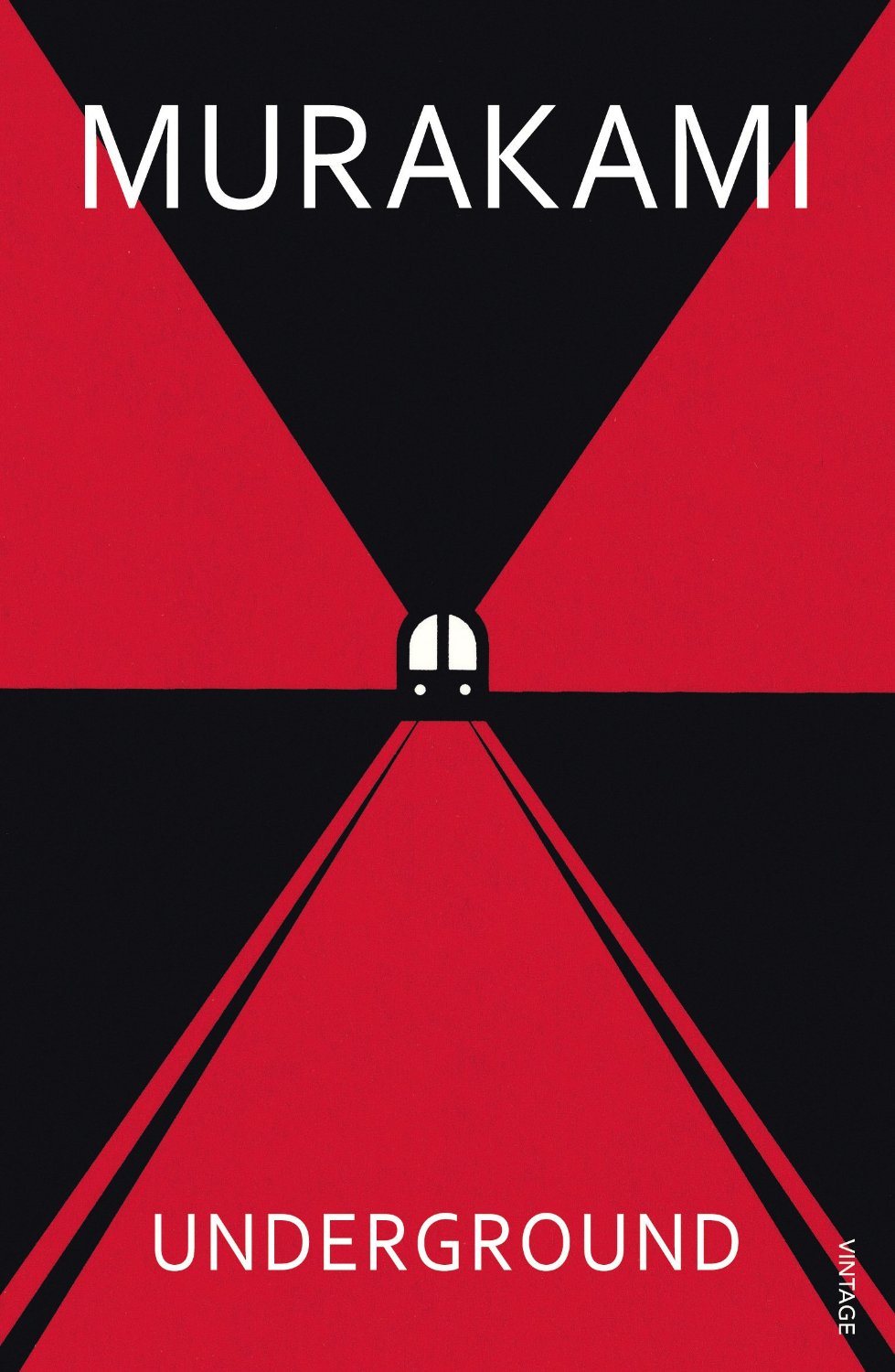
The book Underground contains 34 interviews mostly with subway commuters, but also with station attendants, a subway driver, two doctors and several relatives of victims. A short characterization of the person by Murakami and some remarks regarding the circumstances in which the interview was taken give each interview a similar structure. The survivors tell their story: their background, the commuting routine to work, what happened on that fateful morning and what were the affects of the poisoning. Also how they go on with their lives now – the interviews were taken a year after the event – and what their feelings are toward those who committed these crimes. Murakami lets them tell their stories with very little interfering.

Not surprisingly it must have been extremely painful for the survivors to retell their personal stories, but in most interviews there is also a moment of relief present to talk it over with someone that really listens and not for voyeuristic reasons like most Japanese media – in that respect most survivors had made very bad experiences with journalists and some TV stations.

A common element in the interviews is that the interviewed person tries to downplay his or her own sufferings. For most interviewees it is also important that Japanese society doesn’t forget about the victims and does some soul-searching why it all happened. On a more practical side, a better response by the public authorities to such an emergency is also an element that is important to some of the interview partners.

The gas attack is clearly one of those events that divide a life in a “Before” and an “After”. Life after the attack is not the same anymore for any of the survivors. They all suffer from more or less serious after-effects, most common failing eyesight, deterioration or loss of memory, physical weakness, permanent strong headaches, sleeping disorders, and others. Some of the survivors are permanently handicapped by the attack.

I asked myself several times how would I have reacted confronted with a catastrophe like this. There have been all kind of experiences by the survivors; strangers helping them to get out of the station or to a hospital; station attendants sacrificing their lives by removing the leaking sarin parcels; but also the extreme opposite:

“As I said, there were people foaming at the mouth where we were, in front of the Ministry of Trade and Industry. That half of the roadway was absolute hell. But on the other side, people were walking to work as usual. I’d be tending to someone and look up to see passers-by glance my way with a “what-on-earth’s-happened-here?” expression, but not one came over. It was as if we were a world apart. Nobody stopped. They all thought: “Nothing to do with me.”

In the second part of Underground, which was originally published later but is now part of the book, Murakami interviewed eight Aum members, some of them have dropped out in the meantime, but all of them still hold on to the “values” of the cult. Aum was – or better is, since it is still existing – a sect that was based on Buddhist thought, mixed together with the writings of Nostradamus, certain elements of Christianity, and a kind of elitist touch. According to a former Aum member, you had to be either a graduate from Tokyo University or a beautiful woman in order to advance in the hierarchy of the cult, the latter was referring to the “appetite” of Asahara, the founder and guru of the cult.

Sometimes, as a reader we can catch a glimpse of the great arrogance that seems to be a constitutive element of many of these cults: here are the enlightened, and there is the rest of the humans, and what happens to the latter is not really a concern for the elite, but frequently a source for remarks of a rather contemptuous nature.

Strange, but it seems that such cults offer a “product” that is attractive for a certain category of people. And Aum has still its worshippers, many of them in Russia and Eastern Europe; the same goes for similar cults like Osho, another psycho sect with a charismatic leader, a mind-control ideology with fascist elements, and a practical experience with a bio terror attack. Falun Gong shares also many features with Aum.

Not that I really understand why this Aum sect decided to poison so many innocent people after I read Murakami’s book. But the last interviews give us an insight in the paranoid world of cults: it starts with Yoga and ends with the extermination of people as if they are insects. And to learn that many of the former Aum members still don’t disconnect themselves completely from the ideas of this group made me shiver.

This is a very human, even noble book. Haruki Murakami – I am usually not a big fan of his books – gave the victims a voice and a face. I like his respectful approach in these interviews; he restored the dignity of the people who went through this terrible experience.

“I’m not a sarin victim, I’m a survivor,”

says one of Murakami’s interview partners. This is, despite the depressing topic of the book, a consoling statement. Fortunately all interview partners of the first part move on with their lives, as difficult as it may be for each single one of them.

Murakami

Haruki Murakami: Underground, transl. by Alfred Birnbaum and Philip Gabriel, Vintage Books, London 2003

see also Robert J. Lifton: Destroying the World to Save It. New York: Metropolitan Books, 1999

© Thomas Hübner and mytwostotinki.com, 2014-5. Unauthorized use and/or 
duplication of this material without expressed and written permission from this blog’s author and/or owner is strictly prohibited. Excerpts and links may be used, provided that full and clear credit is given to Thomas Hübner and mytwostotinki.com with appropriate and specific direction to the original content. 
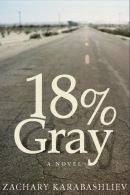
18% Gray

Eighteen_Percent_Gray-web_large

When you take photos sometimes, you may know or not know that cameras have a light meter. All light meters including those in every camera must be calibrated to assume a certain percentage of light being reflected from the subject you want to photograph.

Each light meter can be used to determine correct exposure so long as the photographer knows the angle of measurement and knows how to isolate what is being measured. In addition to knowing the area from which the reading is taken, it is also important to know the approximate reflectance of that area. This is the part that can make using a reflected meter difficult, since the meter can’t determine subject reflectance for you and you must mentally calculate it.

Or you use a standardized surrogate subject such as the common Kodak Gray Card, which has a stated reflectance of 18%. Hence the title of this book, which has also a metaphorical meaning, as readers will find out.

Zack, the narrator/protagonist of this book – the fact that he has the same name as the author is a hint that probably a part of this novel is autobiographical – has two serious problems at the beginning of this book: Stella, his wife and the big love of his life has left him (and as we later learn: for good), and as a result of that Zack is in a severe crisis; and furthermore he comes unintentionally into possession of a big bag with marijuana.

What follows is a road trip from California to New York, and also a trip into the past of Zack’s and Stella’s lives. A man tries hard to find the woman he loves and whom he has lost (long before she physically left him); but he also tries to find again his vocation as an artist; and besides, he wants to sell the dope at the East Coast and maybe start a new life with the money.

The book is structured in a very interesting way: there is the story of Zack, after Stella left him, and his journey through the country; there are flashbacks that describe Stella’s and Zack’s story from the moment they met, in Varna, Bulgaria – by coincidence also a very important place in my life – , in the last days of the communist regime, their move to the U.S. as students, their attempts to build a new life – Stella as a painter, Zack as a photographer and after this fails, as a supervisor of test results for a pharmaceutical company -, and how their lives are drifting slowly apart; and there are short conversations between Zack and Stella, all recorded in moments when Zack takes photographs of Stella, and which give a clear indication of how their relationship slowly changes.

All three lines of this story have their own typography, so it is very easy for the reader to follow these permanent switches, which structure the texts into quite short sections. Here and also in the very good dialogues the reader feels that the author is also a prolific screen writer. This novel has a movie-like feel, and it is not surprising that it will be made (or is it already made?) into a movie.

The novel touches on many interesting topics: how do relationships change over time, and what can we do to prevent us from losing “it” – the love and also the purpose of life, which for Zack was first the music (when he was in Bulgaria, he started a career as front man of a punk band), later photography, and finally writing; it is also a novel about emigration and how it affects the identity of those who give up their home country and re-invent themselves somewhere else; it is a book about America (there are excellent descriptions not only about California and New York, but especially about the Mid West, Texas and all the other places Zack is crossing); can money really compensate us for other losses – the answer is obvious…; and a few more.

“I now realize that my American West was not a geographical place, but a sacred territory in my dreams. Perhaps everybody has their own Wild West. From a very young age, I knew with certainty that one day I would live in mine. I’d caress the yellow prairie grass and the wind would kiss my face. When did I lose all that? How did I manage to desecrate my West by replacing it with the plastic version of what I’ve been living in for the last few years of my life? “

I like about the book also that it is obviously in the tradition of the Künstlerroman (artist’s novel); but it reminds me at the same time of American road movies. There are plenty of absurd situations and people in the book, and also a kind of roguish humor which is a good antithesis to Zack’s and Stella’s sad story. I also like the somewhat ambiguous end and the wonderful last sentence:

“We watch the world outside through our reflections.”

A great book, if you ask me.

The English translation by Angela Rodel is flawless and excellent.

By the way, I read the English edition published by the Bulgarian publisher Ciela. For the cover they used a photo by the author (now editor-in-chief at the same publishing house) that fits this book very well.

PS: One – minor – correction: Old Firehand is of course NOT “a fictional native American hero” of several Karl May novels, as a footnote on page 190 informs us. “Hugh, ich habe gesprochen!”

 Karabashliev


Zachary Karabashliev: 18% Gray, transl. by Angela Rodel, Open Letter Books, Rochester 2013, Ciela, Sofia 2015

This review is part of Stu’s (Winstonsdad’s Blog) Eastern European Lit month: https://winstonsdad.wordpress.com/2015/03/02/welcome-to-eastern-european-lit-month/


© Thomas Hübner and mytwostotinki.com, 2014-5. Unauthorized use and/or 
duplication of this material without expressed and written permission from this blog’s author and/or owner is strictly prohibited. Excerpts and links may be used, provided that full and clear credit is given to Thomas Hübner and mytwostotinki.com with appropriate and specific direction to the original content. 

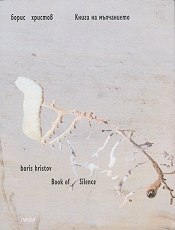
from/aus: Book of Silence / Buch der Stille

Книга на мълчанието

пролог

Какво говори философът?
Не е ли същото, което аз живея –
но без думи?

1.
 
Навсякъде в небето примки и капани –
богослужебни знаци, псалми и бръмчене.
Навсякъде край нас спасителни камбани…
И ни една душа спасена.

2.
 
Разхвърляно до хоризонта Време –
да ровим в него и с усърдието на клошари
да го събираме на мънички купчини,
които вятарат безмилостен отвява.

3.
 
Оставени сме тук обърнати по гръб да драскаме
въпроси по небето и да си отговаряме сами –
докато някой ден Безкраят се смили
и подаде ръка да ни изправи.

4.
 
Загърната в парцали от мъгли къде отива
сляпата тълпа, която се представя за човечество?…
Следи наоколо от хиляди посоки –
и ни следа от Пътя.

…..

___________________________________________________________________________

Book of Silence

Prologue
 
What does the philosopher say?
Is it not the same as what I am living –
but without words?

1.
Everywhere in the sky snares and wiles –
liturgical signs, psalms and buzzing.
Everywhere beside us, saving bells…
And not a single soul saved.

2.

Time, scattered to the horizon –
to search in it and with the zeal of a vagrant
to gather it up in tiny heaps,
which the wind unmercifully blows away.

3.

We are left here, turned to our backs, to scratch
questions on the sky and to answer them alone,
until one day Eternity deigns to stretch out a hand
and stands us upright.

4.

Wrapped up in shreds of fog, where does the blind
mob go, which passes itself off as humanity?…
All around – tracks from a thousand directions,
but not one track from the Road.

…..

__________________________________________________________________________

Buch der Stille

Prolog
 
Was sagt der philosoph?
Ist es nicht dasselbe, was ich lebe –
nur ohne worte?

1.

Überall am himmel stricke und netze –
liturgische zeichen, psalmen und summen.
Überall um uns herum rettungsglocken…
Und nicht eine einzige seele gerettet.
 
2.

Die zeit, verstreut am horizont –
in ihr suchend und mit dem eifer der landstreicher
sie in winzigen haufen sammelnd,
die der wind unbarmherzig verweht.
 
3.

Zurückgelassen sind wir auf dem rücken liegend um
fragen in den himmel zu kratzen und sie uns selbst zu beantworten –
bis eines tages die Unendlichkeit sich unserer erbarmt
und uns die hand nach oben reicht.
 
4.

Eingehüllt in fetzen aus nebel, wohin geht
der blinde mob, der sich selbst als menschheit ausgibt?…
umgeben von spuren aus tausenden richtungen
aber nicht eine spur vom Weg.

…..

Boris Hristov

from: Boris Hristov: Book of Silence (Kniga za malchanieto), bi-lingual edition Bulgarian-English, transl. by John Hamilton, Riva, Sofia 2014 – Boris Christov: Buch der Stille

German translation: Thomas Hübner

© Boris Hristov and Издателство Riva, 2014.
© Thomas Hübner and mytwostotinki.com, 2014-5. Unauthorized use and/or 
duplication of this material without expressed and written permission from this blog’s author and/or owner is strictly prohibited. Excerpts and links may be used, provided that full and clear credit is given to Thomas Hübner and mytwostotinki.com with appropriate and specific direction to the original content.