Category Archives: Books

The Seventh Well

IMG_0106

The Seventh Well by Fred Wander is a book in the tradition of the works of Primo Levi, Imre Kertesz, Elie Wiesel or Julius Fučík about the Holocaust. Although it’s a novel, it is an only slightly fictionalized account of experiences of its author as an inmate in no less than twenty Nazi concentration camps in France, Poland and Germany.

The book consists of twelve comparatively short chapters. The chapters as well as the events reported in them are not always in chronological order. The book – and this was a wise decision in my opinion – does not aim at being an exhaustive report of all the sufferings of its author/narrator; it rather focuses in each chapter on one or a small group of inmates, their characteristics, background, bits of information about their life “before” – when they were just ordinary people with all their strengths and defaults, dreams and obsessions, family life, political convictions, religious creeds, with their love of money, sex, alcohol, or literature and story-telling. And indeed, the title of the opening chapter is How to Tell a Story, and I must quote the very first sentences here:

“In the beginning was a conversation. Three weeks after the conversation, Mendel died.”

What follows this almost Biblical entry is a portrait of the above-mentioned man, Mendel Teichmann, a middle-aged Jew who would tell every other Sunday afternoon stories to the other inmates who gathered to listen to him. These first eight pages set the tune for the whole book. The other vignettes in the book are similarly impressive.

While the SS guards and their willing local helpers are indiscriminately called “jackboots” throughout the whole book and almost none of them is identified by a name or some individual characteristics (contrary to many recent books and movies about the Holocaust that are indulgent in their portrayal of sadistic, demonic and somehow charismatic Nazis, while the victims don’t play an important role; the most extreme case that I know of is Jonathan Littell’s The Kindly Ones, a book that I find highly problematic – but I digress…), the prisoners of the camp in these approximately 150 pages gain an individual stature and profile. While many things we know about the camps – the selections, the arbitrary violence and killings, the role of the Prominenten and Kapos, prisoners who made themselves useful to the SS guards and became part of the system that kept the work in the camps going, the hasty evacuation and Todesmarsch (death march) from one KZ to the next, the slow physical and psychological decline of the inmates, the permanent exhaustion and starvation to name just a few -, there are several reasons why The Seventh Well stands out in comparison to other works.

The Holocaust was such a monstrous crime, the number of victims so huge, and the extermination was organized in such a bureaucratic, industrialized and cunning manner that there is a danger that the individual victims are easily forgotten. By remembering a few of them, the author/narrator gives them a face, a fate, a story to remember. These are not anonymous victims, these are people from different countries, Jews, Christians, Jehova’s Witnesses, Atheists; there are communists or other leftists; homosexuals and Russian POW’s; people with a working-class background and intellectuals. And they all struggle to keep their human dignity against all odds by acts of resistance: for example by forming a literature club, by singing an Italian opera aria or Spanish songs from the Civil War, by protecting a fellow prisoner who is in bad physical shape from discovery, by not committing suicide, by fighting to keep their younger brothers alive (the last chapter Joschko and his Brothers is particularly touching), or – by telling stories.  

The episodic character of the chapters makes it easier for the reader not to get overwhelmed by the subject matter. While some of the chapters could be stand-alone stories, others have more the character of essays. The translation of Wander’s sparse, but beautiful prose by Michael Hofmann is excellent.

I cannot say that I “enjoyed” this book – for obvious reasons.  But I am very glad that I read it. The Seventh Well is a truly humanistic book, because it helps us to remember the humanity of at least some of those who perished and suffered in the Holocaust.

A post-scriptum: In Germany, Fred Wander is probably less well-known than his (second) wife Maxie Wander, author of the celebrated interview book Guten Morgen, du Schöne (Good Morning, Beautiful), and her posthumously published diaries. He wrote also an autobiography Das gute Leben (The Good Life), which I plan to read as well – maybe for next years’ German Literature Month, who knows?

The Seventh Well

Fred Wander: The Seventh Well, translated by Michael Hofmann, Granta Books London 2009

This review is published in the framework of the 2017 edition of German Literature Month, organized again by Caroline from Beauty Is A Sleeping Cat and Lizzy from Lizzy’s Literary Life. A list with links to all published reviews by the participating bloggers can be found here.

#germanlitmonth2017

© Thomas Hübner and mytwostotinki.com, 2014-7. Unauthorized use and/or duplication of this material without expressed and written permission from this blog’s author and/or owner is strictly prohibited. Excerpts and links may be used, provided that full and clear credit is given to Thomas Hübner and mytwostotinki.com with appropriate and specific direction to the original content.

German Literature Month 2017

IMG_0106

It is a tradition already: November is the time to read German literature! For the seventh time, Caroline from Beauty Is A Sleeping Cat and Lizzy from Lizzy’s Literary Life host the German Literature Month again, and I will be glad to join again!

As for my reading and reviewing plans: I will keep that for myself in the moment. Better not to promise too much…

Are you joining too? That would be great! Over the years, this event has developed into probably the biggest joint event in the book blogging community, and I am looking forward to it with great curiosity again!

#germanlitmonth2017

© Thomas Hübner and mytwostotinki.com, 2014-7. Unauthorized use and/or duplication of this material without expressed and written permission from this blog’s author and/or owner is strictly prohibited. Excerpts and links may be used, provided that full and clear credit is given to Thomas Hübner and mytwostotinki.com with appropriate and specific direction to the original content.

The Reckoning

Penguin’s Little Black Classics Series introduced me to number of authors I hadn’t read before; among them Edith Wharton – admittedly a rather embarrassing omission from my reading list until now. The Reckoning, a small booklet that contains apart from the story of the same name only one more piece, Wharton’s first ever published story Mrs Manstey’s View. 

Mrs Manstey’s View appeared 1891 and marked the beginning of the career of one of the most important American author’s of the first half of the 20th century, and although Wharton was later very critical regarding her early stories – most of them are not reprinted in her Collected Stories -, it is of course very interesting to get a first-hand impression of her writing before the novels that made her famous, following the publication of The House of Mirth.  

Mrs Manstey’s View is one of the most devastating portraits of lonely widowhood I have read. When the view from the window of her rented room in a boarding house to which the title is referring and which is her only joy is threatened by the construction of an extension building, the elderly Mrs Manstey, practically forgotten by her daughter who lives far away and considered as mad by her few social contacts because of her obsession about her view and her inadequate attempts to stop the construction work that will destroy this view for good, comes up with a last desperate idea to put a halt to the extension plans, an idea with catastrophic consequences…

While the language and the setting of the story are rather conventional, and while the story is too short to get a really deep inside into the character and psychology of the protagonist, this piece works nevertheless well as a short story, and although the more mature author found certain flaws in her early stories, it is already with this first work that appeared in print that the author made a mark in literary circles in 1891, the date of the first publication. 

The Reckoning, first published in 1911, shows Wharton already at the height of her powers as an author. It is considerably longer than the first story, and is also more elaborated in more than one respect. 

The story’s main character, Julia Westall, is married to her second husband Clement since ten years. Her marriage can be considered a “modern” one: in a time when divorce was – especially for a woman – a social stigma, Julia has left her first rich husband without regrets. Too socially awkward, too “impossible” was John Arment, and the friends of the Westall’s, among them the upper-class Van Sideren’s consider this, together with Julia’s obvious disinterestedness (her second husband is moving slowly upward the social ladder, but is not a really wealthy man) as something that makes an otherwise in such circles scandalous divorce acceptable. When Westall, a verbal advocate of “modern” ideas also regarding the institution of marriage, takes a serious interest in the daughter of the Van Sideren’s, Julia finds herself from one moment to the next in a situation where her orderly and seemingly happy life collapses. The surprising climax of the story sees Julia in the home of her first husband. But I will not reveal more details here…

With its six more elaborated characters, and especially with a heroine that has considerably more depth than the protagonist of the first story, The Reckoning is a really fascinating story. It is also a strong, almost brutal analysis of the power balance between men and women in the society in which Wharton was living. Once a husband decided to discard his wife, it meant for her usually that she lost everything, including her position in society (which considered women mainly as an adornment of their husbands). What is additionally tough for Julia is the fact that she doesn’t exactly understand why it happens, the marriage having been over ten years a happy one (at least by superficial standards), and her visit at her first husband is acknowledging the fact that now she knows that he also didn’t understand what happened when she left him ten years ago…

Altogether, The Reckoning is a remarkably fresh story that resonates long in the mind of the reader. 

I am glad that I started my personal Edith Wharton Reading Challenge with this teaser; now I am curious to read not only her most accomplished novels but also her Collected Stories!

Edith Wharton: The Reckoning, Penguin Books 2015

© Thomas Hübner and mytwostotinki.com, 2014-7. Unauthorized use and/or duplication of this material without expressed and written permission from this blog’s author and/or owner is strictly prohibited. Excerpts and links may be used, provided that full and clear credit is given to Thomas Hübner and mytwostotinki.com with appropriate and specific direction to the original content.

My personal Edith Wharton reading challenge

A phenomenon with which every reader is familiar: no matter how much you read, there will be nevertheless always important books and authors that you will miss. A reader’s life is too short even for compulsive readers like me to have a complete overview regarding all important books and authors.

Despite this biological limitation, I am making an effort from time to time to fill in a few gaps; authors whose names are well-known to me and considered as important by authorities I usually trust; books that are on my personal TBR pile since a long time but which have constantly evaded my attention in the last moment. 

One such author is Edith Wharton, and since I have no less than five books by her on my shelves, I will read and review these books in the next weeks, and form my own opinion of this generally very well-reviewed author.

Have you read any of Edith Wharton’s books? Or are you willing to join this personal reading challenge of mine? If so, drop me a line here, or in the next weeks under one of my upcoming Edith Wharton blog posts. 

© Thomas Hübner and mytwostotinki.com, 2014-7. Unauthorized use and/or duplication of this material without expressed and written permission from this blog’s author and/or owner is strictly prohibited. Excerpts and links may be used, provided that full and clear credit is given to Thomas Hübner and mytwostotinki.com with appropriate and specific direction to the original content.

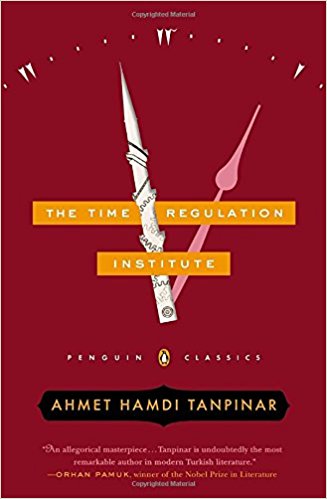
‘The Time Regulation Institute’ by Ahmet Hamdi Tanpinar

The Time Regulation Institute

Years ago, I came across the name of Ahmet Hamdi Tanpinar (1901-1962) for the first time. I was reading Orhan Pamuk’s book about Istanbul and Pamuk refers to Tanpinar as his most important teacher as a writer and novelist. That’s a sufficient reason to have a closer look at this author and his novel The Time Regulation Institute, first published in book form in 1962.

Tanpinar belongs to a generation of Turkish authors that grew up in the Ottoman Empire and lived through the first decades of modern Turkey with its Kemalist reforms that deeply affected every aspect of life. It is important to keep in mind that – while the book is clearly a modern novel, written by a university professor that was very familiar with modern European literature – the author was at the same time deeply rooted in the pre-modern Ottoman traditions; and the same is true for his characters in The Time Regulation Institute.

The novel is the first-person narrative of the life of Hayri Irdal, a loafer, a man who grows up in rather poor circumstances and with limited school education, but who shows at an early age a talent in repairing watches, a craft he learns at the workshop of Nuri Efendi, whose thoughts about the role of time and about how important it is to make good use of it will play an important role later in the novel.

We see Hayri Irdal being a rather weak person, with a problematic second marriage (after his first wife died early) and with children that are not really close to him. He is spending most of his time with a strange circle of friends, alchemists, spiritualists, fortune seekers, project makers. This collection of characters gives Tanpinar an opportunity to unfold his satirical talents. The first part of the novel takes place in the time before and during WWI, and this part frequently reminded me of a Karagöz performance, the Turkish version of the Commedia dell’arte; the tales of Nasreddin Hoxha came to mind as well. Not only the men are shown as objects of the author’s wit, also the female characters get their fair share of satirical treatment, particularly Hamdi’s aunt, but also his second wife and her sisters with their obsessions regarding cinema or singing.

A change of luck for Hayri happens in the moment when he gets acquainted with Doctor Ramiz, a psychoanalytic who has just returned from Vienna and who applies his newly acquired (and superficial) knowledge of modern psychotherapy to cure his patient, with analysis of dreams that the doctor “orders” his patient to have, and discussion of German-language brochures on psychoanalysis inclusive (Hayri speaks of course only Turkish). Once Hayri is released from the hospital, Doctor Ramiz introduces him to Halit Ayarci, a modern project maker who understands to utilize Hayri’s potential and who – thanks to his connections in important circles – is also able to find the funding for a revolutionary idea: the creation of the Time Regulation Institute. The institute, a (fictitious) part of the reforms in the 1920’s in Turkey is supposed to ensure that all clocks and watches in the country show the correct time, and a mechanism to ensure that – and of course also a sophisticated system of fines – is quickly developed.

A big part of the second half of the novel deals with the finding of financial backing of the project, the creation of a bureaucracy and the erection of a suitable and representative office building of the new institute, so that the big number of employees – all of them of course relatives and friends of the director, Halit Ayarci, and his deputy, Hayri Irdal – have excellent working conditions. A special task assigned to Hayri is the writing of the biography of Ahmet Zamani Efendi, an Ottoman predecessor of the idea of measuring time in the modern way; and the fact that this person never existed gives Hayri a perfect opportunity to bring his storytelling talent to good use. Too bad that a Western scholar shows up one day, who is looking for further evidence, and that on top of it, a visiting commission questions the work and the usefulness of the Time Regulation Institute…

Bureaucracies seem to have a great fascination for novelists. But while Kafka or Ismail Kadare (in his Palace of Dreams) focus on the dark, nightmarish implications of such bureaucratic institutions, Tanpinar offers his readers the satirical version, a farce. Hayri represents the old generation of people who don’t really believe in what the institute stands for, but who seize the opportunity to employ a lot of friends and relatives, or who take advantage of it in any other way; Halit Ayarci on the other hand is a ‘modern‘ character, someone who clearly understands that the institute can be an instrument to satisfy his personal ambition, and who is very clever in using his contacts in political circles to find the money and public recognition for his project. And of course, a bank and a housing project are also needed in this context…

I mentioned already that Tanpinar was very familiar with modern European literature; and I can’t help but thinking about Italo Svevo’s Zeno Cosini, or the “heroes” of the novels of Robert Walser that seem to come from the same mould as Tanpinar’s characters. Halit Ayarci and his project also reminded me a bit of the Parallelaktion, and the character of Arnheim in Robert Musil’s Man without Qualities.

What is the message of Tanpinar’s novel? Maybe this one: you cannot transform people that are deeply rooted in a medieval society into modernity just by enforcing some radical reforms, like the Kemalists did in the 1920’s and 1930’s. All these reforms will be superficial and will not change the mindset of people. Tanpinar mentions the paintings of Osman Hamdi Bey, and the tortoise of Hayri’s dervish friend is also an obvious reference to the most famous of Osman’s paintings, The Tortoise Instructor; the tortoises being a symbol for the Turkish people as seen by Osman. Can you really teach or instruct a tortoise? Tanpinar ends on a slightly more optimistic note. Hayri’s estranged son is supporting his father in the end with his construction project; and while he clearly sees his father’s limitations – and that of his surrounding -, this son who distanced himself geographically, and also by name (choosing a new name for himself), seems to look at his father with mild irony and understanding. Several generations need to pass probably until a modern Turkish society will evolve. In the meantime, Hayri, and also Turkish society in general still struggle with the Father complex that was diagnosed by Doctor Ramiz in the novel. But I am quite sure, Tanpinar had not only Turkey in mind when he wrote about bureaucracies, and about how a certain category of men is using projects like the Time Regulation Institute to re-write or plainly invent the past and turn such projects into a kind of machinery for self-promotion, generation of media attention, influence, and money. Therefore, it is easy to relate to this novel, even when the reader may not be familiar with the Turkish setting and background.

Overall, I can say that I liked and enjoyed this book very much. It is a fun read thanks to the ability of its author to combine satirical criticism, traditional ‘oriental’ storytelling, and a very accomplished use of the form of the modern novel, with an unreliable narrator. If Tanpinar had lived longer and would have had an opportunity to edit his novel more diligently, he might have cut some passages that are redundant, but that’s a very small criticism of an otherwise truly important and enjoyable book.

The translators of this edition made an obvious effort to render the author’s multi-layered style into a similarly multi-layered English. I cannot really judge the quality of the translation since I don’t know Turkish, but it was a smooth read that didn’t create any challenges for me as a reader.

Bibliographic Information:

‘The Time Regulation Institute’ by Ahmet Hamdi Tanpınar, translated by Maureen Freely and Alexander Dawe

Publisher: Penguin Classics

Publication Date: 2013

432 pages

ISBN: 978-0143106739

Ahmet Hamdi Tanpınar was a Turkish poet, novelist, literary scholar and essayist, widely regarded as one of the most important representatives of modernism in Turkish literature. In addition to his literary and academic career, Tanpınar was also a member of the Turkish parliament between 1944 and 1946.

The Istanbul Tanpınar Literature Festival (ITEF) is named in honor of Tanpınar and has been held annually since 2009. The Ahmet Hamdi Tanpınar Literature Museum Library, is a museum dedicated to Turkish literature in Gülhane Park in Istanbul.  It opened in 2011.

Maureen Freely is an American journalist, novelist, professor, and translator. Born in New Jersey, Freely grew up in Turkey and now lives in England, where she lectures at the University of Warwick. She is the current President of English PEN, the founding center for PEN International. 

Her seventh novel, ‘Sailing through Byzantium,’ was chosen as one of the best novels of 2014 by The Sunday Times.  Freely is also an occasional contributor to Cornucopia; a magazine about Turkey. She is best known as the Turkish-into-English translator of Orhan Pamuk’s recent novels.

Alexander Dawe graduated from Oberlin College in 1996 with degrees in French and Classical Guitar Performance. He has translated several contemporary Turkish novels including Ahmet Hamdi Tanpınar’s The Time Regulation Institute with Maureen Freely.  In 2010, he received the PEN Translation Fund to translate a collection of short stories by Tanpınar. He lives and works in Istanbul.

Thomas Hübner is a German-born economist and development consultant with a life-long passion for books. He lives in Chisinau/Moldova and Sofia/Bulgaria. He is also the co-founder of Rhizome Publishing in Sofia, and translates poetry, mainly from Bulgarian to German (most recently Vladislav Hristov, Germanii, Rhizome 2017). He is blogging at www.mytwostotinki.com on books and anything else that interests him.


Visiting a painter’s studio

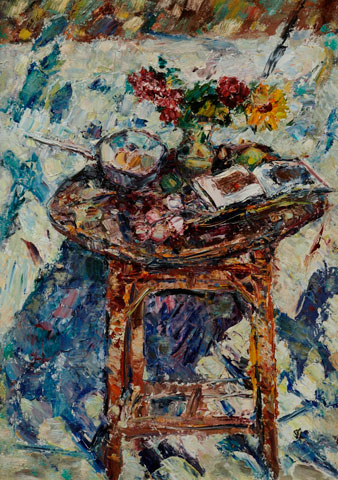
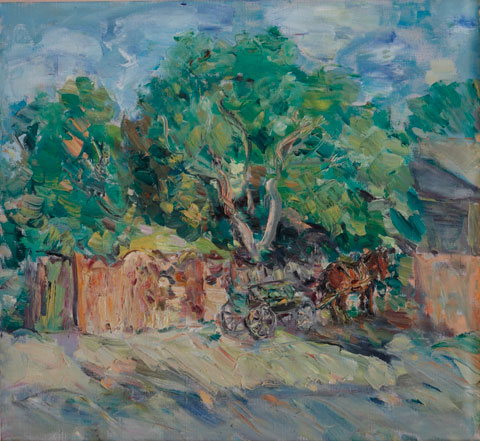
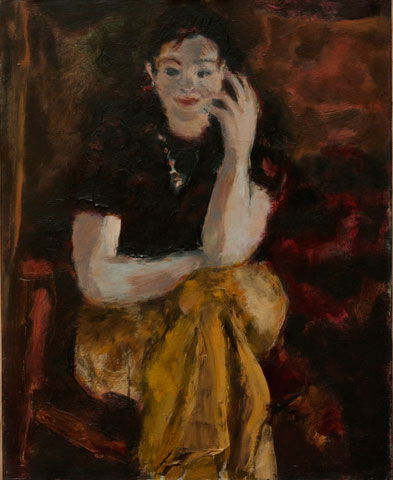
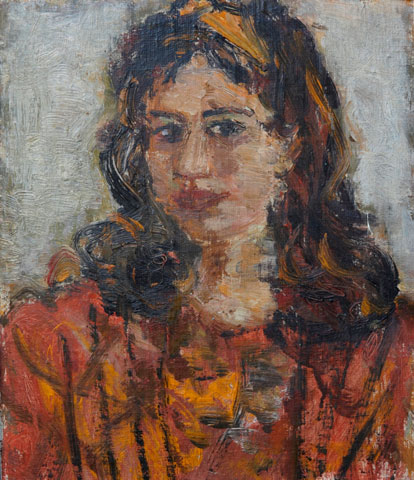
Yesterday, I had the opportunity to visit the painter Dmitrie Peicev (Димитър Пейчев) in his studio in Chisinau. Peicev was born 1943 in Burgugi, a Bulgarian village in the Budzhak region, the part of Bessarabia that belongs now to Ukraine (Odesa oblast). He received his artistic education in Chisinau and Moscow. The influence of the French impressionists, Courbet and of his teacher (and father-in-law) Mihai Grecu is visible in many of his paintings, although Peicev has his own distinctive style.

Peicev is also a poet. He has published three collections of poetry in his native language in Bulgaria. A fourth collection is in preparation. Many of his poems circle around childhood memories from his beloved Budzhak.

It was supposed to be a friendly, short visit; but we ended up (supported by some Moldovan wine) to discuss for about six hours a big variety of topics from the world of art, poetry, and life in general. For me it was particularly interesting to learn about the life of the Bulgarian minority in the region and their history and culture. And of course it was an opportunity to see quite a number of his artworks, mainly from recent years; portraits, landscapes, still lives.

Although the artist, a very humble person, who didn’t say anything bad about anyone during our meeting, has done a lot of efforts to keep his Bulgarian identity and to keep the Bulgarian community in the region together, I had the feeling that his experiences in Bulgaria were a bit mixed (to say it friendly). While he has some close friends in Bulgaria and spoke very fondly of his visits there, he is not very well known in Bulgaria, and a big exhibition tour years ago ended in a disaster for the artist: most of his 80 paintings exhibited there were stolen, and his experiences with Bulgarian art galleries (and the customs) were not of the kind that make him very eager to exhibit again in Bulgaria. Still, I hope that one day we will see a big exhibition of his artworks in Bulgaria.

The friendly artist suggested to paint my portrait; although vanity is usually not one of my sins, I am considering it…

I truly enjoyed to meet such an interesting person! My special thanks goes to my friend Kate Baklitskaya, who not only introduced me to the artist, but who was also brave enough to listen for the biggest part of the visit to our conversation in Bulgarian.

Some works of Dmitrie Peicev:

© Thomas Hübner and mytwostotinki.com, 2014-7. Unauthorized use and/or duplication of this material without expressed and written permission from this blog’s author and/or owner is strictly prohibited. Excerpts and links may be used, provided that full and clear credit is given to Thomas Hübner and mytwostotinki.com with appropriate and specific direction to the original content.
© Dmitrie Peicev and National Museum of Art Moldova, Chisinau, 2010-2017

Why I rarely publish negative reviews

Since I started this blog, I have reviewed approximately 120 books here; I share these reviews also in Goodreads and in Facebook. But I read much more books, which means that I am by far not writing about all the books I am in fact reading.

The reasons for this are mainly the following:

Reviewing takes some time; if you want to write something more than just a few superficial remarks, something meaningful, you need to spend a comparatively big amount of time – time I sometimes don’t have, or time I prefer to invest in something to me more valuable in that moment – for example in reading, travelling, working on my actual book project, or spending quality time with people that matter to me! And imagine, I have a job too, haha.

Furthermore, a lot of the books I am reading are not really creating this urge in me to write about them. Maybe it’s just me, or maybe the book is kind of dull and boring, or it is more or less ok, but nothing special and I have already forgotten the plot after a short time, or the topic is too special to be of any interest for a wider audience. So what’s the point to bother someone with my thoughts in such cases?

A special case are awe-inspiring books, books where I feel that at this moment they are beyond my capacities as a reviewer – recent example: Dostoevsky’s Demons. I would need to write a 10,000 words text if I wanted to review it, otherwise I would have to neglect important aspects of the book as I understand it. And if I will ever be able to express my limitless admiration of and fascination with Hans Henny Jahnn’s strange behemoth of a novel River without Banks – a book that literally changed my life and my view of life in general – in an adequate way remains a big question for me. (I reviewed the first part here; the biggest part of the novel was never translated in English.)   

The fourth category are the hopelessly bad, crappy, worthless books that you come across sometimes. I am not particularly inclined to write reviews about books I didn’t enjoy or that I even strongly dislike. In general, I prefer to be silent in such cases instead of wasting valuable time to indulge in negative feelings. In general, I believe that I am usually much better in positively raving about the qualities of a book than to give it the thump-down. Therefore, only about 5% of my published reviews so far are negative; if I would write a review about every single book I am reading, this percentage would be much higher, maybe more like 25-30%.

So, in which cases of this fourth category I am nevertheless making the effort to publish my negative opinion about a book? There are of course, as I see in retrospect now, a few reasons:

There are books and authors that have acquired the status of a “classic”, or at least of being extremely popular. While I have no problem with popular books and authors in general, I have experienced a couple of times the situation that I read a book that was praised as a “masterpiece”, or even as “one of the best novels of the 20th century” – and it turned out to be awfully bad from whatever standpoint you look at it. That’s what I call the “Emperor’s-New-Clothes syndrome”, and in such a blatant case as this one I feel obliged to raise my finger and voice my objection. This specific book and author get in my opinion much more attention than would be deserved if we look just at the – according to me hardly existing! – literary quality of the work; it is more a result of the successful efforts of the author during his lifetime to turn himself into a brand, than of the genuine quality of his writing that he occupies such a prominent place in literary history, and this book is praised by so many people although it is obviously no good at all (admittedly not all books by this author are as bad as the one I reviewed). The purpose of my review is to be a small contribution to a re-assessment of this specific book, and thus maybe also to a re-assessment of other, much better novels published during that period by authors who were not so good in self-marketing, but maybe better writers with some meaningful message in their works, written in a much better prose.

Another category of books are those by contemporary authors, who – supported by an aggressive marketing, a devoted group of friends in the media, and a similarly devoted crowd of “groupies” in social media – blow the horn and thus make a lot of noise around their silly, shallow, obnoxious books and turn this kind of attention into a mass phenomenon, and in extreme cases even into a movement that shares certain elements with a sect. That’s what I call the “One-million-flies-cannot-go-wrong syndrome”, and again I find myself every now and then in a position that I simply must voice my objection against such a book, and may it even be in a very succinct way, like in this case. (This review by a fellow book blogger sums it up very nicely in more detail what is wrong with this book and its author.)

Closely related to the last category are books that are lacking a basic quality a book (and its author) should have in my opinion: intellectual integrity. When the content and the message of a book is in stark contrast with the personal behaviour of its author, it is clearly a case of hypocrisy and lack of integrity. Intellectual impostors like the author of this book, should be always exposed.

Some books simply make me angry. A lot of people like this book and similar one’s by the same author – but to me it is obvious that the book is just an alibi for something else. This author makes his living by providing arousal templates for the needs of a very “special” audience. His sick anal-sadistic torture fantasies are poorly written, and as a reviewer I really hope that I prevent a few readers from exposing themselves to this revolting stuff.  

Very young and inexperienced authors will be usually treated with kindness by me; most bad books I read by such authors will be never reviewed here. In exceptional cases, when for example the publisher is to blame for not editing a book by an inexperienced author at all (and thus doing him a very bad service), like in this case, I will make an exception. Not because I want to slam the poor author for his shortcomings, but because I find it unethical when some publishers don’t protect authors from seriously damaging themselves.

Another exception are cases (like this one) in which a young author who in my opinion lacks literary talent is “made” by a publisher, in co-operation with key figures of the literary scene; a system that manipulates the public, arranges that such an author gets literary awards, and plenty of media attention that will in turn help to generate additional money and influence for this person in the literary scene, damages the chances of other young authors with real literary talent (but maybe with less talent for self-promotion), and even corrupts the readers and potential young authors, because a system that systematically ignores literary merit must in the long run have negative repercussions on the literary life in general, especially when the book market in that country is very small. Also in these cases, a reviewer should speak out and make it clear when such a “hyped” book has no literary value, and is obviously more a media or lifestyle phenomenon than serious literature.  

Hey, before I forget it – I know some authors personally. Some of them are nice people, others not so much. It is just like in all other spheres of life. Would the fact that I am in good or maybe not so good terms with someone influence my judgement (as imperfect as it may be) regarding the quality of their respective writing?

The answer is obvious: never!

© Thomas Hübner and mytwostotinki.com, 2014-7. Unauthorized use and/or duplication of this material without expressed and written permission from this blog’s author and/or owner is strictly prohibited. Excerpts and links may be used, provided that full and clear credit is given to Thomas Hübner and mytwostotinki.com with appropriate and specific direction to the original content.

Another case of the “Emperor’s new clothes”

Even a well-meaning reader can hardly consider this book as something else as an immature and narcissistic collection of clichés and of not very cleverly disguised and recycled “findings” from the works of other poets (and songwriters). I feel pity for the young author. If his aim was to make himself a name as a poet, then he was obviously ill-advised to get this rather embarrassing book published at all.

I wouldn’t have bothered to comment on this book if it wasn’t for the extreme media hype around it and its author in his home country. Another case of the “Emperor’s new clothes” in my opinion.

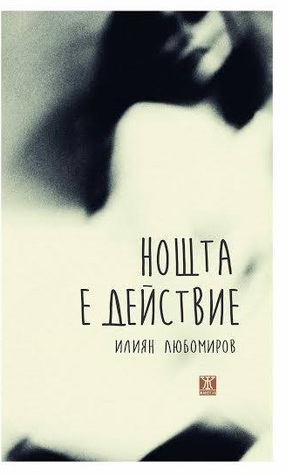
Нощта е действие

Илиян Любомиров: Нощта е действие (Iliyan Lyobumirov: Noshtta e dejstvie), Janet-45, Plovdiv 2014

© Thomas Hübner and mytwostotinki.com, 2014-7. Unauthorized use and/or duplication of this material without  expressed and written permission from this blog’s author and/or owner is strictly prohibited. Excerpts and links may be used, provided that full and clear credit is given to Thomas Hübner and mytwostotinki.com with appropriate and specific direction to the original content.

The horror! The horror!

153 of my Facebook friends “like” the official FB page of #PauloCoelho.

© Thomas Hübner and mytwostotinki.com, 2014-7. Unauthorized use and/or duplication of this material without expressed and written permission from this blog’s author and/or owner is strictly prohibited. Excerpts and links may be used, provided that full and clear credit is given to Thomas Hübner and mytwostotinki.com with appropriate and specific direction to the original content.
Man lernt nie aus…

Wie soll man sich eigentlich mit Populisten in einer Diskussion auseinandersetzen? Eine wichtige Frage, und von daher ist ein Buch wie “Logik für Demokraten” von der Themenstellung her sehr interessant. Interessant ist allerdings auch, wie der Autor dieses sehr hochgejubelten Buchs selbst diskutiert. Ein kleines, aber typisches Beispiel aus einem einzigen Kommentarthread zu einem Artikel, der sich mit dem unsäglichen Herrn Gauland befasst, und in dem der Buchautor sich logisch-argumentativ mit einigen mir politisch sehr fern stehenden, aber durchaus nicht übermässig aggressiven, teilweise sogar ausgesprochen höflichen Zeitgenossen wie folgt auseinandersetzt:

“halbstark…Maulheld…Phrasendrescher…ideologische Masturbation…Novizin in Sachen Urteilskraft…auslaufendes Geseiere…Kaskaden phrasenhafter Adjektive…beleidigt passiv-aggressive Wortspiele…Pseudoempirismus und verachtenswerte Faulheit des Denkens…Bullshit-Manöver…dumm…selber doof… es scheint seinen Horizont zu sprengen…ist das denn gesund für jemandem in Ihrem Alter…assoziativer Wortdurchfall…es geht nicht in Ihren blonden Schädel hinein…” usw.

(Das ist nur eine kleine Auswahl logisch-argumentativer Höchstleistungen des Buchautors, sozusagen ein “best of” aus einem – ich wiederhole mich – einzigen Kommentarthread!)

Unter “Logik für Demokraten” hatte ich mir bisher etwas anderes vorgestellt, aber man lernt ja nie aus…

Daniel-Pascal Zorn: Logik für Demokraten, Klett-Cotta, Stuttgart 2017

s.a. hier

© Thomas Hübner and mytwostotinki.com, 2014-7. Unauthorized use and/or duplication of this material without expressed and written permission from this blog’s author and/or owner is strictly prohibited. Excerpts and links may be used, provided that full and clear credit is given to Thomas Hübner and mytwostotinki.com with appropriate and specific direction to the original content.