Category Archives: Books

In Ruse with Elias Canetti

In the first volume of his autobiography Die gerettete Zunge (The Tongue Set Free), Elias Canetti writes about his early childhood in the Bulgarian city of Ruse – Canetti uses throughout the book the old name Rustchuk -:

“Everything that I experienced later, had already happened once in Rustchuk…On any one day you could hear seven or eight languages.”

Despite having spent only his first six years in the city of his birth – the family emigrated to Manchester in 1911 and Canetti came back only once for a visit in 1915 – Ruse and its unique multilingual and multicultural atmosphere at that time left a lifelong mark on the future writer.

A small book in Bulgarian language with the title In Ruse with Elias Canetti (В Русе с Елиас Канети) sheds additional light on this early period of Canetti’s life, family background and social surrounding.

In the middle of the 19th century Ruse had developed into a thriving city. Located at the Danube it had by then attracted a lot of trading activities and the port of Ruse was the main artery through which goods were imported and exported from and to the whole region. An additional boost to the economic development was the fact that Ruse had a fast-growing Jewish (Sephardic) community which was one of the driving forces for Ruse’s modernization; this together with a general economic boom in the then revived Bulgarian state (until the Russian-Turkish War 1877-78 it had been part of the Ottoman Empire for almost five hundred years) made Ruse the then most modern and truly European city in Bulgaria.  

The authors give us interesting information about the origin and growth of the Jewish community in Ruse and trace back also the family background of Canetti’s parents. Grandfather Elias Canetti (the namesake of little Elias) came from Adrianopel (Edirne) to Ruse and became a successful trader, first with his partner in Constantinople, later on his own. He reigned his firm and his family like a benevolent despot, a true family man that cared a lot for his grandchildren and particularly his oldest grandson Elias; but at the same time he expected that his sons gave up on their own plans and would be part of the future family business with branches in all other important Bulgarian cities.

For Jacques, young Elias’ father, this was a source of permanent inner conflicts – he was a talented violinist and dreamed of a career as a musician in a chamber quartet. Also Mathilde, his wife and Elias’ mother, was a talented amateur musician (she played the piano); there are photos that show the parents as musicians in a public concert in Ruse. Another photo shows Jacques, then a dashing young man, in a carnival costume – both parents who had spent years in their youth in Vienna loved the theatre and literature, things for which Grandfather Canetti had not much interest and which he might have considered at best as harmless hobbies, but as nothing serious.

Beside this latent conflict between Jacques and Elias Senior, another quite open conflict clouded the childhood of the future Nobel Prize winner. Mathilde’s family, the Arditis, were against the marriage of their youngest daughter with Jacques Canetti. The Arditis, one of the oldest and high-ranking Sephardic families could trace back their origin until the 13th century when some of their ancestors were astronomers and doctors at the courts of the Kings Alfonso IV and Pedro IV. After 1492, the family settled in Livorno and later in the Ottoman Empire, where several of their members became famous rabbis, kabbalists and scientists; the Arditis were among the first Jewish families in Ruse and looked down on Elias Senior and his family as upstarts, who had just arrived from the Orient and were no match for the famous and cultured Arditi family. One of the remaining (and traumatic) memories of his early childhood in Ruse was for Canetti a visit in Grandfather Arditi’s house. This grandfather, who never paid much attention to Elias and never gave him a present, asked his grandson on one occasion, which of his grandfathers he loved more – Grandpa Canetti or Grandpa Arditi. When the poor boy said “Both!”, he was immediately called a liar and hypocrite by his maternal grandfather. 

One of the most interesting chapters for me was the one on the artistic talent of Canetti’s parents, especially that if his father. Ruse had quite an active social and cultural life, and much of it was initiated and kept alive mainly by its Jewish citizens. Ruse has a beautiful theatre that regarding its size and architecture could be as well in Vienna or Budapest. During Ruse’s best times, many famous international troupes visited the Danubian city, the same goes for many musicians and orchestras. There were amateur theatre groups and concerts that raised funds for the education of poor but talented Jewish children, the Bnai Brith Loge played an important role in the social fabric of the Jewish community, and there were also some of the first Zionist organisations in Bulgaria which had their headquarters in Ruse. Other chapters cover the donations made by Canetti’s grandfather and father, the efforts of Jews from Ruse to support the war effort in the Balkan Wars and WWI, either as soldiers or by financial support. Another short chapter describes how Canetti learned some folk rhymes and stories from young Bulgarian peasant girls, stories he later found again in a German book about Bulgarian fairy tales and folk stories and that left obviously a deep impression on him. Philately, the role of the different newspapers in the Canetti household (in Ladino and in German), and the comet Halley are also covered by short but instructive chapters.

The Orator is the title of the longest chapter of the book, and it deals with Canetti’s relationship with one of the most colorful members of the Canetti-Arditi family, Elias’ cousin Benjamin ‘Bubi’ Arditi (Canetti calls him ‘Bernhard’ in a letter addressed to him that is reproduced in the book). Bubi, just a few years older than his cousin, was for some time a strong influence for Canetti and he is explicitly mentioned in the second volume of Canetti’s autobiography Die Fackel im Ohr (The Torch in My Ear).

After Canetti’s parents moved to Manchester with their three sons (Elias, Nissim and Georges), Elias saw his cousin during both visits in Bulgaria; in Summer 1915 in Ruse and in 1924 in Sofia. During this period Bubi had became a fervent Zionist and public speaker. Elias was so impressed by his cousin who engaged himself with all his energy in something much bigger than himself, a cause for the Jewish community, that we find traces of The Orator also in Masse und Macht and in his Aufzeichnungen. For a short time, young Elias seemed also to have considered to become a Zionist. Bulgarian Jews were in those days frequently targeted by the terrorist IMRO (today this extremist right-wing political party that is still proud of its criminal and antisemitic origin and which propagates quite openly violence against ethnic minorities and refugees is part of the Bulgarian Government!), that openly threatened to kill those who didn’t pay hefty sums to them; blackmail, collection of “protection” money and contract killings were the main financial sources of this “patriotic” group – today, being part of the Bulgarian government, they use means that are only slightly more subtle – that was in its high time considered the most ruthless group of assassins in Europe.  – When Canetti fell in Vienna under the spell of an even greater orator, Karl Kraus, this interest in Zionist politics faded away completely. 

The book reproduces several letters of Canetti to his cousin Bubi and to people in Bulgaria who got in touch with him in his later life. He found touching words for his attachment to Ruse and the importance of the city for himself and his development as a writer.

This small book is not only very informative, it is also an important document of the renewed connection of the writers’ birthplace with this extraordinary son of Ruse. Canetti’s daughter visited Ruse for the first time in 1998 and initiated together with Penka Angelova from the University Veliko Tarnovo and other supporters the International Elias Canetti Society, which is now very active to promote the literary work of Elias Canetti, and the values for which he stood. The three engravings that show Old Ruse and that were among Canetti’s most treasured belongings, are now back in Ruse – a donation by his daughter. And there is a chance that not only the former building of the trading house Elias Canetti (Senior) in Slavyanski Street 14 in Ruse will be revived, but maybe also that the author’s birthplace at Gurko Street 13 will be turned into a museum one day. (Interestingly, the English Wikipedia page about Canetti, claims that the building at Slavyanska is his birthplace – a building that the author has rarely ever entered, since it was an office and a warehouse, not a residential building.)   

While the book provided me with interesting, new to me information and is written with real love and devotion to the subject, I have to mention two points with which I had a problem.

The book contains many reproductions of photos and other documents; that’s a good thing since it adds considerably to the quality of the given information and makes the book even more interesting and readable. However – and this really unforgivable – the book mentions absolutely no sources of any of the photos and documents, and therefore also not of the owners of the copyright of these illustrations. That is highly disappointing and doesn’t correspond with the standard of a book publication; it is even infringing the copyright – something that is considered in Bulgaria unfortunately as no offence at all by many people. For me it is a question of honesty and intellectual integrity not to disregard in such a shameful way the intellectual property of others, and it is a real pity that such an otherwise recommendable book has such a very serious flaw. 

I had also a problem with a question regarding a detail in the chapter devoted to The Orator. Bubi Arditi, a lifelong supporter of the revisionist Zionist Vladimir Zeev Jabotinsky, the Irgun, and other right-wing groups, was also politically involved with the last Czar Simeon II (and later Prime Minister Simeon Sakskoburggotski).

Simeon launched a long time ago a campaign to depict his father Boris III as the “saviour” of the Bulgarian Jews during WWII, a claim that has been a long time ago discarded by serious historians. In the contrary, Boris III was the main Bulgarian responsible for the extermination of the Jews in the annexed territories in Macedonia and Thracia. I don’t want to go into the details here regarding this topic, but it is important to know that Bubi Arditi wrote a book that supports Simeon’s revisionist theory.

After referring Arditi’s position that Boris III was the “saviour” of the Bulgarian Jews and his blaming the “Jewish communists in Bulgaria” that they are liars, the book claims surprisingly that Canetti shared his cousin’s opinion on this question. But while there can be no doubt about the fact that Canetti rejected the communist system in Bulgaria with harsh words, he was never a supporter of the thesis that Boris III was the “saviour” of the Bulgarian Jews and the reproduced letter proves – if anything – the opposite. The rather ambiguous wording of the authors in this particular context leaves room for the interpretation that they think that Canetti shared his cousin’s opinion. But Canetti was never ever a supporter of revisionist ideologues and I was rather annoyed by this passage in an otherwise very recommendable text.   

P.S. In case you wonder, the French actor Pierre Arditi is also a member of the Canetti-Arditi family. His father Georges and Elias were cousins.

.В Русе с Елиас Канети
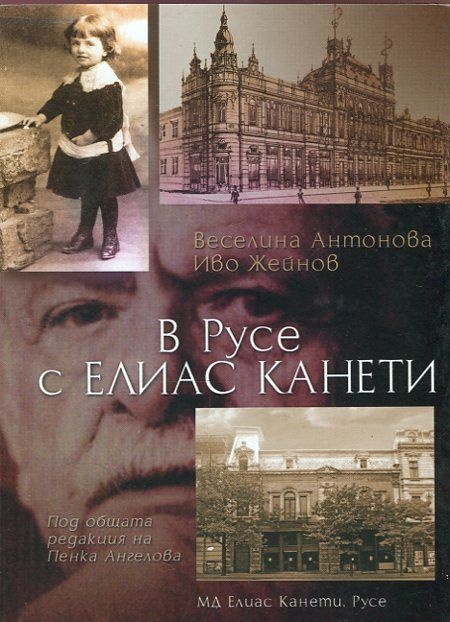
Veselina Antonova / Ivo Zheynov: In Ruse with Elias Canetti, MD Elias Canetti, Ruse 2016

Elias Canetti: The Tongue Set Free, Granta Books, London 1999, translated by Joachim Neugroschel 

© Thomas Hübner and mytwostotinki.com, 2014-8. Unauthorized use and/or duplication of this material without expressed and written permission from this blog’s author and/or owner is strictly prohibited. Excerpts and links may be used, provided that full and clear credit is given to Thomas Hübner and mytwostotinki.com with appropriate and specific direction to the original content.
Moldauisches Heft (1): Bücher und Menschen

Bücher und Menschen

K. und ich sitzen dicht neben dem kleinen altertümlichen Ofen, der auf Hochtouren läuft, aber gerade nur so viel Wärme abgibt, dass man es eben noch so aushalten kann im winterlich kalten Studio des Malers und Dichters D. P. in Chisinau. Uns gegenüber sitzt D., der gerade in einen Katalog eines bulgarischen Malers vertieft ist, den er zu dessen Lebzeiten gekannt hat; zwischen uns ein Tisch auf dem sich Malutensilien, diverse Brillen, Medikamentenschachteln, ein Teller mit Früchten und drei noch halbvolle Gläser mit moldauischem Cognac ein Stelldichein geben. D. strahlt. Der Besuch und das Interesse an seinen Gemälden tun ihm gut und er blüht förmlich auf. Besonders gegenüber der jungen Frau zeigt er sich aufmerksam und charmant und ich wundere mich nicht, dass sehr viele seiner im Studio befindlichen Werke Porträts meist junger Frauen und Mädchen sind. Trotz seiner 74 Jahre flirtet er ein wenig mit K., die es mit gutem Humor aufnimmt. Zur aufgekratzten Stimmung trägt auch bei, dass ich ein Bild gekauft habe, ein stimmungsvolles, schön komponiertes Stillleben mit Früchten und einer Karaffe, welches mir sofort auffiel. D. hat große Probleme mit den Augen und der ausgemachte Kaufpreis hilft, die notwendige Operation zu bezahlen.

– ‚Ich komme aus einer Familie, in der es Bücher gab und in der gelesen wurde‘, sagt D. nachdem er den Katalog zur Seite gelegt hat. – ‚Das war ganz und gar nicht alltäglich in unserem Dorf im Budzhak, dem heute zur Ukraine gehörenden Teil Bessarabiens. Die Liebe zur bulgarischen Sprache habe ich von meiner Mutter, das Verständnis für den Reichtum der Muttersprache und dafür, dass Sprache mehr sein kann als nur ein bloßes Verständigungsmittel; das Wissen, dass man wirklich in der Sprache wohnen und zuhause sein kann habe ich von ihr. Die Liebe zu und der Respekt vor Büchern kommt dagegen vom Vater und Großvater. Zu Anfang des letzten Jahrhunderts hat Großvater angefangen, eine private Bibliothek zusammenzutragen. Darin gab es Bücher in verschiedenen Sprachen, Bulgarisch, Russisch, Rumänisch…viele davon müssen teuer gewesen sein; es waren aufwendig gedruckte und gebundene Bände darunter, viele mit Illustrationen. Er liebte besonders Werke zu religiösen Themen. Auch mein Vater kaufte später Bücher für diese private Bibliothek. Als dann die Rumänen kamen, füllte er eine große hölzerne Truhe mit Büchern in russischer Sprache, die er dann irgendwo vergrub. Wer russische Bücher im Haus hatte, galt den Rumänen als gefährlich, als Verräter, und hatte mit schweren Konsequenzen zu rechnen; mancher verlor sein Leben wegen ein paar russischer Erbauungsbücher im Haus. Später kamen dann die Russen zurück, und wieder wurde eine große hölzerne Truhe gefüllt, diesmal mit Büchern in rumänischer Sprache. Nun wurde nämlich jeder mit rumänischen Büchern im Haus als Verräter angesehen und schwer bestraft, in die Verbannung geschickt oder erschossen. Niemand weiß heute mehr, wo die Truhen vergraben sind; vielleicht hat jemand sein Haus dort gebaut, wo sie liegen, nicht ahnend, was für ein Schatz und was für eine Geschichte dort verborgen ist.‘

Über das Buchenland, die Bukowina, und seine Hauptstadt Czernowitz sagte Paul Celan, dass dort einst Bücher und Menschen lebten; doch dasselbe gilt wohl auch für das benachbarte, am gleichen Meridian gelegene Bessarabien.

© Thomas Hübner and mytwostotinki.com, 2014-8. Unauthorized use and/or duplication of this material without expressed and written permission from this blog’s author and/or owner is strictly prohibited. Excerpts and links may be used, provided that full and clear credit is given to Thomas Hübner and mytwostotinki.com with appropriate and specific direction to the original content.

Alles nur geklaut…

Die Diskussion über ein zeitgemäßes Urheberrecht ist eine Sache – das Respektieren des geltenden Rechts eine andere.

Was mich ärgert, ist die Unverfrorenheit mit der auf diversen Plattformen im Internet immer wieder ganze Bücher, die urheberrechtlich geschützt sind, zum kostenlosen Download eingestellt werden, ohne dass dem der Rechteinhaber zugestimmt hat oder eine ihm zustehende Vergütung bekommt. Das ist nicht nur in Deutschland, sondern in allen Unterzeichnerstaaten der einschlägigen internationalen Urheberrechtskonventionen unrecht und schädigt sowohl Autoren, Verlage, Rechteinhaber und Übersetzer (sofern es sich um übersetzte Texte handelt). 

Ein besonders krasses Beispiel ist die bulgarische Website www.chitanka.info, wo es tausende und abertausende solcher Texte gibt – im Moment z.B. 6434 Romane, davon grob geschätzt etwa 40% urhebergeschützt. Chitanka betreibt bzw. ermöglicht geistigen Diebstahl in großem Stil, und wenn sich schon in Bulgarien nur wenige daran stören – die zuständigen Strafverfolgungsorgane offenbar nicht -, sollten sich vielleicht mal die ausländischen Verlage und Rechteinhaber dieses Problems annehmen.

Hier eine kleine Auswahl, die sich auf vollständige auf Chitanka hinterlegte Bücher aus dem deutschsprachigen Raum (in bulgarischer Übersetzung) beschränkt – die Liste ist nicht vollständig und häufig werden abgesehen von kompletten Büchern Dutzende von weiteren Texten eines Autors zum Download eingestellt; es würde mich sehr überraschen, wenn dies auch nur in einem einzigen Fall in Absprache mit dem/den Rechteinhaber/n geschehen wäre:

Günter Grass: Die Blechtrommel
Heinrich Böll: Ansichten eines Clowns
Thomas Mann: Der Zauberberg; Doktor Faustus
Heinrich Mann: Die Jugend des Königs Henri IV
Anna Seghers: Das siebte Kreuz
Erich Kästner: Pünktchen und Anton; Das doppelte Lottchen; Emil und die drei Zwillinge; Die verschwundene Miniatur; Der kleine Mann und die kleine Miss; Der kleine Grenzverkehr; Der 35. Mai; Fabian; Drei Männer im Schnee; Das fliegende Klassenzimmer
Erich Maria Remarque: Im Westen Nichts Neues; Der Weg zurück; Arc de Triomphe; Zeit zu leben und Zeit zu sterben; Der schwarze Obelisk; Drei Kameraden; Station am Horizont; Schatten im Paradies; Die Nacht von Lissabon; Der Funke Leben; Der Himmel kennt keine Günstlinge 
Patrick Süskind: Das Parfüm
Walter Benjamin: Das Kunstwerk im Zeitalter seiner technischen Reproduzierbarkeit
Waldemar Bonsels: Die Biene Maja 
Lion Feuchtwanger: Die Jüdin von Toledo 
Friedrich Dürrenmatt: Das Versprechen 
Arnolt Bronnen: Aisopos
Daniel Glattauer: Gut gegen Nordwind; Ewig dein 
Michael Ende: Momo; Die unendliche Geschichte 
Erich Fromm: Haben oder Sein; Die Kunst des Liebens
Gottfried Benn: Statische Gedichte
Cornelia Funke: Tintenherz 
F.C. Delius: Mogadischu Fensterplatz 
Alfred Bekker: Da Vincis Fälle (6 Bd.) 
Wolfgang Jäschke: Der letzte Tag der Schöpfung 
Wolfgang Hohlbein: Charity (8 Bd.); Der Widersacher; Das Druidentor 
Ildiko von Kürthy: Herzsprung 
Christine Nöstlinger: Wir pfeifen auf den Gurkenkönig 
Jurij Brezan: Die schwarze Mühle 
Geza von Cziffra: Der Tod schießt Tore
Jürgen Roth: Die neuen Dämonen 
Gerhard Holtz-Baumert: Alfons Zitterbacke 
Herbert Franke: Zone Null 
James Krüss: Mein Urgroßvater und ich; Timm Thaler oder Das verkaufte Lachen; Florentine 
Frank Arnau: Heroin AG 
David Safier: Jesus liebt mich 
Otfried Preussler: Das Geheimnis der orangefarbenen Katze
Kerstin Gier: Rubinrot; Saphierblau; Für jede Lösung ein Problem; Ein unmoralisches Sonderangebot 

© Thomas Hübner and mytwostotinki.com, 2014-8. Unauthorized use and/or duplication of this material without expressed and written permission from this blog’s author and/or owner is strictly prohibited. Excerpts and links may be used, provided that full and clear credit is given to Thomas Hübner and mytwostotinki.com with appropriate and specific direction to the original content.

In the Shadow of the Moon

It is interesting how my reading patterns and interests are changing over the years; for example I am reading nowadays much more poetry and short prose as I used to. The short and the very short prose is a little bit of a step child of modern literature. It seems that today everyone wants to read (and write) novels, particularly long novels. But I prefer a small collection of short short stories over most long novels, especially when the prose is crisp and the stories tickle my imagination. Such as most of the pieces in the book In the Shadow of the Moon by Assen Assenov, a book that is only available in a bi-lingual German/Bulgarian edition (original title: Im Mondschatten/В сянката на луната) .

Assenov, born 1942 in Varna, lives since the 1970’s in Germany. For many years, he was the managing editor of the renowned German literary journal Litfass. Litfass was in the last decades of the existence of two German states one of the few outlets that was open to writers from East and West Germany, and therefore it was an important place of communication between writers and intellectuals of both Germanies. Assenov, who works also as a literary translator, published several collections of his own short prose. Marcel Reich-Ranicki, Germany’s most famous (and most feared) literary critic wrote favourably about Assenov’s prose.

Some of the prose pieces (most of them are less than one page long, the longest cover up to four pages) are focused on (auto-)biographical experiences of the author’s alter ego Velin: the description of a journey to Monte Carlo, a holiday with his future wife, a meeting with her years after they have divorced, a letter his ex-wife is writing him after her new partner has died in an accident. But while the events sound ordinary, even banal at times, there is always an element of surprise, something unexpected that stands for the contingency of life and that may in some cases even come as a shock to the readers; such as in the story Until Noon (Bis Mittag), in which a housewife is making the breakfast for her husband, cleans the dishes after he leaves for work, waters the flowers, deposes the garbage, cleans the shoes, dusts the book shelves, until at noon she opens the window and jumps…Most relationships that are described in the book are unhappy and we as readers see them frequently from the viewpoint of one of the involved parties (like in Next Year, in Novel or in Waiting). Dreams are in some cases the basis of stories (such as Winnetou, or Help); the life of the emigrant between two countries and cultures is an implicit topic of many of the texts. Some use the form of the anecdote, some that of the poem; more than a few drift into another, fantastic reality and reminded me sometimes of Kafka (In Line, or Old House). Writing, one of my favourite texts in the collection, may be considered as the credo of its author:

“Word by word I pick up my life. – How many stories do we have to live through, until we make an experience? How many times must something resonate in our consciousness until you realize it, until you understand it. Until you describe it! – I live in a world, in which almost nothing of what surrounds me, was surrounding me during my childhood. Not the people, not the smells, not the language. What I wanted, I have achieved. But it was not, what I needed. – …Locked into a circle of stories, of a Bulgarian mother, an Austrian wife, a German daughter. Stories that define me. The wish to bring order into my life by writing, to break the circle, to finish the stories.” (My translation) 

Assen Assenov is virtually unknown in the English-speaking world, but a collection of his short prose would find its readers!

Assen Assenov: Im Mondschatten – В сянката на луната, Sonm, Sofia 2002

© Thomas Hübner and mytwostotinki.com, 2014-8. Unauthorized use and/or duplication of this material without expressed and written permission from this blog’s author and/or owner is strictly prohibited. Excerpts and links may be used, provided that full and clear credit is given to Thomas Hübner and mytwostotinki.com with appropriate and specific direction to the original content.


King Solomon’s Mines

Sir Henry Rider Haggard was one of the most successful writers of adventure stories in the late 19th and early 20th century. His most popular novels are King Solomon’s Mines (first published in 1885), which I am reviewing here, and several sequels which describe other adventures of the hero/narrator Allan Quatermain.  

Quatermain is a British hunter/adventurer who spent most of his adult life in the wilder parts of South Africa, a region that had recently gained much public interest at the time the novel was published, following the media hype around the Livingstone/Stanley encounter, and also as a result of the growing tension between the British and the Boer settlers who had created their own republics in South Africa. The novel we are reading is disguised as a report of Quatermain to his son, who is studying medicine in England. 

While we learn en passant a bit about Quatermain’s life as an elephant hunter – he is killing them for the ivory -, it becomes soon clear that the meeting with the Englishman Sir Henry Curtis and his friend Captain John Good, and the adventures the three men will encounter, are the core of the book.

Sir Henry’s only brother and living relative has disappeared in an unexplored area in South Africa, while searching for the legendary mines of King Solomon, where according to some old legends and a dubious map by an old Portuguese explorer, an incredible wealth of diamonds is waiting for its discoverer. After some deliberation, Quatermain agrees to guide the men across the desert and the mountain range that isolate the valley in which the mines are supposed to be located, from the region from which the group is embarking; with his knowledge of the area and its dangers, his experience in logistically planning such an endeavour, and his knowledge of local languages and habits of the different indigenous tribes, Quatermain is the only man at hand to guarantee at least a dim chance to find the missing brother of Sir Henry and the legendary diamond mines. After the necessary equipment is bought and several locals are hired as support staff, the expedition into the unknown starts. (A rather odd fellow, Umbopa, is joining them in the last moment, and – as becomes clear later on -, he has his own hidden agenda.)

What follows are encounters with wild and dangerous animals, with extreme heat and cold, lack of food and life-threatening thirst and many more adventures, such as the uncanny encounter with the skeleton of the old Portuguese explorer in a cave. But finally, the group is descending the mountain range and is entering  a “Lost World”, an indigenous culture that was obviously exposed hundreds of years ago to the influence of a highly developed culture from the North, but that has completely lived in isolation ever since. Finally it is revealed that Umbopa is in fact the legitimate contender to the crown of Kukanaland, Ignosi, which is now governed by the cruel and despotic King Twala, his uncle. Twala, together with his even more cruel son Scragga and the old witch Gagool have established a rule of exemplary cruelty, and a bigger part of the novel is describing the preparations and the execution of the big witch hunt festival that every year leads to the arbitrary killing of many innocent people.

Quatermain, Curtis and Good are drawn into the conflict between Umbopa/Ignosi and military units loyal to him and those part of the armed tribesmen that remain supporters of Twala. A fierce and bloody battle ensues between the two parties, which ends in a blood bath but finally Umbopa/Ignosi gains the upper hand and can finally establish his legitimate rule. The journey to the Mines of King Solomon is still ahead of the group, and the question of the fate of Sir Henry’s brother remains still to be resolved. More adventures are waiting for the men, and you better read about them by yourself…

Did I enjoy the book? Yes, because Rider Haggard knows how to spin a yarn and how to keep the interest of the reader. In my younger years, I read a lot of such adventure stories, and although the reader knows already in the beginning that the book ends well (after all, Quatermain obviously survived the adventure, otherwise he couldn’t have written the account for his son in Engalnd), the book contains quite a number of surprises and unexpected twists and turns that will keep you entertained. There are also humorous moments, for which mainly Captain Good with his eye glass, his starched white collars, and white legs is responsible. Although Quatermain’s world is a man’s world, there is also an encounter with a young local beauty, Foulata, but the unfolding love story with Good ends tragic. 

Rider Haggard who had lived himself several years in South Africa, was of course a Victorian and an imperialist. The superiority of the White Race, and particularly the British over the local tribes is expressed implicitly and explicitly. But by late 19th century standard, Rider Haggard may be described as a rather benevolent man in his attitude regarding the natives, and all three main ‘white’ characters show remarkable empathy on more than one occasion. Umbopa especially, who is not only of royal blood but also in other respect a very remarkable man, is accepted more and more as an equal, and the high degree of social organisation Quatermain and his companions encounter in Kukuanaland provides also some interesting lessons for the British, for example:

“Indeed, in Kukuanaland, as among the Germans, the Zulus, and the Masai, every able-bodied man is a soldier, so that the whole force of the nation is available for its wars, offensive or defensive.”

Yes, even from such primitive tribes, the British could learn a thing or two, seems to be Rider Haggard’s message to his readers here…

Another paragraph that made me cringe was the description of a massacre of an elephant herd; while on a quest to find Curtis’ brother, they encounter a large group of elephants, and Quatermain decides to hunt them, because it would be ‘unethical’ not to do so…yes, not to kill as many elephants as possible would be ‘unethical’ – I had to read that revolting paragraph twice…

As for poor Foulata, who so devotedly took care of the seriously wounded Good: Quatermain, who speaks highly of the qualities of the girl, seems to be quite relieved that she died – imagine the complications if she and Good would have started a relationship!  (As an aside: I am not sure how many readers at Rider Haggard’s times were consciously aware of the obvious homoerotic attraction between Quatermain and the younger men.)

Rider Haggard was a child of his time, and some of his views are for readers of today rather unsupportable; but that’s actually true for a lot of the literature of the past. And once you as a reader accept this limitation, you can still feel entertained by his writing. So, all in all, this was not my most favourite book of all times, but it was OK as a quick read without great literary pretensions in between plenty of more ambitious books on my TBR shelf. 

Henry Rider Haggard: King Solomon’s Mines, Collins Classics 2013

© Thomas Hübner and mytwostotinki.com, 2014-8. Unauthorized use and/or duplication of this material without expressed and written permission from this blog’s author and/or owner is strictly prohibited. Excerpts and links may be used, provided that full and clear credit is given to Thomas Hübner and mytwostotinki.com with appropriate and specific direction to the original content.

Playing the Moldovans at Tennis

Since I am right now living and working in the Republic of Moldova, it will come probably not as a surprise to you, dear readers, when I am trying to get my hands on any books written by Moldovan authors that are translated in a language that I am able to read. There are indeed a few quite interesting authors whose translated books I will feature here in the future. 

Today I am writing a few lines about a rather humorous book by the British comedian Tony Hawks: Playing the Moldovans at Tennis. At the beginning is an eccentric wager: Tony is betting with a friend (after they watched the Moldovan football team in TV losing against England) that he can beat every member of the Moldovan National team in tennis. (It should be mentioned that a short time before his Moldovan adventure he won a bet that included his traveling around Ireland – with a fridge!)

“All I knew about Moldova was the names of eleven men printed on the inside back page of my newspaper. None of them sounded to me sounded like they were any good at tennis…” 

So, the bizarre quest is simply: tracking down the country’s football team, challenging them one by one to play tennis with him – and win! (Maybe I should mention that the loser of the bet is supposed to sing the Moldovan National anthem on a crowded street in London – with his pants down…) 

What follows is the hilarious report of Tony’s adventures mainly in Moldova, with a visit in Northern Ireland (where the football team has a match that would give Tony the opportunity to challenge some players he hadn’t met yet.) and an exciting trip to Nazareth where things seem to go wrong for Tony… 

The guiding principle of the book, the tracking down of eleven football players reminded me of course a bit of The Twelve Chairs. There is plenty of action, unexpected turns of fate, meetings with the Moldovan underworld, gypsies, and every day challenges such as power cuts, huge manholes in the almost unlit streets of the capital Chisinau, adventures in the public transport, but also encounters with plenty of helpful people, especially his guest family with which Tony created a bond of friendship for life. 

A good part of the humour of the book is based on the clash of culture between an over-optimistic Englishman and a local population who seem to be a bit reserved and not particularly surprised about Tony’s plan. In a country where almost everyone is focused on surviving the next day, that is probably not surprising. (The book was published in 2000, but things have not changed a lot and Moldova is still the poorest country in Europe.) 

Usually, I am a bit reserved regarding the genre “Humorous Travel Books”. Too frequently, the humour in the book is of a condescending and disrespectful nature; the content of this kind of books can be described as “Foreigner from a wealthy Western country travels to a poor country about which he doesn’t know anything and doesn’t want to learn anything, with the sole purpose to poke fun at the hapless and primitive natives, in order to entertain other prejudiced and obnoxious foreigners from wealthy Western countries.” The travel prose of AA Gill and some other hacks belongs to that category. I don’t like that at all.

Fortunately, Tony Hawks is a different kind of person. His humour is self-depreciating, and he is genuinely interested in getting to know and understand the Moldovans. He is even questioning if he is doing the right thing with his bizarre adventure, which seems to him rather frivolous as time is passing, considering the living conditions of everyone around him. 

Of course I am not telling you here if Tony was successful and was really able to beat all players. You have to read it by yourself, and I can assure you, it is a very entertaining book. And since there not many books about Moldova, it is still a must-read for anyone who travels there. 

50% of the royalties of this book go into a fund that supports a local children’s health centre in Chisinau, the Tony Hawks Centre. Tony is still traveling regularly to Moldova and is doing additional fundraising for the good cause. If you want to learn more about the Tony Hawks Centre, or about Voinicel, another NGO in Chisinau that supports children with special needs and their parents, visit their respective websites. And maybe you consider also if you can make a donation – it is for a good cause! 

Tony Hawks: Playing the Moldovans at Tennis, Ebury Press 2007 

© Thomas Hübner and mytwostotinki.com, 2014-7. Unauthorized use and/or duplication of this material without expressed and written permission from this blog’s author and/or owner is strictly prohibited. Excerpts and links may be used, provided that full and clear credit is given to Thomas Hübner and mytwostotinki.com with appropriate and specific direction to the original content.

In Times of Fading Light

IMG_0106

In Times of Fading Light is the debut novel of Eugen Ruge (b. 1954 in Sosva/Ural). It is loosely based on the fate of Ruge’s own family and tells the story of the four generations of the Umnitzer family. The book was very favorably reviewed after publication; it was awarded the Deutscher Buchpreis (German Book Award) in 2011, and sold more than half a million copies on the German-language market. In the reviews it has been sometimes compared to the Buddenbrooks by Thomas Mann. Foreign rights have been sold to 28 countries so far.   

The book has, as I understand it, two central themes: the slow disintegration of the Umnitzer family, whose story is told in the book, and the change of attitude by the four generations of the family toward the big experiment of communism, as applied in the GDR. 

Wilhelm Powileit, the family patriarch whose 90th birthday celebration in October 1989 is one of the central events in the book, was a communist from early age on. A metal worker, party member from the time of the foundation of the KPD (Communist Party of Germany) in 1919, later involved in fighting the Kapp putsch, and during the first years of the Nazi era busy with illegal work for the party that included smuggling of people and propaganda material, but also the liquidation of ‘traitors’, felt always to be a man with a purpose and without doubt. The hardships of exile in Mexico, later a short stay in Russia and return in 1952 to East Germany even strengthened his belief in the Stalinist ideas. As a so-called Westemigrant he was viewed with suspicion by the people in charge in the Party in the GDR, and therefore he was not able to rise to a higher rank in the party hierarchy. But he develops a kind of grass root activism that earns him year after a year a new medal of honor and a visit of the party secretary with rather boring speeches. It suits the party to showcase a man like Wilhelm Powileit, with such an exemplary resume, even when some of the events mentioned in it are somehow blurred, and it is fairly obvious that the official CV is more a legend than the truth. But the most important is anyway always missing in official resumes – a truth that Wilhelm discovers surprisingly once his memory becomes very weak as a result of beginning dementia (or is it the medication that his wife is supervising?).

Contrary to Wilhelm, his wife Charlotte (divorced Umnitzer, hence the different family name of the following generations) made quite a career after returning to the GDR, in the newly founded Academy. Her marriage of convenience was based mainly on the shared belief in the communist ideal, and their long life together was always submerged to the fight for an allegedly brighter future for the working class. But for Charlotte, who had a very unhappy and abusive childhood and difficult first marriage with two children, the communist ideology was also a kind of escape, an idea that filled in a void in her life, something to stick to with all her might, because it provided the stability that was lacking in her life. 

While the oldest generation seems to have no doubt about their political convictions and beliefs, the same cannot be said for Kurt Umnitzer, Charlotte’s son and Wilhelm’s step son. Kurt is an academic, one of the leading historians of the country, and a very productive one. While he is convinced that the ideals of socialism are worth fighting for, and also that the experiment of its practical implementation is a historical major achievement, he is not blind for certain unpleasant truths. As an adolescent, he and his brother Werner were growing up in the Soviet Union to be trained as a part of the future post-WWII elite in Communist Germany (Wolfgang Leonhard or Markus Wolf come to mind), but a letter in which they voiced doubt regarding the wisdom of the Molotov/Ribbentrop pact changed their lives dramatically: as a consequence of the discovery of the content of this letter, they were exiled to different camps in Siberia; Werner didn’t survive this punishment in Vorkuta, but Kurt who was exiled to another place did, later to return with his Russian wife Irina and their son Alexander to the GDR; Irina’s mother Nadjeshda later joins, but she never feels at home in Germany and dreams to go home to her village in the Ural.

Alexander, Kurt’s and Irina’s son, is in some way the central figure of the novel. This is obvious from the fact that the book starts and ends with a chapter following his fate. The book’s first chapter describes how Alexander, just diagnosed with an obviously incurable form of cancer, takes care of his father who suffers from an advanced form of dementia. In an attempt to re-connect with the story of his family and in making sense of his life, he travels to Mexico, a place he knows from many conversations at home. But it’s not the real thing, a touristic experience with a bit of nostalgia. Alexander, who left the GDR shortly before its complete collapse, thinks about his failed career in West Germany, his inability to feel at home anywhere, his failed relationships with the women in his life, his complete failure as a father. The socialist ideal was never something that appealed to him, but he wasn’t able to find something else to occupy this empty spot in his life.

For Markus, the youngest Umnitzer, and representative of the fourth generation, the political ideas of his grandparents and great-grandparents are already history only. It’s something about which you read in the history book but with which you have no connection, despite the fact that once great-grandfather Wilhelm visited the school to tell the students about his early years in the KPD and his acquaintance with Karl Liebknecht, the party founder. 

There are other interesting elements in the book; particularly the role of the women in the family as opposed to the men. They are not just some kind of ‘sidekick’, but occupy a prominent role in the novel, and have to struggle with their own tragedies. Also the structure of the novel is very interesting and elaborated: while several chapters, including the first and the last take place in 2001, the one central event in the book is Wilhelm’s 90th birthday, a day in which almost the whole family comes together and in which the open and hidden conflicts are revealed; no less than six chapters focus on this single day; in between them there are several flashbacks – starting from 1952, the year of return of Wilhelm and Charlotte – and also returns to the present time (2001); additionally, there are various flashbacks that recount certain events in the past, so that the novel covers over all a period from 1919 to 2001. This structure is rather elaborate and may sound confusing, but I had no problem to follow it; one of the advantages of this structure as compared to a linear and chronological account was for me that it was clear from the beginning that Alexander is the main hero of the book – although as a reader you can make also a different choice.

There are a number of comical situations, and also humour in the book. The language is unpretentious and doesn’t try to impress you. Maybe that was one of the reasons why this was such a successful book: it is easy to read. No long and winding Thomas Mann sentences, no polished prose as in Uwe Tellkamp’s The Tower, the novel with which Ruge’s book has sometimes been compared. 

The title of the book is a reference to the potato harvest in the village in the Ural in early fall in which Kurt lived, but it is also a metaphor for the fading light that the communist ideal shines on the Umnitzer family and that gets weaker with every generation.

Overall this is a well-crafted novel I really enjoyed. I read it in German; therefore I cannot say anything regarding the quality of the translation. 

Eugen Ruge: In Times of Fading Light, translated by Anthea Bell, Graywolf Press 2014 

This review is published in the framework of the 2017 edition of German Literature Month, organized again by Caroline from Beauty Is A Sleeping Cat and Lizzy from Lizzy’s Literary Life. A list with links to all published reviews by the participating bloggers can be found here.

#germanlitmonth2017

Other Reviews:
Lizzy’s Literary Life 
MadabouttheBooks 
James Reads Books
love german books
Tony’s Reading List
ausgelesen
Kultur oder Wissenschaft

© Thomas Hübner and mytwostotinki.com, 2014-7. Unauthorized use and/or duplication of this material without expressed and written permission from this blog’s author and/or owner is strictly prohibited. Excerpts and links may be used, provided that full and clear credit is given to Thomas Hübner and mytwostotinki.com with appropriate and specific direction to the original content.

Master of the Day of Judgment

IMG_0106

Automn 1909 in Vienna. The famous actor Eugen Bischoff has invited a few friends to his villa for a Hausmusik evening (a tradition in many cultured German and Austrian homes). Together with his wife Dina, her brother Felix, his friend Doctor Gorsky, and the narrator Rittmeister von Yosch the amateur musicians play several pieces from the classical repertoire. A rather late arrival, the engineer Solgrub interrupts unintentionally the music performance, and the friends are starting to ask Bischoff about his new role, Shakespeare’s King Lear. Bischoff retires briefly to a garden pavilion pretending to need a short preparation time for giving his friend a short performance to show them how he understands this role. Suddenly, two shots are heard from the pavilion. When the alarmed company rushes to the place, they find Eugen Bischoff dead.

Was it suicide? Was it murder, as Solgrub believes? But then, the door of the pavilion was locked from the inside…Had the narrator a hand in it? After all he had a motif: four years ago, he had an affair with Dina and was madly in love with her. While Dina and Felix suspect at least an indirect involvement of von Yosch in the death of Eugen Bischoff, Solgrub points at several similarly mysterious suicide cases in the recent past. While all four male characters start – sometimes individually, sometimes together – to investigate about what’s behind the mysterious death of Eugen Bischoff, it turns out that more shocking events are going to happen. The key to resolving the mystery seems to be an old manuscript from the 16th century that tells the tale of an Italian painter, known as the Master of the Day of Judgment, a tale that gives an uncanny explanation to the mysterious events unfolding in the Vienna of the year 1909.  

It would spoil the fun to read this book if I would give away more details here regarding the plot. I enjoyed this book tremendously, for several reasons.

Perutz writes a very elegant prose, and this together with his ability to depict situations, people and the few unexpected twists and turns in the story made me devour this book in one sitting. I found it unputdownable (I like this English word!). Perutz knew the milieu about which he was writing very well, and I had the impression that he had a fine ear also for social differences and how they affect the way how people speak in the book – the use of dialect of a taxi driver; the switching to the familiar ‘Du’, but adding the for non-Austrians funny ‘Herr Rittmeister’ by a former army officer unknown to von Yosch when he is talking to the narrator, based on the simple fact that they served in the same military unit; the servile approach of the people working in the pharmacy; the extremely polite way of speech of the Sephardic money-lender; these are just some of the pleasures of this book.

Another thing that I liked: it is difficult to say to what genre this somehow hybrid book belongs, and I think this is one of its strengths – it so unlike most of other genre books you will read. It borrows elements of the mystery genre; it is also a variation of the locked door mystery; there are elements of horror that let me think of E.T.A. Hoffmann, Edgar Allan Poe, or even Stephen King. And it has also elements of a historical novel. Additionally, the narrator is a character with more facets as meet the eye in the beginning. Below the surface of the cultured, book and music loving man with a rich emotional life, is also someone who is strictly following the military code of honor, and to him the killing of a man in a duel for a rather trifling matter is not a big deal, a fact about which even his friends have no illusion.

And one more thing: the novel is also to be read in the tradition of the literary sub-genre “The Perpetrator as Investigator” that is quite popular in German literature: the main character is investigating a crime that he himself has (possibly) committed – Heinrich von Kleist’s Broken Jug, Heinrich Spoerl’s The Muzzle, or Heimito von Doderer’s Every Man a Murderer come to mind.

The last chapter, the remarks of the person who found von Yosch’s manuscript, give the text again a new possible interpretation. The story can be read as a mystery or fantasy novel; but the biggest mystery, as the novel advances is hidden in the souls of the characters of this book, and their obsessions with the horrors they faced in a certain moment of their lives, and with the feelings of guilt they experienced in traumatic situations. To quote a word by Edgar Allan Poe: “I maintain that terror is not of Germany (or in this case: Austria – T.H.), but of the soul.”

I read the book in German, therefore I can’t say anything regarding the quality of the translation.

Leo Perutz was born in Prague in 1882; he attended the same school as Max Brod and Felix Weltsch, two close friends of Franz Kafka, who were slightly younger than Perutz. Later he worked in Trieste (in a time when James Joyce and Italo Svevo lived there) as a mathematician for the same insurance company as Kafka. A compensation formula he worked out was for a long time used in insurance business all over the world (the ‘Perutz’sche Ausgleichsformel’). Just like Robert Musil, who left a mark outside the literary world (he invented the ‘Musil color top’), he was a man with more than one talent. Perutz was very successful as an author in Vienna in the 1920’s and 1930’s, but his Jewish origin made publication after 1938 impossible, and his emigration to Palestine where he felt cut off from the culture and language to which he belonged, made his life difficult. Additionally, he was opposed to the creation of the state of Israel and was supporting a bi-national solution for Palestine as a home for Jews and Arabs as well. In the 1950’s he started to travel to Austria again frequently. He died in 1957 in Bad Ischl, while visiting his old friend Alexander Lernet-Holenia.

If you haven’t read anything by Perutz, I can heartily recommend his books. And if you don’t trust me, trust Jorge Luis Borges, Italo Calvino or Graham Greene who loved his books. Also Theodor W. Adorno, Ian Fleming, F.W. Murnau and Alfred Hitchcock were fans of Perutz. My personal Perutz favorite is By Night under the Stone Bridge, but also The Master of the Day of Judgment is excellent in my opinion.

Leo Perutz: Master of the Day of Judgment, translated by Eric Mosbacher, Pushkin 2015

This review is published in the framework of the 2017 edition of German Literature Month, organized again by Caroline from Beauty Is A Sleeping Cat and Lizzy from Lizzy’s Literary Life. A list with links to all published reviews by the participating bloggers can be found here.

#germanlitmonth2017

© Thomas Hübner and mytwostotinki.com, 2014-7. Unauthorized use and/or duplication of this material without expressed and written permission from this blog’s author and/or owner is strictly prohibited. Excerpts and links may be used, provided that full and clear credit is given to Thomas Hübner and mytwostotinki.com with appropriate and specific direction to the original content.

Hear the Wind Sing

Hear the Wind Sing is Haruki Murakami’s first book. The short novel was published in 1979.

The story takes place in August 1970 when the nameless narrator is in his early twenties. He is spending his time mostly drinking beer with his friend, the Rat (we never learn his real name) and the barkeeper J (we also never learn his real name). There is also a girl – you guessed it already: her name is never revealed – who has only nine fingers, with a mother she doesn’t like (we never learn why), and a twin sister to whom she is equally not close (not surprisingly also the reason for this remains a mystery). She works in a record store, and this leads to some references to mostly popular music of that time. The music plays a big role, there are also conversations with a radio DJ with a hiccup, and a letter of a hospitalized girl to the DJ from which is quoted extensively. Apart from that, there is a random meeting with a woman in a bar who drinks several gimlets, makes several phone calls, and goes to the bathroom several times. For some reason, the narrator and the Rat talk about books although the latter is not a reader. Containing no sex scenes and having no one in it who is dying are considered as the main characteristics of a good novel (for which reason they consider this as important is, you know it by now, not explained). The girl has an abortion, and disappears later completely. The narrator mentions the three girls with whom he had sex previously and who all committed suicide. Oh, and there are also some sentences about the pulp fiction writer Derek Hartfield and his bizarre suicide in 1938.

When this blog post seems like a mess to you, it is not my fault. Most of the things happening in this book seem to me completely pointless and not connected to each other. I didn’t understand why things were happening or what was the function of a single of the described events. The characters are shallow, the dialogues bad Hemingway. Maybe it was the intention of the author to show these young people as representatives of a counter-culture, a generation that had no intention to become part of the mainstream Japanese post-WWII society with its salarymen and consumerism. But if that was the idea, it would have been a good thing to describe a little bit more realistic characters with some depth that would have been able to attract some interest and empathy from the side of the reader, and not the flat placeholders without names in this to me pointless narrative.

This is a book for you if you are a big fan of Haruki Murakami. For all the others I can’t recommend it. Fortunately, it is a short book, I read it in one sitting. There is a sequel, Pinball, 1973, which I have also on my shelves. Not really sure if I want to read it.

It is a strange thing. So many people are raving about Haruki Murakami and his writing, he is every year on top of the list of the most probable candidates for the next Nobel Prize for Literature. But to me he seems not to be a remarkable author of literary fiction, although I tried by now already quite a considerable number of his books. The only work by him that greatly impressed me so far was his non-fiction Underground, which I have reviewed here.  

Haruki Murakami: Hear the Wind Sing, translated by Ted Goossen, Vintage 2016

Other Reviews: 
Tony’s Reading List 

© Thomas Hübner and mytwostotinki.com, 2014-7. Unauthorized use and/or duplication of this material without expressed and written permission from this blog’s author and/or owner is strictly prohibited. Excerpts and links may be used, provided that full and clear credit is given to Thomas Hübner and mytwostotinki.com with appropriate and specific direction to the original content.

Memoirs of a superfluous woman

IMG_0106

“Once, when I looked out of the window during the Lord’s Prayer instead of looking at the crucifix, my mother hit me in the face, so that the blood was running from my mouth and nose, and I did not get anything to eat and had to kneel on the ground during the meal.” (Als ich einmal beim Vaterunser statt auf das Kruzifix zum Fenster hinaussah, schlug mich die Mutter ins Gesicht, dass mir das Blut zu Mund und Nase herauslief, auch bekam ich nichts zu essen und musste während der Mahlzeit am Boden knien.)

This is a comparatively mild form of physical abuse and violence that Lena Christ, the author of  Erinnerungen einer Überflüssigen (Memoirs of a superfluous woman) had to endure during a big part of her childhood and youth by her mother. Verbal abuse of the most aggressive and malicious form, savage beatings not only by hand but with all kind of instruments at hand that resulted in several hospitalisations and suicide attempts; this is what Lena Christ received from her mother instead of love and care. Even more than a hundred years after the publication of this book, it is difficult and heartbreaking to read these memories of a woman that had to endure so much rage, hatred and violence from her own mother.

Lena grew up at the end of the 19th century in rural Bavaria and had a comparatively carefree early childhood in the home of her grandfather and step-grandmother. The illiterate grandfather, a kind and emotionally supportive person, and also the grandmother who was also taking care of several foster children, gave the young Lena obviously enough space to develop herself. Christ is describing the typical village childhood with pranks of children, village and church festivities, almost idyllic. Like most children, she has a keen eye for what’s going on around her and gives interesting characterisations of villagers she knew and anecdotes from this happy period of her life. The parents of Lena are absent: the father dead – his ship sunk when Lena was two -, the mother in Munich, who turns up only very rarely and who speaks not at all with her daughter when she comes for a short visit.

Lena was born out of wedlock, a so-called illegitimate child. The fate of such children was frequently rather sad. They were – like Lena – seen as a shame, and what is more: a permanent living reminder of this shame. Frequently they were subject to verbal and physical abuse, and had usually a very hard life. But while Lena’s fate may to some degree be considered as typical, the sometimes insane hatred of her mother is extraordinary.

After the first years with the grandparents, Lena’s mother sends a message that will change Lena’s life forever: she has married and from now on, Lena is supposed to live with mother and stepfather in Munich. But while the stepfather, a few years younger than the mother, shows a certain kindness and understanding for Lena on several occasions, the mother knows no limits for her rage directed at Lena, which almost costs the girl’s life. No wonder that she is running away on several occasions. Once, she convinces the bigoted mother to allow her to enter a convict, but also this experience was not a lucky one. (The Catholic church and their representatives had their fair share in Lena’s suffering, and the author mentions on more than one occasion the bigotry of priests and nuns.) Surprisingly, Lena is homesick. And who knows, maybe things have changed at home at least a little bit…but that’s an illusion as she has to learn very soon the hard way.

To avoid a wrong impression here, I should mention that Lena is despite all her bad experiences described as a quick-witted and rather self-confident young person who rules efficiently over the cuisine of the restaurant that her father is managing with growing success. Lena’s family is not poor and well-respected and a growing number of (legitimate) children is also proof for a seemingly “normal” family which is slowly climbing up the social ladder. From a certain age on, Lena attracts also a considerable number of suitors, but when a young man from an allegedly wealthy family proposes to her, she accepts although she doesn’t know the boy; she is just happy to get away from her mother – who not surprisingly curses her in even by her standards very harsh words.

Lena’s marriage is described only in comparatively summarily form: the husband turns out to be a drunkard who is permanently abusing and raping his wife (because as a husband he has legally “the right” to do so…). He is going bankrupt and becomes mentally insane, and leaves Lena with several children alone and homeless. Lena finds a temporary shelter and work as a secretary. With a slightly optimistic note that Lena tries to prove that she is a more than a superfluous, unwanted person, the book ends.

Lena Christ wrote this book in 1911 and published it after she got a very positive feed-back by the author Peter Jerusalem, who read the manuscript. Jerusalem became her second husband. Other Bavarian authors, like Ludwig Thoma and Korfiz Holm encouraged Lena Christ and helped her to find publishers for several volumes of stories and two novels she wrote. But it seems that she was haunted by nightmares and that her childhood abuse by her mother left her soul scarred for life. She left her second husband for a much younger man, started to forge paintings and got in conflict with the law. She committed suicide in 1920, only 38 years old. The cyanide was provided by her estranged husband, who later lived mainly from the royalties of Lena Christ’s writings. It seems that he more than a bit distorted the image of her personality, giving the impression that she was insane. He created a kind of legend and it took a very long time until serious research had a second look at Christ, whose work could as well be considered as an early example of feminist writing in difficult times.

The book has to my knowledge never been translated into English. One reason might be the language. Lena Christ’s book is written in a language very close to the real, spoken language of the people among whom she grew up. The Bavarian dialect that is present on almost all pages of the book may be a real challenge for any translator. But these memoirs have also a tremendous charm; Lena Christ had a great natural talent to tell her story, and the book is not only valuable as a witness of a certain historical period but is also proof that someone with comparatively little knowledge regarding literature can be an excellent author.

Emerenz Meier, Franziska Reventlow, Elisabeth Castonier, Marieluise Fleißer – these are some more remarkable female writers from Bavaria from that period. They should not be forgotten and should be read more frequently. And why not in English translation?

Lena Christ: Erinnerungen einer Überflüssigen (Memoirs of a superfluous woman)

The short quote in the beginning was translated from the German by me.

This review is published in the framework of the 2017 edition of German Literature Month, organized again by Caroline from Beauty Is A Sleeping Cat and Lizzy from Lizzy’s Literary Life. A list with links to all published reviews by the participating bloggers can be found here.

#germanlitmonth2017

Other Reviews:
Tony’s Reading List

© Thomas Hübner and mytwostotinki.com, 2014-7. Unauthorized use and/or duplication of this material without expressed and written permission from this blog’s author and/or owner is strictly prohibited. Excerpts and links may be used, provided that full and clear credit is given to Thomas Hübner and mytwostotinki.com with appropriate and specific direction to the original content.